
Growing up in a Vizhnitz Hasidic home, soldiers were a presence I could not name—shadows flickering at the edges of our insular world. In my school, the Zionist army was described as a machine designed to dismantle the world of Torah; to wear the olive-drab was to commit treason against God. And yet, every year on Independence Day, my father took us to Ramat Gan, the secular city just across the border from Bnei Brak, to watch the soldiers. And every year, in the same breath, he would speak with bitterness about Zionist pride—about how that pride had led to the deaths in the Yom Kippur War. I did not know how to hold both things at once: the ritual of going and the condemnation of what we went to see.
Every so often a soldier would pass through our neighborhood. I remember the way we boys looked at them—their uniforms, their posture, the rifles slung over their shoulders—and hungered to be that kind of man, while holding in our hearts the fear and knowledge that becoming that kind of man would be a form of betrayal.
At twenty-two, I left the Hasidic world and enlisted in the IDF. The months before I reported were months of open conflict at home. I could no longer sit with the Talmud. The yeshiva world was suffocating my relationship with the Divine and with Judaism—not ending it, but narrowing it so that I could not breathe. My parents did not know what to do with that. Leaving the Hasidic world to enlist in the Zionist army was a stain on the family, with consequences that reached beyond me to my siblings’ prospects for marriage. I was the second of seven, and my departure made waves that could drown them all.
My father became physically ill. My mother told me then that the pain I was causing might kill him, and that I should leave their home and their lives. I understood that enlisting was a betrayal of him and of everything the Hasidic world valued. But my father’s silence told me there was something else, buried deep inside him, that I could not reach.
On the day I was discharged, the army offered me a deal: If I volunteered for the IDF’s body identification corps, my reserve days over the next twenty years would be fewer than average. The catch was that I could be called in for actual operations when needed. I did not fully calculate what I was agreeing to. The Second Intifada was approaching its peak. The army would enter my life with a force that has marked my soul to this day.
The identification course was, for most of its duration, spectacularly dull. I knew that in a few months I would begin studies at Hebrew University, and I sat at a table far from the officers who trained us and read Camus under the pages we were supposed to be studying. Reading Camus gave me a sense of intimacy with death that was a stark contradiction to the cold, technical procedures the army was teaching us.
Then came the day we received our unit assignments. One soldier to the Armored Corps, another to Northern Command. The senior officer of the corps, who had come that day specifically to oversee the placements, chose me for a unit assigned exclusively to special forces and the Air Force. Two other soldiers were assigned alongside me. They were, without question, the top performers in the course. I thought it was a mistake. I had done nothing the entire course except read philosophy in silence.
That afternoon, the visiting officer gave a lecture on what to do if war breaks out and there are thousands dead within days. He spoke about his experience as a young soldier in the Yom Kippur War—about the massive casualties on the Egyptian front, about the army’s desire to bring the fallen to burial quickly—and how that urgency created total chaos because no one knew which body belonged to which soldier. The officer responsible for identification on that front went into combat shock and ceased to function.
In the vacuum left by the collapse of the high-ranking officers, a simple soldier without a rank stepped in. For weeks, he did not leave the camp. It was a Sisyphus-like cycle: During the days he helped identify the fallen, and at night he ensured the files were closed so the bodies could return to families hollowed out by waiting. Every morning the trucks would arrive with more, and the work would begin again. Later he led the unit into the heart of the fighting, to find the missing who lay across the Sinai desert and inside the Suez Canal.
He paused and looked directly at me. He did not move his eyes. “I still use the doctrine he created. I call it the Englander Method—named after the family of that soldier, who after the war was decorated and given an honorary officer’s commission.”
My heart stopped.
After the lecture, the officer called me over. “Do you know why I placed you in this unit?” he asked. “In a real event, nine out of ten soldiers cannot function—they run back and vomit. My job is to predict who will function, and in classified units, I have no room for error. You are your father’s son.”
After these things, my relationship with my father changed. He became the first person I called after every terror attack and operation where I was summoned to identify the dead. With him, I could find stuttered words for the scenes I witnessed. I could share the feeling of wearing uniforms soaked in blood and the smell of death—realizing they were defiled and holy all at once. Only with him could I speak of the guilt, of the moments where I felt I had failed to function.
From him, I learned how deeply the Yom Kippur War had shaped him: the cost of seeing what happens when Jewish power becomes Jewish pride. He spoke of the arrogance of General Gorodish, Commander of the Southern Command, who refused to listen to the soldiers who sensed what was coming, and his respect for General Sharon, who crossed the canal into Egypt and turned the war around. My father, I discovered, had reached a point one hundred kilometers from Cairo, identifying those who had been missing for months.
What we built between us gave him permission to open. He told me about a general who had lost his son, a young tank soldier whose tank sat trapped in a minefield. The General ordered my father and his friends to enter the minefield and retrieve the body. My father refused. He argued that it was better to wait for the ceasefire, when engineering forces could clear the mines and return the son’s body alongside the bodies of his fellow tank crew. He insisted that the son’s body was not worth the risk of more living men. The General could not believe a soldier without rank was contradicting his order. That night, the General sent other soldiers in. They did not come back. My father later recovered their bodies too, along with the son, and returned them to their families.
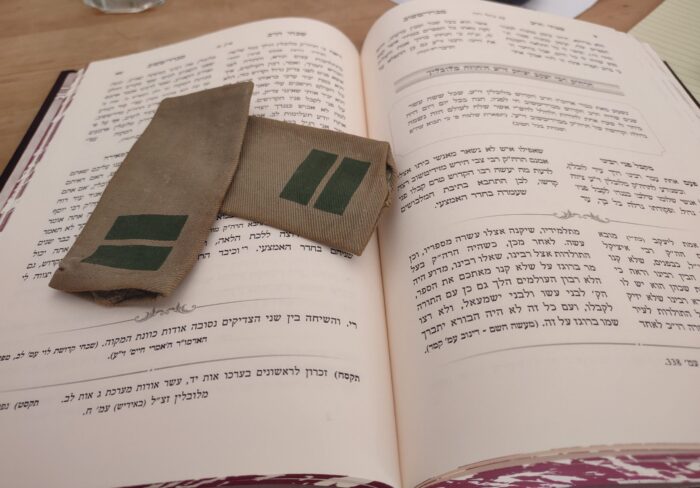
For what he did in that war, my father received officer’s commissions. They have sat in a locked closet at home for decades. I had seen the fabric of those ranks several times before, but without context, they held no meaning for my life, nor for the lives of my brothers and sisters. Last year, on my birthday, my father gave me a gift. A Hasidic book. When I opened it, beside the inscription, his officer’s commissions were lying there.
I am the son who betrayed the Hasidic world and left. The damage my leaving caused our family is real and lasting—a stain with consequences that reshaped everyone. My brothers continued in Torah and, without question, they are scholars. I am the different one. The only one of seven who served in the army of the Zionists. In the Hasidic community, I am considered a traitor.
In one sense, I am the only one who continued my father’s legacy. Like him, I served in a body identification unit. Like him, I functioned in events that should never happen to anyone—neither to Israelis, nor to Palestinians, but that happen to both. My hands are bloodied, and they will remain so until I find my final rest. Perhaps then I will be able to connect the souls I meet to the bodies my hands once carried.
My father and I—a Hasidic father and a son who is not—are among the few who can share what it costs to hold, in your own body, the meaning of Jewish independence.