
My favorite teacher died last week.
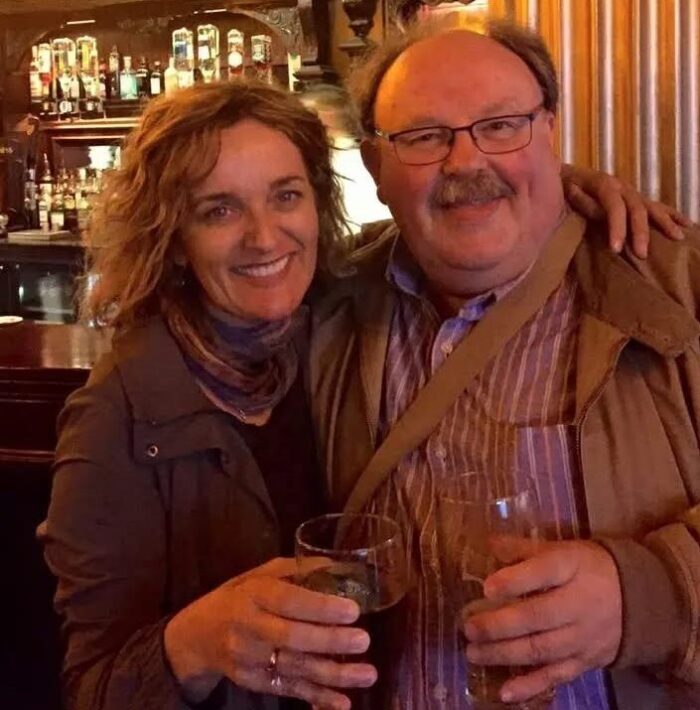
His wife emailed me with the news, and she also took the time to tell me how pleased he had been to see me over a decade ago, when I was back home. I’ve thought about that afternoon in Belfast often, partly because it gave me the chance to finally say thank you properly, over pints in Robinson’s, and partly because it reminded me how rarely we do that sort of thing, especially with our teachers.
I was humbled that she found me at all. We have never met, and yet she knew of me because of things I had written about her husband over the years. That, even in her grief, she took the time to track down my email address and write… it’s the kind of grace you notice more as you get older, and wish you practiced more often yourself.
It felt, in its way, like a continuation of the lesson.
Teachers spend their lives shaping the lives of other people, and then they tend to slip quietly out of the story without much acknowledgment at all. It feels like a structural flaw in the narrative.
Of course, this is something you might only recognize later.
Having been a teacher myself for the better part of thirty years, I understand you almost never get to see where your influence ends. You teach into the world, and you rarely hear what came of it, reminding me of that quote attributed to Henry Adams that was taped on the wall behind my desk: “A teacher affects eternity; he can never tell where his influence stops.”
Mr. Jones was my English teacher at Antrim Grammar School. I wouldn’t have known it at the time, but he was quietly changing the direction of my life, which is exactly what a good teacher does—without announcing it.
A young man in the 1970s, at the start of his career, he wore the same tweed jacket to school every day. It had leather patches on the elbows and a “Save the Otter” button on the lapel, which already tells you a great deal. He looked like someone who belonged to another, more literary century, a time where people dropped opinions about Chaucer into everyday conversation and expected others to have them too.
Naturally, he was well-read, but what I remember most is that he never made it feel like something you had to admire from a distance. He could make the more questionable characters of The Pardoner’s Tale feel as though they had just walked into our classroom room, slightly embarrassed but willing to explain themselves.
He also had a precise instinct for when we’d had our fill of Wordsworth or Dickens for one day. At such moments, he would pause, look up, and tell us to underline a chunk of text in red ink and learn it. For emphasis, he would add, “Great stuff!”
And somehow, I would. Off by heart. This was not typical behavior for me in other classes.
I still have my Choice of Poets textbook, Wilfred Owen’s war poems all marked up in red, snippets of what Mr. Jones had said, scribbled in the margins. Dulce et decorum est pro patria mori. That poetry led me toward the Campaign for Nuclear Disarmament, and to the small Ban the Bomb badge I pinned to my blazer to impress him—which is how a good deal of my early political consciousness was formed.
I was 16 when he told our class about No Nukes, a concert in New York organized by Musicians United for Safe Energy. There was a live recording, and I saved my lunch money to buy it, my first triple album, from Ronnie Millar’s Pop-In record shop in Antrim.
Today, it sits on my bookcase in Mexico, leaning against albums that I suspect were also in his collection. It features a young Bonnie Raitt singing John Prine’s “Angel from Montgomery,” a song that has followed me for over forty-five years like a thought I haven’t quite finished thinking. How does a twenty-something mailman write from the vantage point of a middle-aged Southern woman? And how did he know that a teenage girl in Northern Ireland was already quietly wondering if she might one day feel the same way?
These were not questions I would have known how to ask. Mr. Jones probably knew anyway, or would have had a wise answer ready.
I like to think he would enjoy the fact that I now sing that song in a band. Every so often, it carries me back to that classroom, and to him.
He created a classroom that felt like possibility, which was no small feat in 1970s Northern Ireland, where possibility was not exactly the default setting. The daughter of working-class parents who did everything they could to push me forward, I had passed the 11+ to earn a place at the “posh” school. I was often aware I was out of my depth.
Mr. Jones noticed. In response, he made the classroom feel less like something to survive and more like somewhere I might belong, which is an entirely different proposition.
He let us glimpse his other life, where music played a huge part—Bob Dylan, Bruce Springsteen, Jackson Browne, Little Feat. Somehow, those names felt less like references and more like extensions of the classroom itself. He even let me borrow his records, which, given how I am about my albums now, seems like an act of enormous trust. And then, without ceremony, he would take us back to Dickens and Wordsworth, and the slightly more urgent business of O-level English.
There were other teachers, of course. Some kind, some less so. And there were some who seemed to regard the children in front of them as an unfortunate but necessary detail of the job.
But Mr. Jones was different in the way that matters most. He made the room feel like it was holding something open for all of us. Every day.
There, I mattered. And I knew that I mattered, which of course is what matters most.
This might explain why I became a teacher, and why I remained one for so many years, driven by the hope that the students in my classroom might feel they mattered too, even if they didn’t always appreciate my musical references.
When his wife wrote to tell me he had died, she also told me something I didn’t know—that a tribute I had once written for him had been shared over the years, and that they hoped to include part of it in his memorial service.
There it was—the quiet, improbable loop closing in a way no one could have planned.
It left me slightly undone.
When we sit down by ourselves to write about someone who mattered to us, it can feel like tossing a message in a bottle into the sea. We don’t expect it to return. Not really. Teachers, I think, spend their professional lives doing exactly that, sending something out, without ever knowing where it lands.
And then, sometimes, it does.
Logging into the memorial service for Mr. Jones, I found myself smiling, which felt like something he would have wanted. Before any tributes were read, there was music. The Allman Brothers’ “Jessica,” and Linda Ronstadt’s “Desperado.” Not solemnity exactly, but something more human.
I learned things about him that made perfect sense—his attentiveness, his humor, his reverence for the arts and for the natural world. He was a birder, his lifelong fascination beginning when he was a boy watching his mother feed birds from a little saucer on the windowsill. His father, a bookbinder, had once taken his son’s nature magazines and hand-bound them in beautiful volumes.
At one point, I heard the words I had once written, folded into the larger story, exactly where they belonged.
By then, I had become aware of the birds in the trees around our house. They were making their usual, insistent music, perhaps not entirely indifferent to what was happening in a funeral home on the other side of the world.
They are still singing.
As one of his final wishes, Mr. Jones had chosen Raymond Carver’s Late Fragment:
And did you get what
you wanted from this life, even so?
I did.
And what did you want?
To call myself beloved, to feel myself
beloved on the earth.
By all accounts, he was.
May we all be.