
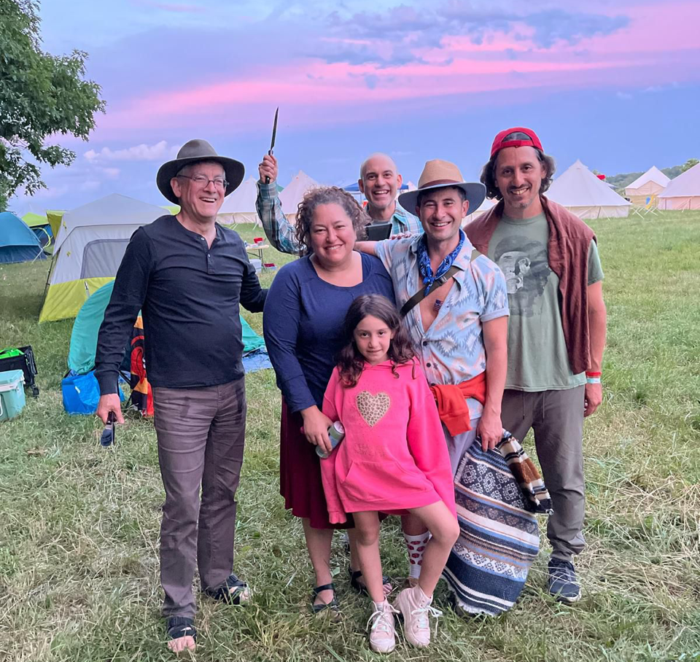
I keep a banjolele on the wall in my office. Part ukulele and part banjo, I see it every day and so does anyone on a Zoom call with me. Its high visibility serves as a reminder of a critical part of my identity. Although I rarely play as it hangs in my office, one weekend a year that all changes. It comes off the wall and into its special case. Usually the third weekend of July, the banjolele gets packed, alongside all my camping gear, for my annual pilgrimage to a massive bluegrass festival in upstate New York. For eleven years, a few Jewish friends have gathered alongside five thousand other random fellow travelers in a weekend of camping, celebration, and relaxation. If you asked me, “Why do you go“ or “What are you celebrating,” I’m not sure I could even say in one coherent sentence. It changes based on who we are each year, which is always a little different. Although we have only been doing this for a decade, something about it feels very old. As if my ancestors were inviting me into this annual rhythmic march. Maybe they are.
* * *
In ancient Israel, there were three pilgrimage festivals coinciding with both the holiday and agricultural calendars. Three times a year, on those biblical holidays, thousands of Israelites would journey to Jerusalem to celebrate, commemorate, and honor the divine presence in their lives through ancient traditional observances. Although each holiday showcased their own particular symbols and rituals, the three pilgrimages were united in a coherent super-narrative around how the seasonal cycles of the Earth propel us toward our divine purpose.
Our collective memory of this glorious era of pilgrimage is somehow still alive. Stories in the Talmud share that Jerusalem would swell to many times its normal population. Pilgrims came from all over the land of Israel and the diaspora, walking in caravans, singing as they approached the city. A conversation in the Talmud between Rabbi Levi and Reish Lakish went as far as to claim that even when the hundreds of thousands of pilgrims crowded onto the Temple courtyard for these festivals, no one ever lacked for space or complained about the crowd.
Imagine the inspiration, buzz, and sheer aliveness of the waves upon waves of people marching toward Jerusalem. These ancient pilgrimage festivals, which coincided with Passover, Shavuot, and Sukkot, were anything but quiet religious observances. Sometimes they lasted a week, sometimes just a few days, but from the information we have, they were understood to be intense, sensory, communal experiences: part sacred ritual, part massive national gathering, part joyful street festival. Different parts of the ancient society weaving together to create a shared experience.
One example was the celebration on Sukkot known as Simchat Beit HaShoeva or the “Water Drawing Festival.” Part ritual and part blowout party, the Simchat Beit HaShoeva was famous for nighttime dancing, torch juggling, music, and ecstatic celebration. There are legends that the wicks on the torches were made from the undergarments of the High Priest. The Talmud famously says, “Whoever has not seen this celebration has never seen joy in their life.” There was excitement in the air: reunion, anticipation, a sense that something big was happening. Inns overflowed, people camped on rooftops and hillsides, and strangers became temporary neighbors.
* * *
Many of us today are the descendants of those who trekked and who gathered in large numbers in holy places. Like our forebearers, many of us crave space and carve out time in our lives for the privilege of pilgrimage. I go to a bluegrass music festival with people from many faith (and music) traditions. That cannot possibly compare to what took place in Jerusalem 2500 years ago. How can they possibly be connected? And yet they are. Using Kabbalah’s “Four Worlds” model, here is how today’s pilgrimage might resemble the ancient triannual path of my ancestors through body, heart, mind and spirit:
Level 1: (Assiyah – The world of the body)
From a purely physical and organizational level, it is a huge effort to get to the festival. Although we are driving and not walking by foot, at its core this is a camping trip that involves a ton of preparation. Not just the packing and the shopping, but menu-planning and figuring out the route. Who from our tiny crew is coming this year? Do we want to recruit new people? Which day will we arrive? Will some of us come up together? What communal items do we need to bring? What is the weather forecast? Is there anything different happening this year that we need to take into account? How do we set up our communal campsite?
Level 2: (Yetzirah – The world of the heart)
Once we arrive and have set up camp, a new reality begins to descend upon us. It starts with a shift in how we relate to one another. The “how are you?” impulse to start conversations centering on our work and home lives begins to fade. Our troubles, our differences, and our opinions about the world naturally give way to the project of a building of communal energy of sorts. All of the sudden, it becomes easy to talk with strangers. Sometimes a twist of anxiety comes rushing in, followed by a reminder to trust in the magic that happens at this festival.
Level 3: (Briyah – The world of the Mind)
As we check in to the festival, a program with a schedule is handed to us. These raggedy brochures are helpful to see where the largest concentrations of human gatherings will likely occur. At the same time, what appears on the official schedule might only be a fraction of the experience for any given person. As we begin to let go of what we “should be doing,” our patterns and perceptions around time shift. Spontaneity, chance encounter, and timed activities begin to dance in a cosmic swirl. Wherever we go and however we end up spending our time is exactly where the magic is. Without thinking about it, we are in a state of continuously redefining what it means to have reached our destination.
Level 4: (Atzilut – The world of the Spirit)
What ultimately convinces one to go on a pilgrimage trek? For some, it lines up with a powerful moment in their lives attached to yearning for some kind of completion. For others, an inexplicable calling. Sometimes it is just a very persuasive and persistent friend. Maybe you have no idea what you are doing. You don’t even like camping. And then, in a flash, it all makes sense. Without warning, suddenly the pieces fit together. You belong here right now. And for no obvious reason, this moment is worthy of celebration. And that is exactly what happens.
Song breaks out everywhere, calling us from multiple directions at once. Sometimes we howl and hoot for joy without reason. Rituals emerge. Strangers become friends. Our lives are sanctified. Old questions seem new again. Who are we this year? What is different? Who have we lost? What insight have we gained? How are we relating to the mysterious forces animating our lives? It doesn’t matter that we’re drenched in sweat and swatting away flies. It all feels like one giant blessing.
* * *
Recently, I remarked to a friend, “It’s wild to me that my annual pilgrimage would end up being to a bluegrass festival. I’m a rabbi. I would not have predicted that for myself.”
His response? “Umm, I could have predicted this for yourself. You have a banjolele.”