
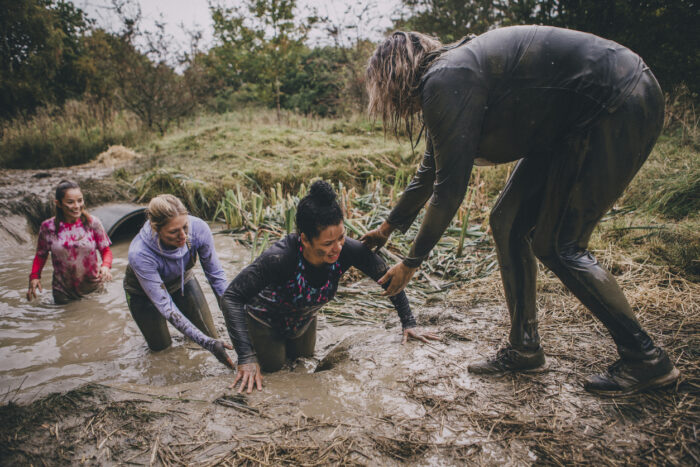
If you are losing faith in humanity, then you need to get in the mud.
I feel like everyone is suffering. The news, the shifting political landscape, war, famine, rising gas prices, Israel. What’s the future of the Jewish world? Will A.I. replace all of us? How will we meet the needs of the next generation? Will my kids be able to afford to feed themselves, let alone buy their own home and thrive? It’s a lot.
I feel many different feelings right now. I think optimism is in short supply and hope is almost as wisps of mist. I had a recent experience which anchored me into the Jewish spiritual practices of arevut (leaning on one another, mutual responsibility) and chesed (loving kindness) as survival strategies.
For Mother’s Day this year, I signed my daughter and me up to participate in a muddy obstacle course event—a mud run. These are high-energy endurance events that combine trail running with messy, mud-soaked physical challenges.
And the one we did this year filled me with hope.
There are different kinds of mud runs orchestrated by different companies. We have each done several. While we are not new to mud runs, this year we were with a different company: Mudgirl Run. If some races are designed to make you fail, Mudgirl runs are designed to make you succeed.
We arrived at a farm ahead of our mid-morning start time. The field was full of cars, full to overflowing. We were assigned to a mid-morning heat for the race, and I imagined the field had been full since early that morning and would remain full until late in the day. As we made our way to registration, we saw women. So many women. Some men, too. The men were all carrying the stuff and the kids. And the women were dressed as various kinds of warriors. Some women were finishing their races, their mud-caked bodies sated from their efforts, heading back from their adventure and shifting slowly back into the rest of the world. The look of both sweet and bitter on their faces.
Some women were nervously looking around, wondering if they could do what they were asking their bodies to do. Have you done this before? A woman, maybe in her 60’s, timidly asked me as we joined the throng of people weaving through the field’s chaos of parked, entering, and exiting cars. You can do this, I told her. We will all do it together. My daughter, just a few days into being 11 years old, encouraged and supported her as well. I have done this before. I can do it. You can, too.
We registered, stored our things, and joined our heat. My daughter and I wore matching pink ballet skirts. People everywhere were in costumes. There were bright, colorful teams wearing matching outfits, singular, sensational, creative displays, and tutus. So many tutus.
There was an emcee at the starting line who called us to attention. She invited representatives from five teams to join her at the front. My daughter, in spite of our team only having two people in it, jumped at the chance. I was full of pride at her courage: She is not usually a jump-to-the-front girl. I think there was something about this crowd of people, this instant community of fellow female travelers that empowered and emboldened her.
The emcee announced a dance contest. One at a time, each contestant of varying ages, colors, and body types, the youngest being my girl and the oldest a 70+ year old black woman with beautiful gray dreadlocks, stood on a tall platform in front of the one hundred or so people gathered for the heat, and showed everyone their moves. The crowd was wild with love, admiration, support, and enthusiasm. To see my own kid dance like no one was watching while everyone was watching brought tears to my eyes then—and is doing it again now as I write this.
And then we were off. You should have seen it. Little kids, big kids, moms, grandmothers, all moving through. There were 13 obstacles spread over three miles. I will describe for you one in particular, because it was the best part.
We had just done a commando crawl under a cargo net in a mud bath. We were literally covered shoulders to toes in thick mud. In long stretches between obstacles, we had sung whatever pop songs my daughter loved as loud as we could. It’s the kind of place where you can do that and not be weird. My daughter, who is not a runner, had run in many bursts, pushing herself to make it to the next signpost or the next tree—going just a little further each time than she thought she could.
The next obstacle was a series of oversized moguls, or a series of small hills, set in a muddy moat. We slid into the moat, up to my waist and up to her chest, surrounded by other muddy humans. We then needed to climb up the mound of dirt ahead of us. It was maybe six feet tall and very slippery. Before we started our ascent, we helped other people with theirs. And we knew others would help us with ours. I held one woman’s heel in place in a divot in the mud mound as she hoisted herself, supported by the reaching arms of those at the top pulling up those below them.
It was so incredibly beautiful. We were all strangers to one another, and yet it did not matter. Imagine a world for a moment where this is life all the time. This was my arevut moment: everyone leaning on one another. The Talmud (BT Shevuot 39a) teaches “kol Yisrael aravim zeh l’zeh”—each of the people Israel is responsible for one another. Everybody leans, one on the other. It was a special moment to feel this teaching in the world around me.
It gets better. Someone’s efforts to anchor their foot in the mogul sent a spray of mud straight into my face. The woman next to me and I laughed together at the ridiculousness of it. There was no anger or hurt feelings. Slinging mud had not been intentional; it was just what happened. My laughmate said, “I don’t know if any part of me back there,” and she gestured over her shoulder to her shirt on her own back, “is clean, but you can use what you want.” I looked and there was a small clean patch of her shirt, which I promptly used to clear mud from my eyes. I was grateful. It was a generous and caring act. Intimate in an unexpected way with someone I did not know and would not recognize if I ever saw her again.
My daughter, this stranger, and the people around us made our way to the top with the help of others. We turned to offer our hands to those behind us for a moment. And then my daughter said to me, “Let’s stay here.” And so, we did. We lay on our bellies on top of a muddy pile and reached down to woman after woman after woman to pull her up. I watched my child delight in her own strength and power as she realized she could care for those around her.
This was the chesed, loving kindness, moment. In Psalms 89:3, we read, “Olam chesed yibaneh”—we will build a world of kindness. To feel it lived in front of me mattered and touched me deeply.
As we left the moguls for whatever was next, I noticed how universal we each and all had become. Gone were the markers of age and race. We were all muddy blobs of people. A united humanity. We took the hand of someone who seemed less agile and slid like skiers down a small embankment. We chatted with the creatures to our right and to our left. We made friends with a mother and daughter half a generation older than us, and we waited for them at the finish line just to make sure they made it.
Finishing the race was bittersweet. It was proof of what we had accomplished. It had felt so good to immerse ourselves in this muddy magical world and I did not want to leave. We rinsed off in ic-cold showers and made our way back to the car to return to a different world.
As I think back on those hours spent in this other world, I can see how the magic there can also be magic here.
In the weeks since, the feeling of camaraderie, equity, unity, and shared responsibility has stayed with me. Knowing that there are places in the world that still exist where we can be that with and for each other gives me hope. While it is sometimes hard right now to remember that shared humanity, it is not gone, but rather may just be dormant. And I believe that leaning into these spiritual practices from the mud can help make the experiences outside the obstacle course better, softer, and easier to endure. This is my hope: that we can all lean into leaning on one another and building the kindness we wish to see in the world.