
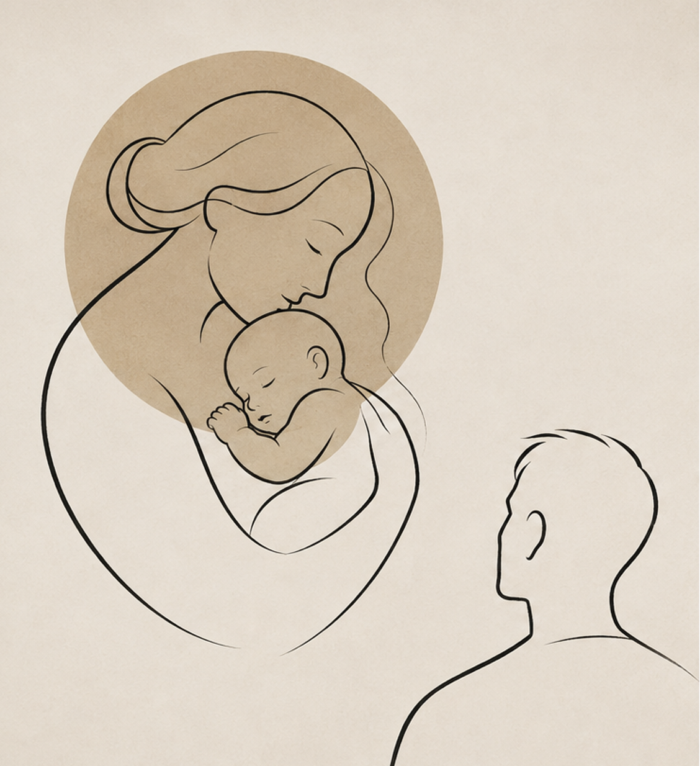
Some nights, after Zusha falls asleep, I join both him and Annika in bed—Annika on one side, Zusha between us. His face is turned toward her, nursing even in sleep. I place my palm on his back. Less than a minute later, without waking, he pushes my hand away.
Zusha is made from Annika. His blood, his brain, his heart. For nine months he was part of her. During the first months of his life, when almost anyone reached for him, something primal moved across Annika’s face. As if someone was trying to cut something from her that was still attached.
At night, when she breastfeeds him, he crawls back to the womb. They are two fused into one, and I am the observer. She holds him in a way that protects him—his pull toward her is so strong that it could suffocate him, and her body has to arch painfully, to prevent that. A few times a week I massage her muscles, taut from the way she folds her body around him in bed. This is my role: her ezer kenegda.
When we say “parents,” we are using one word for two entirely different relationships. The relationship between Annika and Zusha is a relationship like between God and the first human. Between Zusha and me is a relationship between two human beings. During the day, Annika and Zusha slowly untangle, and he turns toward the world. I am the first human he meets, after a night with his Creator.
*************************
The creation story in Genesis is not a myth about the past; it is the blueprint of Zusha’s psyche in relation to our parenting. It is a map I have for this wilderness. And I see in it that the role I play is Adam, and the role Annika plays is Eve.
Our tradition teaches that God created Adam and placed him in the Garden of Eden, where he was given everything he needed. I see that the Garden is a womb. Adam lacks nothing. He is held. And, when he is expelled from Eden, this is his human birth.
Eve is different. According to the Talmud, the Holy One tested Adam—to see how much he wished to be a partner in creation, what he would choose to share in order to bring the rest of humanity into being. But Eve is taken from Adam’s side—tzela (“rib” or “side”) in Hebrew. All Adam yielded was that smaller piece of himself. God perhaps understood that Adam was not willing to give Eve the kind of nurturing love she needed, and so the Divine tenderly sculpted her body and her soul—and braided her hair with his own hands so that she would feel loved. The power of birth went to Eve, the Woman. Adam, the Man, would not alone create life.
When Eve gave birth, she named the child Cain: Kaniti ish et Adonai—“I have created a human, together with God” (Genesis 4:1). Not “together with my husband.” The Midrash is uneasy with Eve’s declaration here. That Eve and not Adam names Cain, and that she emphasizes her relationship with God rather than with Adam, troubles the Sages. In moments of discomfort, the Midrash often offers a new narrative. This is how Pirkei DeRabbi Eliezer (8th century) describes the creation of Cain: Eve did not want to conceive a child with Adam. She knew, from her own experience, that he was not capable of giving their child the kind of love he would need, because Adam couldn’t give that kind of love to Eve herself. She wanted to create a human being as God had created Adam in the womb of the Garden of Eden, and as God had created her herself, braiding her hair with love, unconditionally. So, she sought a partner who stood on the threshold between the divine and nature. She went to the serpent—the angel Samael, according to the Midrash. This is the one who occupies the boundary between consciousness and nature.
In this Midrashic retelling, Eve and Samael made love, and the seed of the Serpent / Samael impregnated her. Adam became aware of their union and understood what had happened: “And Adam knew his wife Eve” (Genesis 4:1)—understood by the Midrash to mean that he knew she had chosen to create a human being, without him. So that Adam might feel that he too was connected to this act of creation, Eve allowed him to place his human seed within her. The child Cain, born from that double union, thus bore a double body—from Adam and the serpent, and a double soul—from the love between angel Samael and Eve.
*************************
For Annika, Zusha is a continuation—of herself, of nature, of God. For me, he is an encounter. She is everything to him right now—she is Goddess. When he nurses, she allows him to return to the Garden of Eden, to the womb. As for me, I am the first human he has met.
Last week, Annika went out with friends after Zusha was asleep. We assumed, as we always do, that he would sleep for at least two hours without waking. Five minutes after she left, he woke up. He screamed. Nothing I did worked; he did not want me, a human, me. He wanted to return to the womb, to his Goddess. And the womb, for the first time in his life, was not there. This was Zusha’s expulsion from the Garden of Eden.
And in that moment, holding a screaming child who wanted what I could not be, I remembered something. There was a time in my own life when my God died.
I had grown up in a Hasidic world where God was everywhere. And then, at some point, the God of my father and mother, the God of Hasidism and childhood—that God died. Not murdered, as in Nietzsche. Not absent, as with Jesus. Simply died. The image collapsed. And I was left in the dark—an orphan. I experienced what the Christian mystics call a “dark night of the soul.” This lasted for a year, or maybe two.
What kept me from descending into total darkness were the Hasidic mystical melodies. As a child, during the long hours of Shabbat prayer at the Hasidic synagogue, when I did not know what to do with myself, my father told me that the synagogue is a place where prayers are absorbed into us—but only when we sleep there while the congregation prays. Sleep allows the prayers to enter the body, without understanding, without conscious awareness.
For years in my childhood and even as an adult, I slept during many prayers. And later in life, in moments of distress and confusion, the right prayer rises from within and allows me to carry the pain. And so my mourning over the death of God was accompanied by melodies that allowed me to keep walking in the dark.
The poet Fania Bergstein wrote:
Shtaltem nigunim bi, imi v’avi —
You planted melodies in me, my mother and my father.
Me’al l’cheshkat hat’hom —
Above the darkness of the abyss.
The melodies of prayer appear in the presence of my abyss.
Perhaps this is the role of the father—the first human the child meets—to plant melodies in the body of the infant. Not what a mother gives—not the womb, not the source, not the one Zusha returns to in the night. Something else. The melodies that will hold him when his Goddess is gone. And she will be gone—not because she will leave him, but because that image of her as his Goddess, like the God of my childhood, will one day have to die, so that he as a human adult can finally be born.
So I sang my ancient melodies into his terror. He screamed, and I sang. The prayers of my childhood, the melodies that had carried me through my own darkness. Slowly, Zusha quieted. I kept singing until Annika came home. That night, I accepted my role of fatherhood.