
I’m one of those people who believes that you can talk in synagogue, as long as you are respectful and not disturbing someone else’s prayer experience. But there are two specific prayers in the Saturday morning service that tend to command my silence consistently: the mourner’s kaddish (the prayer mourners recite) and the prayer for healing (the mi shebeirach). Bringing comfort to mourners is a mitzvah (commandment) that stands on its own without justification. Whenever I hear the spoken word version of the kaddish, I become alert, focused, and quiet. For just a few minutes, my sense of self diminishes in service of supporting the mourner. It is an automatic, maybe even ancestral response, even as someone who has yet to be a mourner myself according to Jewish law.
It is different, however, with the prayer for healing. Although the healing prayer also demands silence, it is a qualitatively different variety of silence altogether. For most of my life I never questioned how and why we pray for each other’s health. Only recently have doubts and questions emerged for me.
By “the prayer for healing,” I am specifically referring to the pause in the middle of the Torah service. The service leader invites congregants to stand up to pray specifically on behalf of the sick. The primary instruction is to say aloud the name or names for whom you are directing the prayer. Interestingly, you almost never see someone reciting the prayer for healing on their own behalf. This particular healing ritual developed as an action you only do for the benefit of someone else. If you, yourself, are ill, presumably your loved ones will pray on your behalf.
Depending on the community, there may be variances in how the ritual is performed. Some synagogues encourage participants to say the names out loud one at a time, while other communities mumble the names all at the same time. Some individuals will say the name of just one person, while others have a whole list of names prepared. You might hear some names spoken, while others are chanted. Some recite the names in Hebrew, which traditionally includes adding the person’s mother’s Hebrew name, while others say the name in a different language.
Only recently have I realized that lot of decisions are happening in the moments leading up to the healing prayer which can feel “high stakes.” People are deciding, in real time, for whom to pray and for whom not to pray. Are they praying for a healing of body or primarily a healing of spirit? The traditional prayer specifies both body and spirit.
The choreography seems to matter, too. Similar to the mourners’ kaddish, in many congregations, those reciting the healing prayer are invited to stand up while others observe from a seated position. What happens if, for whatever reason, we choose not to stand for the prayer? Will the prayer be diminished if we are seated or not saying the name out loud for all to hear?
On a theological level, we may wonder: To whom should we praying? Should all prayer be directed at the G-d as described in the Torah and the prayerbook? Maybe the focus would be better spent on healing through visualization techniques. Can we integrate our prayer with what we know about medicine and science? What is the role of prayer in hoping for a medical breakthrough?
Even the status of this prayer I find confounding, especially on Shabbat. I was taught that Jewish practice forbids petitionary prayer on Shabbat. We’re not supposed to ask G-d for “things” during the day of rest. For one day a week, I learned, we accept the world as completely perfect. Doesn’t the healing prayer fall into the category of petition? Yet even in orthodox communities, the prayer for healing does not get omitted on Shabbat.
For most of my life, I generally accepted the traditions surrounding these prayers as passed on to me. But I’ve begun to wonder what it means to pray for someone’s health even when they specifically tell you they do not want to recover. Should we include and insert the names of loved ones into the prayer even if they actually want to die?
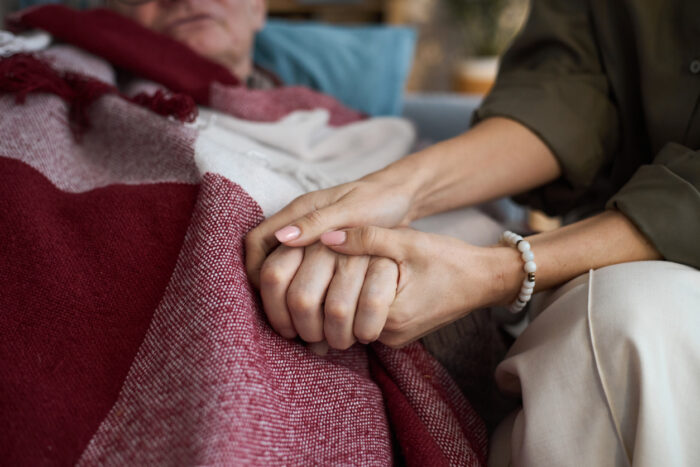
Earlier this year, my paternal grandmother passed away at the age of 103. In the weeks and months leading up to her death, she talked about it. She would say how all her friends are dead and that she’s ready to die. At some point I realized that in all my life I don’t think I ever prayed for her health. Yet, for some reason, it was only in those final months that I found myself finally praying on her behalf. But why now? If not her health, for what should I have been praying? There is no specific prayer for a “safe passage from this world to the next” in Judaism. All we have for the sick and the dying is the healing prayer. It was not enough for me this year. It is not enough.
At her funeral, my sister and I were asked to offer a few remarks on behalf of all the grandchildren. We used the time to thank her for all the lessons we learned from her over a full life. Yet, the line that has stayed with me from my eulogy was: “Grandma, thank you for letting us know you were ready to die.” Maybe that was the prayer I had been looking for.