
This column is dedicated to the IAC employees, who work day and night as devoted public servants (Shluchei Tzibur) for the Israeli-American community in the United States.
There is a question I have been carrying for two years, and I have not known how to ask it out loud—partly because I was ashamed to complain when my people are in an existential struggle for survival, and partly because my role is not to complain but to be the one who finds solutions for the community’s distress. But the fatigue, the exhaustion, and the fear that my silence will become a liability—that it will prevent me from serving the community—compel me to ask: What is the responsibility of the Jewish community toward its leaders, especially in times of crisis? How must a community support its leaders so they can continue their public service?
As a child growing up in the ultra-Orthodox city of Bnei Brak, in Israel, every other Shabbat my father, my brothers, and I would walk to pray at the court of the Rebbe himself, the spiritual leader of our community. The hour walk was a kind of ritual. My father would fill the time with stories of the tzadikim—the righteous ones, the great Jewish leaders of previous generations. One Shabbat, I asked him “Abba, why is the Rebbe considered a holy man? Is it because of the miracles he performs?”
My father shook his head. “The miracles,” he said, “are just a footnote. The Rebbe is a tzadik—a righteous person—because six, seven hours every single day, he sits and receives people. He listens to their tzuros.” Tzuros—the Yiddish word for sorrows, troubles, the accumulated weight of a life that has not gone as hoped. “One man has no livelihood. A woman was widowed and left with eight children. Parents cannot find a match for their fifth daughter. Another family just buried their son, who died from cancer.” My father paused. “Anyone who can hold that much pain—that alone makes him a tzadik.”
Even then, as a child, I knew I would want to try to be something like a Rebbe.
Working with the Israeli-American Council (IAC) and the broader American Jewish world for over eight years. I have thought about that conversation with my father countless times. But on that Saturday morning in October of 2023, something shifted permanently. My WhatsApp became a lifeline. My phone became a command center. And the work—the endless, necessary, heartbreaking work—never stopped. And how fortunate I am, how truly blessed, to know that I have merited being part of the ancestral Jewish chain of shlichei tzibbur, servants of the community, those who carry the needs of the many on behalf of the many.
First I heard from the families here in America who discovered that their relatives in Israel were hiding from Hamas terrorists, sending goodbye texts from unsafe homes. Having served in an IDF unit identifying body remains, I took it upon myself from here in America to help equip the unit with the supplies it needed—supplies that ran out within days because of the sheer number of those murdered. Soon after, it was helping families with loved ones taken hostage; then followed the rise in antisemitism in the US, the protests on campuses, the sense of siege and the feeling that almost no one understands us; then came the war with Iran and the war with Lebanon, like the first Netflix season and now the second season; then the waves of Israelis arriving in America—some for medical treatment, some displaced, some simply unable to go back—all of them carrying the trauma of war. Each wave brought new needs, new calls, new families who had nowhere else to turn.
A few days ago, I was sitting with my wife Annika on a Zoom call with our son Zusha’s daycare. Zusha was born with a brain injury, and he requires constant care and attention. The teachers were telling us something we did not want to hear: He was going backward cognitively; difficulties he had faced before that we believed were behind him were returning again.
At the same time on that very same day, I had over ten new Israeli families waiting for me to find them host families, a project I had taken on at the IAC to help Israelis stranded in America because of the war with Iran find temporary homes with American Jewish families.
During the meeting with Zusha’s teachers, I felt an enormous anger: at them, for wanting me to solve my son’s problems, at this cursed war that simply will not end, and most of all at myself for being a failure as a father. I knew that once again everything was falling on my beloved Annika, because I was using my standard excuse: “Who is my child and his struggles compared to the plight of dozens of families who have no way to return home, to their children, to their lives.” And more than anything, I wanted to sleep. Like Jonah, the prophet in the storm sleeping at the bottom of the ship, I wanted to sleep and not wake up until all the noise was over.
I stayed in front of my laptop, trying to match the Israeli families. I did not say to myself, “Today I focus only on my son.” I tried to hold both. And I went to bed that night completely shattered, in resisim, fragments.
That is what it feels like to be a communal servant right now. Not broken in one place. Broken into pieces, each one flying in a different direction.
Rabbi Israel Hager of Vizhnitz, known as the Baal Ahavat Yisrael—the Master of Love for the Jewish People—who led his community through the horrors of World War One, used to say: Anyone who does not feel the pain of a Jew at the other end of the world is not a Rebbe. The brokenness of the tzadik to resisim is precisely what allows his spirit to feel pain from one end of the world to the other.
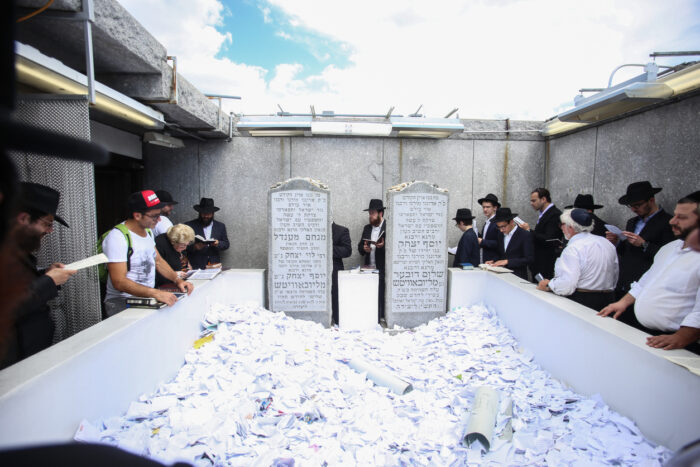
In Hasidic tradition, when you come to see the Rebbe, you bring with you a kvitl—literally, a small slip of paper—on which you write your name and your need: your crisis, your deepest ask. In the Israeli-American version, the kvitlach I receive are the endless WhatsApp messages from people I have never met, but who need me. If only Zuckerberg knew how sacred the invention of WhatsApp has become. But for the Rebbe, there was something else that came with the kvitl. Alongside it, the Hasidim brought a small gift of tzedakah, charity, to support the Rebbe and his family in their work.
From the outside, modern critics have sometimes dismissed this practice as transactional, as if the Rebbe were selling miracles. And perhaps there is some truth in that critique. But it is also the mistake of those who observe a culture from the outside, without sensitivity to its internal language. The gift alongside the kvitl was not only payment. It was a declaration of partnership. It was the community saying: We understand that you are carrying us, that you feel so alone and so exhausted, that your partner barely gets to be with you. And we will carry you back.
The Hasidic world understood something that the modern Jewish communal world has largely forgotten: The community must protect its leaders with the same ferocity that the leaders protect the community. The Rebbe took vacations—twice a year, even during wartime—not as a luxury, but as a communal necessity. The community ensured his children were provided for. This was not charity. It was the architecture of sustainable leadership.
When people ask me about my colleagues—the directors and leaders of the Israeli-American community in cities across this country—I tell them they are “Secular Rebbes.” All day, every day, they absorb the sorrows of immigration. Questions about children who cannot find their footing in a new country, about losing jobs, about navigating systems in a foreign language and culture. Since October 7th, some of them have sat with families on Zoom shiva calls—the Jewish mourning ritual—for relatives killed in Israel, while those families were thousands of miles away and could not come home. They hold the grief of a community watching a war happen to their loved ones in real time, while also trying to navigate rising waves of antisemitism and hatred toward Jews and Israelis here in America.
They do this largely without acknowledgment. And they do it largely without support. But no one can do it alone. Not even the Rebbe.
The Babylonian Talmud, in tractate Horayot (10a-b), tells of Rabban Gamliel, who sought to appoint two of his students as communal leaders. Out of humility, they did not come to receive the appointment. And Rabban Gamliel said to them one of the most piercing lines in all of Jewish tradition: “Do you imagine that I am giving you power? I am giving you servitude.”
But even servitude requires a foundation. If we want our leaders to keep carrying the kvitlach of our community, we must remember the gift that came with them. We must build a community that doesn’t just ask its leaders for strength, but offers them the grace to be human, to rest, and to heal. Only then can we turn our collective fragments into a whole.