
I am staying with some friends in New York. And this morning, they were chattering excitedly about the recent results from Israel’s election, or more exactly, they were chattering about how stressful it is that we just don’t know. To look before all of the ballots have been counted is unhelpful, but of course, human. And I could feel the heightened stress in the room. When I told one of these friends that I needed to write an essay for the Wisdom Daily, and I didn’t know what it should be about, she said, “Got any spiritual tools for times of uncertainty?”
We both laughed, of course, because uncertainty has been our day-to-day for a really long time now. I do think that we have, within Jewish tradition, some deep spiritual wisdom about dealing with uncertainty. And we don’t have to go so far to get it. One of the things that I love about the siddur, the Jewish prayer book, is that it contains simple spiritual wisdom. You don’t have to go digging in the Zohar or in esoteric Kabbalistic texts for it. Those texts can be beautiful, but they’re not the most accessible.
But there it is, right there, in the pages of the prayer book. I knew the prayer book when I was a kid backwards and forwards, or at least that’s how it felt. I went to day school and Jewish summer camp and Hebrew school because I was one of those kids. So I knew the words of the prayers, and I even knew what they meant, but I don’t think I knew how to use them. That is to say that often, we let prayer remain in the realm of the intellectual, when it’s really meant to support our hearts.
So what heart support might the liturgy give us in times of uncertainty? I’ll tell you a story, a story that is paraphrased from my teacher Rabbi Reuven Kimmelman, whose liturgy class my first semester at Brandeis transformed my understanding of liturgy and set me on this path to where I am now today: obsessed with it.
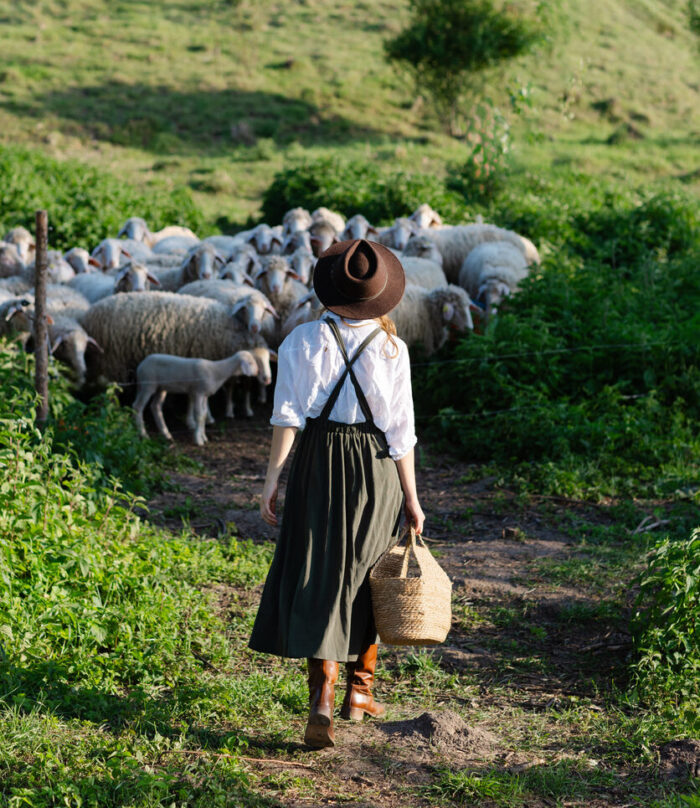
Imagine you’re a shepherd. And imagine that you wake up, what might you think? Ah, another day of herding sheep. Every day is just like the last. So boring, so predictable. Maybe you’re not excited about your day. But here comes the blessing after the barchu, in Shacharit, the morning service. And its themes are all about newness. Creation is renewed every day! There is a new light that is here! Light and darkness. You don’t know what’s going to happen today. Every moment is made new. And maybe that would give you some comfort. And the tools you needed to see a little bit more wonder in your day.
And now imagine that after a day of herding sheep, the sun is beginning to set. And perhaps a bit of fear sets in. Nighttime means uncertainty. There could be a chill in the wind. Someone could come and steal your sheep, your belongings. The nighttime can be so scary. And here comes the paragraph after the barchu in the evening service, Ma’ariv. And it says: Notice, the day turns into night, the night turns into day. The sun sets, and tomorrow the sun will rise, and the stars each have their place and order in the sky. In this moment of uncertainty, can you notice what is constant? Can you bring your awareness to what remains steady? And let that steadiness steady your heart? And maybe it would give you, dear shepherd, some comfort. And perhaps it could give you, dear person living in the current world, some comfort also.
What I appreciate so much about our liturgy and our prayer and ritual practice is that we are not meant to cover our ears and say, “la, la, la!” and cover our eyes and not see the world as it is. The world is fundamentally broken and in need of repair. The only reason we keep singing Oseh Shalom [a prayer for peace] is because we know that peace has not been reached yet, and we need that reminder.
But it is not all about the brokenness. We are invited to notice what is beautiful and miraculous in our everyday lives. Whether that’s the sun going up in the morning, the stars coming out at night, the fact of our own aliveness, being together, the capacity for love. In a world of chaos and uncertainty, it can be so easy to forget these things. And yet through the siddur our spiritual ancestors are nudging us to notice.
What if you noticed the mixing of the colors in the sky as the sun sets? And what if you invited in a feeling of wonder? A feeling of gratitude, a feeling of stability. Yes, the world is fundamentally broken and in need of repair. But the world is also a beautiful, miraculous place worthy of our praise and gratitude. And it’s in that dialectic that we’re invited to live.
Now, the shepherd didn’t have to contend with stressful elections. But I still see myself in those shepherds. I’m grateful for the tools that they left us. And I invite us to see our spiritual liturgical and ritual heritage as those tools. [as I say above, when I was a kid, I] knew all of the Hebrew. I even knew what a lot of the prayers meant, but I never learned how to use them. I knew that Ma’ariv Aravim was about the day turning into night. But not that I could notice that moment and invite in a feeling of wonder. And that that could add a little bit of stability to my life.
Our liturgical and spiritual and prayer tradition is full of these tools that can help us live in the world as it is, and fight to change the world for the better. But only if we teach it and experience it and lead it towards that outcome. All of the tools are there. It’s up to us to use them. And these days, I’ll take all the help I can get.