
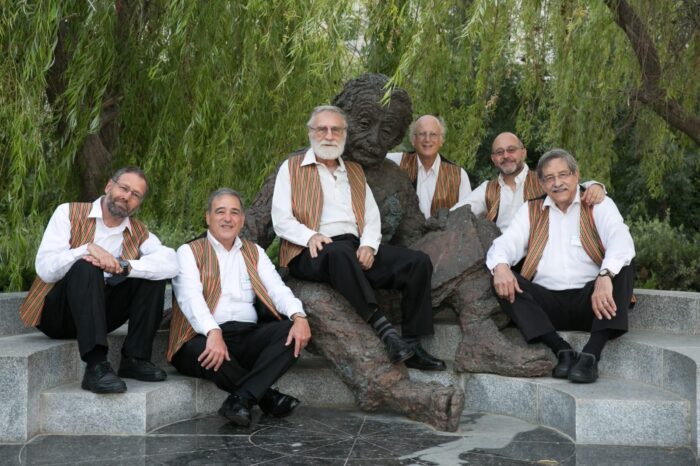
Jerusalem Barbershop Ensemble, photo by Assael Romanelli
Movember is mental health awareness month for men. Many men suffer in silence, and some lack the skills, space, or permission to explore and express our internal world. This article suggests one way in which Jewish communities can provide safe spaces for men to talk about their feelings.
Lo tov heyot ha’adam levado. It is not good for man to be alone.
When I was eight and living in Jerusalem, my dad formed a barbershop quartet, the first in the Middle East. Every week, four men would assemble in my living room and sing. On their breaks, while eating hummus and vegetables, they would talk about their day.
That group became a second family to him, and their rehearsals were a place where he could unpack and unwind. He has said that, in many ways, that barbershop quartet saved his life. At the time I didn’t understand why.
In 2020, my family left Jerusalem and moved to Kfar Saba, a new place for us where we faced a lot of unknowns, with no close friends and opening a new clinic in a new area. I wanted to meet new people and work through these changes in my life, so I decided to try something new: I joined a men’s circle.
The format was simple: a small group of men met in a school classroom one night a month, to talk about our lives. Sometimes our discussions were prompted; others were just a free-flowing conversation. We talked about our fathers, our marriages, our kids, our sex lives, and our childhoods. We listened, nodded, felt, laughed, and sometimes cried. One man brought his failing marriage, another spoke about the loneliness of being single. I shared my challenges of being a father to a tween boy. One man shared how his affair cost him his marriage. We silently supported each other as each of us found ourselves stripping down and sharing vulnerable feelings. One time we all brought pictures of our fathers and shared memories of them, some warm, others painful. The catharsis was powerful. For some, this was the first time they ever shared their struggles openly. It was only then that I realized what my father had meant about barbershop saving his life: what I had been witnessing in our living room at all those rehearsals was a men’s circle.
After 12 sessions, my own men’s circle ended. We wanted to continue, but the logistics were challenging and the financial costs were too high. The circle certainly helped me process the transition, but it was too short for me to really bond and go deeper. I was sad the circle ended, and except for one guy, I never spoke to them again.
Some years later, I was working at a Jewish summer camp in the US when one of the Israeli counselors, who had just come out of reserve duty in Gaza, shared that he was suffering from troubling thoughts about the war. He didn’t know what to do. As I heard his story, I reflected on my experiences and my father’s barbershop, and I intuited it would be easier for him to lean on a circle than to open up one-on-one. I offered to convene a men’s circle, and he enthusiastically agreed, sharing that he and his friends used to meet regularly to process their experiences in the army during the war.
We gathered quickly: five men, of different ages, American and Israeli, sitting around a bonfire, at night. He told his story, and we all echoed it. We shared stories of manhood, stories of pain, stories of loss. He thanked us for coming. Before we ended, he asked to play an Israeli song that expressed his feelings. We all listened silently, then got up, hugged, and left.
That’s the power of the men’s circle, but many of us don’t have anything like that. We don’t have a group of peers to hold us.
There’s got to be more
Last year I moved with my family from Israel to the suburbs of New Jersey. We joined a shul, which I was surprised to discover had a men’s club. In Israel it had been so hard to organize one men’s circle, and here I was in a place with a whole tradition and infrastructure for men to meet. However, I quickly realized that the spirit wasn’t quite the same. You could see it in the name: Jews and Brews. Steak and Scotch in the Sukkah. Poker and Prayer. Bagels, Lox and Tefillin. Tailgate and Torah. Kickball after Kiddush. You sense the theme: it generally features rhyme or alliteration, and often promises alcohol. I attended some of these events and enjoyed them. But something was missing for me – and my professional experience made me suspect I wasn’t the only one.
As a couples therapist, I see in my clinic how complicated it is to be a man these days. Be strong, be sensitive; be a provider, be a partner; be firm, be gentle; listen more, talk more; lean out, lean in; open up, keep it together; practice closeness, make space.
The cliché is that men are less emotional than women, but that is untrue: We have as many emotions as women do, we just don’t have the platforms and permission to feel them. We lack opportunities to explore, practice, express, and expand our emotions.
Since many men don’t have places to share out loud, which is an integral part of processing feelings, often don’t have the opportunity to “name it to tame it.” This means they can end up stuck and frustrated, acting out their emotions with cynicism, apathy, or worse. By the time I meet these men in the clinic, there’s usually already a crisis or a drama, and the stakes are high.
So where can men process their inner world?
The future is relational
I know from my personal experience as well as my professional and religious life that there are thousands of Jewish men craving richer relationships. Craving intimacy. Craving more joy, more laughter, more love, but also more opportunities to safely dig into the tougher emotions. In short, they lack safe spaces to feel.
Luckily, Judaism has always been relational, and I believe it has the answer: coming together, as in beit knesset, is baked into our religion.
Previously, I’ve argued that working on our relationships is a form of divine worship, and suggested we see synagogues as relational playgrounds. Through that prism, our communities would be a place for us to engage in spiritual practice and improve our relational intelligence. As Martin Buber taught us, by meeting the thou of the other we meet the eternal Thou.
Many American synagogues already have the institutional structure of the Jewish men’s club in place, and I am not calling to replace these groups. I am suggesting that if we want them to be enduringly appealing to a new generation of Jewish men, we need to offer a new form of emotional minyan. What if, once a month, the synagogue men’s club offered a men’s circle? Keep the alliteration, shift the content: Love and Laughter. Father Figures and Faith. Children and Crisis. Jealousy and Judgment. Sex and Serenity. Work and weariness.
This would not be group therapy or a support group, but a community, a circle offering the opportunity for actual intimacy, meeting on a regular basis, panim el panim (face to face). A vulnerable, honest brotherhood. A place where men could be free to feel, together.
The good news: This infrastructure exists
In Relational Judaism, Ron Wolfson notes that the Federation of Jewish Men’s Clubs has an initiative called Hearing Men’s Voices: “Local chapters are taught how to have a ‘talking circle’ where guys can tell ‘the story of their journeys as Jewish men.'” The program is still running. Its rules are the same as the ones practiced in my circle in Kfar Saba – and the same unspoken rules observed by my father and his barbershop buddies back in our living room in Jerusalem: “What is said in this room stays in this room” and “Reflect your personal experience rather than your opinion.”
To take this one step further, to the boys and young men now coming into adulthood, I agree with the poet Robert Bly in his book Iron John, where he emphasizes that what’s missing for men today is initiation by other men; that is, spaces for men to support other men on their way to connect to their deeper, more mature masculinity and spirituality. There have been calls by Jewish men for these kinds of brotherhood-based initiatives, such as Men to Mensches on campus; Adam Teitelbaum’s inspiring proposal to reimagine the bar mitzvah as a six-year track culminating in a Nesher Mensch (Eagle Man) project; or the invitation by Rabbi Noam Raucher, FJMC’s executive director, for men to build a modern, vulnerable minyan, “A space where you are safe to be who you really are.”
The Relational Mensch
I believe these circles would have a double effect. They would make our synagogues and communities more attractive and more relevant for the many men who want to engage more with their feelings, from emerging adults, newlyweds, and young fathers to divorcees, widowers, and empty-nesters. Their shared experiences, panim el panim, would not only be a sorely needed source of support in the short term, as was so vital to the returning soldier at our ad-hoc summer camp men’s circle. It could, as it did for me and for my father before me, ripple into our marriages, our parenting, our work, and our community.
This rapidly changing world, full of depersonalized new technologies, bombards us with disturbing and violent visions of what a man should be. Now, more than ever, there is a need for a new kind of space that offers men a safe playground to explore their own idiosyncratic masculinity. This will help them become a new kind of mensch, one who is connected to his feelings, connected to others, and connected to himself. A man who is not just surviving life with a narrow emotional range, living from “Shabbat to Shabbat,” as we say in Israel, but a relational mensch, who feels free to be himself, and free to help others become the best versions of themselves – together.
Assael Romanelli, PhD, LCSW, LMFT, is a couples therapist and Jewish relational educator. He has been working with men for over 15 years in therapy, men’s circles, and workshops. He and his wife, Galit Romanelli, are international experts in helping couples renew and reimagine their relationship and “remarry” each other through The Remarriage Roadmap. Together they run Yachasim, the initiative for applied relational Judaism, teaching relational skills to communities, professionals and couples. Assael and Galit are both presenting at FJMC’s International Men’s Day Gathering, a free virtual day on men’s mental health, on November 15.