
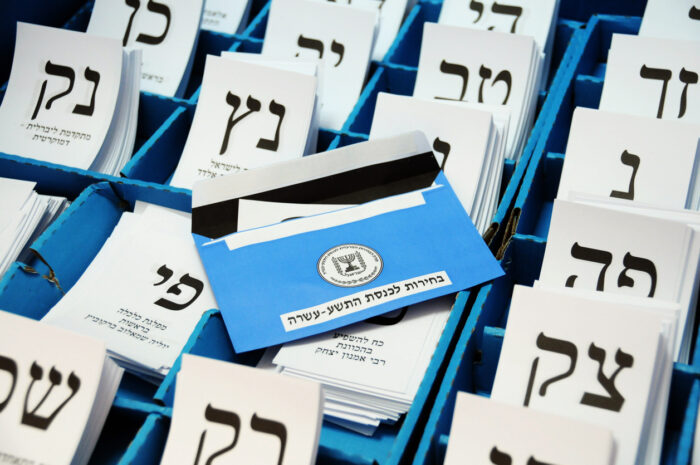
The election results in Israel reveal a deep social and political phenomenon: The “Change Bloc”—the coalition seeking to create an alternative to the current government—has reached a structural dead end. Mathematically, to secure a majority in the Knesset, the bloc must align with one of two major communities: the Haredim (Ultra-Orthodox) or the Arab parties. However, a central pillar of the bloc’s campaign was a repeated promise to voters: under no circumstances to sit with either group, framing them as non-Zionist and, therefore, inherently illegitimate partners in governing the state. At the same time, they drew an absolute red line against sitting with the Likud under Netanyahu or with the Religious Zionist and far-right parties.
In other words, Israeli political discourse has ceased to be a debate over ideas and has become an obsession with identity. The question is no longer, “What do you believe and how do you act?” but rather, “Which tribe do you belong to?” This dynamic is not exclusive to one side—it plays out with equal intensity on the Right, where political rivals are routinely labeled “traitors” or “internal enemies.” Yet today, the Change Bloc finds itself deeply entrapped in a snare of its own making.
To understand this crisis, it is worth returning to the core of Jewish tradition.
On the eve of last Yom Kippur, my wife and I were reviewing the prayers for the holiday. Coming from a Buddhist background of meditation retreats before joining the Jewish journey, she brings a fresh perspective that forces me to reexamine my own implicit assumptions. As we read the prayer that opens Yom Kippur—Kol Nidre—she was surprised. The prayer is not addressed directly to God, but inward, to the community:
“By the authority of the Heavenly Court and the earthly court… we permit prayer with the transgressors.”
From an individualistic or meditative standpoint, this seems puzzling: Why would anyone need explicit permission to sit in a room with “transgressors”? But Judaism is fundamentally a communal religion. Every kind of person can come to the synagogue.
Imagine sitting in a small European synagogue in the 1960s and discovering that a few rows away sits a man who served as a kapo in a concentration camp—a fellow Jew who humiliated others to survive. These are stories I heard from community members in Holland, where I served as a rabbi. On the holiest day of the year, in a space where you are meant to be entirely vulnerable, you are expected to sit and pray beside someone who caused profound injury.
Kol Nidre is a radical communal declaration: a Jewish community, by definition, includes its transgressors. As one Hasidic master, Rabbi Aryeh Leib of Shpola (the Shpoler Zeide, 1725–1811), famously put it: “These are my Jewish thieves—thieves, but still mine.”
This principle carries a profound consequence: Once you invite someone into a space of shared vulnerability, you forfeit the right to use that moment to assault them. A few years ago, I attended Yom Kippur services at a liberal synagogue in Philadelphia. The prayer and singing were filled with genuine devotion. Wrapped in my tallit, I felt safe enough to take off my glasses, close my eyes, and pray deeply. But when the rabbi gave the sermon, it was dedicated entirely to a fierce critique of the State of Israel. As an Israeli-American, I felt as though I had been invited into a space of shared vulnerability, only to have the host turn and attack my core identity. Even if I was viewed by some in that room as a political transgressor, the spirit of Kol Nidre dictates that once an invitation to pray is extended, you do not attack the guest.
Choosing to sit with the transgressor carries immense theological weight. On Yom Kippur, as we negotiate our lives for the coming year, we surrender the convenient claim: “I may not be righteous, but at least I am better than him.” By sitting beside the transgressor, we tell God: “This is my transgressor. He may have sinned, but he is part of me, and I take responsibility for him.” This is why throughout the liturgy we do not say “I have sinned” in the singular, but rather “Ashamnu,” “Bagadnu”—”We have sinned,” “We have betrayed”—as a community.
Yet a critical boundary exists. Kol Nidre specifically permits transgressors—it does not extend to external enemies or terrorists. In the Israeli security establishment, for example, a clear operational and conceptual distinction exists between crime and terrorism. Criminality is handled by the police, and the offender remains part of the civil fabric; terrorism is treated by the Shin Bet as an existential threat standing outside the boundaries of society.
The tragedy of our political discourse today is the complete collapse of this boundary.
In recent years, instead of engaging in substantive debate over policy, we evaluate the identity of the person standing across from us. When debate shifts from substance to identity, the threshold for boundaries changes: It becomes easy to reduce a political rival to a “transgressor”—and when that category no longer generates enough fear to exclude them, the next step is to upgrade them to an “existential enemy.”
The Change Bloc in Israel fell squarely into this trap. To motivate its base, it was tempted to categorize entire communities not merely as “transgressors” with whom one can negotiate, but as existential threats to the state.
The transformation of Naftali Bennett illustrates this shift clearly. While in 2021–2022 he dared to break historic taboos by forming a coalition with an Arab party alongside calls for partnership with the Ultra-Orthodox, his recent television appearance just days before the election revealed how deeply he has fallen into the same polarizing trap. When confronted on live television regarding Haredi conscription, rather than extending a hand to young ultra-Orthodox Jews who want to serve and framing the struggle as one against political bosses keeping them trapped, Bennett chose to lash out at the entire community for draft-dodging. In that single broadcast moment, instead of treating them as brothers in a shared societal challenge, he painted an entire public group as enemies of those who serve. Likewise, instead of acknowledging Mansour Abbas—a proud Muslim Israeli citizen, who sat with him in the previous government and has consistently advocated for internal reform within the Arab community, including mandatory civil service for Arab citizens—Bennett chose to declare outright that he would not sit with Arab parties. He effectively reduced potential partners for genuine civil integration to persona non grata.
When a political movement defines entire communities—whether Haredim, Arabs, or ideological rivals on the Left or Right—as existential threats, it absolves itself of the moral duty to sit with them. This is a profound flight from responsibility. It is far more comfortable to brand the other as an “enemy outside the camp” than to admit they are part of us and share in the collective responsibility for our future.
This is the enduring lesson of Yom Kippur for political life: A healthy community is not one without conflict, nor is it one without sin. A healthy community is one that remembers how to sit with its transgressors—without turning them into enemies, and without shirking its share of responsibility for the whole.