
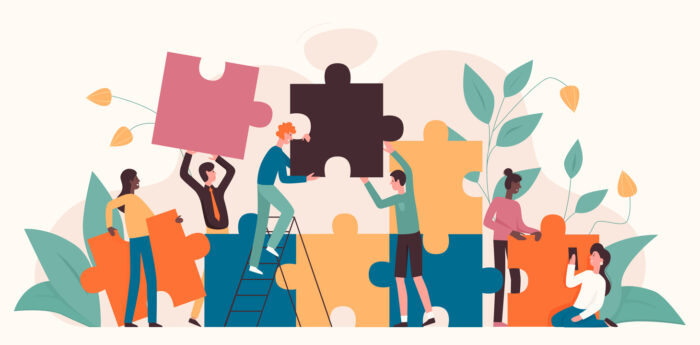
I don’t know about you, but I feel my heart tugged at multiple times a day by all of the challenges and sorrows of the world. A need will well up inside me, a need to do something immense and impactful, something that will make a big difference. But is it really the work of me doing one big, bold flashy something that will meet the needs of today’s conflicts?
It is a helpful reminder, then, that nine times out of ten, there is already someone working on the problem. There are organizations and networks on the ground in cities that know what they actually need. If I ignore the work of those already addressing the problem, my support will be redundant, ineffective, or even make things worse. Do I want to just be seen as making a difference, or actually making one? While one flashy idea might seem shiny, it probably won’t be as effective or sustainable as it would be if I worked together to build with others.
Likewise, the Israelite people have a problem in the Torah. Moses has been up on Mount Sinai for what seems like forever. They have just had a really intense experience with this g?d character, but now g?d is nowhere to be seen. And the one guy who can mediate between them and g?d has been gone for some time.
So they go to Aharon. He’s a people pleaser—he’ll know what to do. “Hey there,” the people say, sheepishly. “So we’re having a bit of trouble with this whole incorporeal g?d thing. We know g?d took us out of Egypt—we were there—but we need some way to focus our gratitude and praise and attention. We were so used to idols, and now we aren’t even allowed to look at or pretend to look at g?d. And the only person who knows g?d well enough to translate is gone. We’re abandoned. Help.”
So Aharon takes their gold and makes a calf. The people are pleased. “This is our g?d!” they cheer. “This is our outlet! Let’s focus on this!” And they dance and sing and everything is lovely.
Meanwhile, up on the mountain, Moses and g?d are having a similar conversation. “Look Mo,” says g?d. “I bet the people are going to have a hard time with this whole incorporeal g?d thing. I know I led them out of slavery and all, but they come from a world where gods are represented in stone and ink, and that’s not Me. They’re going to need a way to focus their gratitude and praise and attention. So how about this: Let them build me a home—not a literal home, but a place they can all come to be with Me. And through giving of their time and energy, through focusing on every tiny detail, through making it the most beautiful they can, they will come closer to each other, and therefore, to Me.”
So g?d tells Moses the exact specifications for this home, called the Mishkan. When it’s time for him to go down the mountain and tell the people, shouts of cheers and song are heard in the camp. G?d goes to see what the ruckus is, gives Moses the news that the Israelites are worshipping an idol, and neither of them are very pleased. Moses takes the two tablets of the covenant, this covenant signed onto by a fearful people and this incorporeal g?d, and smashes them on the ground in frustration, as if to say, “Guys, we were working on it!”
It can be challenging to be part of a religion where g?d cannot be seen. There is little certainty, even within Tanach (Hebrew Bible), of who and what g?d is and how g?d works in the world. Even Moses only sees g?d’s back (Exodus 33:22). It can feel very separate, very distanced. But we desire to be close to that-which-is-greater-than-ourselves. We call out to the mysterious and the holy, and we find channels for our gratitude, praise, and attention. It’s up to us: We could build a calf of gold, something big and flashy and distant. Or, we could build a Mishkan, a sacred home for the Divine that is created by working together, for the purpose of gathering together.
It can be a challenge today to address our shared problems and make change, whether that’s in an organization, family, or community. When it feels urgent, going alone can feel more time-efficient. But if we notice something is off, others probably do, too. Communication and collaboration might take more time, but finding shared solutions will likely be more sustainable. When you feel your heartstrings tug at the suffering of the world, can you ask: Who is doing this work already? How can I support them? How can we work on this problem together? The way we do something has an impact on our outcome. When we weave together our skills, strengths, and shared purpose, we move even closer to building the fabric of a more just society and a world we know is possible.