
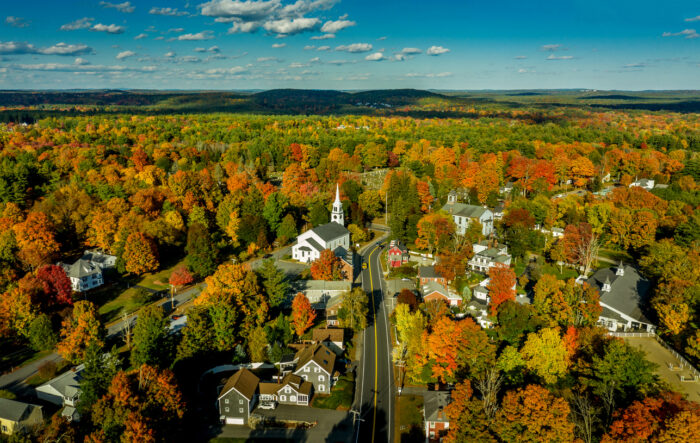
One afternoon last October, I was returning home from a speaking gig when I switched off my car GPS. Instead of driving the east-bound highway home, I exited the highway to drive a set of familiar backroads, up into what we call “the hill towns” of Massachusetts.
An hour later, I parked by a lake to walk up to the village and a set of rustic stone pillars. Next to the pillars stood a painted, wooden sign that had, since my last visit, faded to near invisibility. In there, at the end of a pebbled driveway, sat a (now defunct) writers’ retreat center with its gabled roof and blue-shuttered windows.
For two decades, from fall 2000 to the spring of 2020, I had booked myself in there, unpacked my bags, laptop, and notebooks into one of those single-occupancy rooms, each one named for an American writer.
When I got there this time, the front parking lot was empty. As I stepped gingerly along that driveway, I was on the lookout for a new occupant or a neighborhood watch villager. If they called me on my trespassing, would they buy my story about a sudden urge to drive here, to visit a once beloved place?
In winter, the hill behind that house was often snowbound. In spring and summer, it was loud with bird song. I remember one winter night, I woke to what sounded like gunshots. Turned out, it was an ice storm making those tree branches snap-snap-crash to the ground. Next day, as I walked the village and lakeside roads, I moved through and beneath the miniature rainbows refracted through the ice on those trees.
Like many of our shared spaces, the COVID pandemic had forced the retreat owners to stop accepting and hosting new or repeat retreatants like me.
A quarter of a century ago, in 2000, I was browsing through a national writers magazine when I spotted that word—retreat—in the classifieds. Back then, that word conjured my only other residential retreat.
I was about 14, a year younger than my convent-school classmates, when that rented bus parked outside the school walls to transport us girls (and our nun chaperones) to a retreat center in a suburb of Galway City, in my native Ireland. Except for the center’s gothic, grey exterior, I remember little from that weekend of prayers and penitence. But I do recall lying in a huge, dormitory-style room where I listened to my classmates sleeping and wished that I could, too.
My American writing retreat center had a website and photos and an origin story about how the owners, both writers, had redesigned an old carriage house to create a tranquil and affordable space for writers and artists. On that website, I checked each digital photo. Nope, no crucifixes or saint statues. So I called and booked and drove two-and-a-half hours west for what would be the first of many, many retreats, most of them in the Thoreau room. From then on, a few weekends per year, still dressed in my prim office gear, I drove there directly from my day job.
In 2005, when I returned to the United States after my mother’s death and funeral, I knew where I needed to go and be. Downstairs, as I unpacked my groceries into the shared fridge and kitchen, I was pleasant and chattery. Upstairs, I sat at my desk to stare out at that hillside, to beg that sky and trees to decipher or reveal the mysteries of our mortality. In that silent room, 3,000 miles away from the pageantry of an Irish funeral, I followed what the researchers and neuroscientists advise us to do: To name our feelings. To write them down. During that retreat, in 60 written pages, I laid claim to my own, private grief.
Later, I went there during a recession-era job loss. Later still, I went “retreat-ing” as an antidote to a particularly toxic day job. And, of course, I went there during happy times, for happy reasons, such as a publisher’s deadline or a rendezvous with a writing friend.
I didn’t know it back then, in real-time, but my final retreat would happen early in March 2020. That weekend, I had been hired to lead a writing workshop down in the valley. Once my post-workshop chats were over, I drove the now familiar hill town roads to that village and retreat center.
Three weeks later, the world was in lockdown. We were scrubbing down our groceries, sequestered from our loved ones, and wearing COVID-protective face masks.
No. I thought as I stood on that empty driveway, looking across those now-overgrown gardens. No. Contrary to what I’d told myself, I hadn’t only detoured up here to see a house with blue window shutters. Instead, I had come to behold an old and better version of myself—a self who had been more wide-eyed and trusting. A self who had been more open to what and how a day or a week or the rest of a life could or would unfold.
Finally, it was time to walk back to my car and drive home–to walk away from that woman (me!) who had once sat inside those blue-shuttered retreat windows.
Now, five months after my retreat center “pilgrimage,” our New England snow is melted, my garden bird feeder is getting busier, and our trees are finally budding. Meanwhile, each of our spring days is punctuated by a blitz of “breaking news.”
Some days I ask myself this: How long before these breaking news headlines start to break me—or the deeper, real-er version of me?
Now more than ever, do I need to counteract my daily realities and fears by creating my own spatial or existential place to which I can retreat—even for five or ten minutes per day? And, once created, I want to follow the advice of award-winning poet Roger Robinson (“A Portable Paradise, 2019”). In his poem, Robinson, an award-winning British-Trinidadian writer and performer, cites his grandmother’s counsel to carry our personal paradise “always on my person, concealed / so no one else would know but me.”