
Whether we realize it or not, birdwatchers—a quirky group that now prefers to be called “birders”—often find themselves thinking about time.
I’m thinking, for instance, of a recent late-spring morning when my friends Don and Cathy and I set out about 7 a.m. to go birding at Sucker Lake, a regional park in Vadnais Heights, Minnesota.
We had a fine outing. Wood anemones and buttercups bloomed along the trails. Morning sunshine seemed to varnish the trees and shrubbery with excited new greenery. It was early enough in the season that we didn’t need to swat mosquitoes, and with three sets of ears and eyes we spotted something every few minutes. Cathy reported twenty-five species on her eBird account, two of which (a cedar waxwing and a willow flycatcher) were new to my annual list. By 9 a.m. we were driving home, reviewing our lists and half-congratulating ourselves on such a good morning.
“On such a good morning.” Birding is always linked to notions of time. We had risen early, because we knew the birds would be active, and we knew that it was nearing the end of the spring migration. Few birders would presume to call themselves ornithologists; strolling and observing are a far cry from a hard science that rests on massive data collection. Still—though climate change has begun to monkey with their inherited calendar—most birders consider themselves phenologists of a sort, intuitively attuned to seasonal changes. Birders understand the year as a mosaic of (usually predictable) arriving and departing species.
Late April through early May is warbler season; early October is its counterpart, when spring’s darts of color return buff and drab, presaging the mutedness of November just ahead. Great blue herons and statue-still egrets in the ponds declare the exit of winter. The menacing calls of gulls and terns confirm deep summer.
Birds also migrate in and out of our own lives. They write themselves into our memories, We register the bird in front of us in a sequence of time since the last time we saw that species; a dialogue between our presents and our pasts.
I often find myself saying it’s been fifty years since I saw x, y, or z—a bobolink, a bittern, a loggerhead shrike. The last bobolink would have been on a telephone wire in Sibley County, near my grandparents’ home. The last bittern—my dad called them shypokes –would have been at Prairie Island, on a Labor Day weekend as we harvested elderberries along the Mississippi backwaters. The last shrike was somewhere near Alexandria, Minnesota, on a midsummer vacation.
There is a proverb, almost a Zen koan, that “Every bird is one bird.” It’s true, however much an individual bird might shimmer in its distinctiveness, it’s also linked to larger groupings—the species, the seasons, nature itself
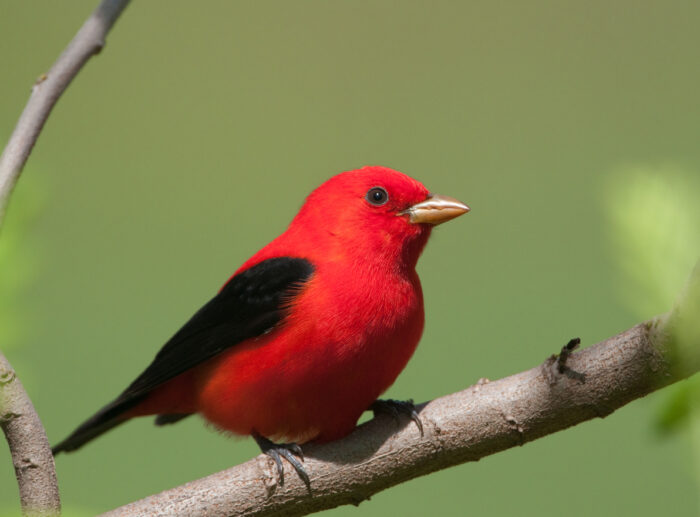
I thought about that on a dreary evening last year. I was grudgingly trudging to the grocery when I saw a flash of red and black—just a flash, but enough to ID the bird. I knew it was a scarlet tanager, a tropics-worthy songbird that I had not seen since childhood (my holy grail for birding this year will be to see another). And, in the same moment, I remembered the previous time I had seen a tanager, my first sighting, in an undeveloped area we called the ravine. I would have known scarlet tanagers from the bird books at the library. Looking up and spotting this most colorful of birds was like being an early Christian receiving tongues of fire at Pentecost, as if a secret, lavish world were revealing itself in that moment.
More than half a century passed before I saw the next one on that rain-soaked urban boulevard.
And yet the later tanager was the bird I had seen, at age eight or nine, in the unclaimed woodland. Yeats intuited something about this continuity when he wrote the great poem, “The Wild Swans at Coole.” His wheeling white birds in the West of Ireland were both the same and not the same swans he had seen decades before.
On that morning at Sucker Lake, Don, Cathy, and I had taken part in a ritual that’s replicated millions of times a day: the practice of taking a bird walk.
Though you can also sit and let the birds come to you.
A humbler approach to time informs the latter experience. Instead of pursuing, you allow the day to bring what it may. The first time I tried a “bird sit” was on a bench near the small downtown airport, a location seemingly bereft of birds. After an hour, I’d seen nine species, including two (a Caspian ten and an eastern meadowlark) that were new to the yearly list.
Much birding involves fleeting glimpses; an extended view is exceptional. And some species, such as barn swallows scoring the air in loops or chimney swifts busy in the evening sky, rarely stand still.
Nonetheless, timelessness runs through the aesthetic of birding—especially when the birds stand still. Some species’ availability gives solemnity to their appearances: a mourning dove, watching and seemingly weeping for the world from a telephone line; a wood duck under the overhanging willows; a red-tailed hawk atop a freeway light post; a green heron silent in the duckweed.
When you plunk yourself down on a fallen tree and watch for hours, you begin to develop a congruity with the natural world around you. You notice the unnatural, as well: passing airplanes overhead, lawn-mowers in adjoining neighborhoods, the too-common glint of litter tossed in the underbrush. Time passes differently when you sit.
Part of the allure of birding lies in its window on the profound creatureliness—which by definition means the profound embeddedness in time—of both watcher and watched.