
The anniversary of my journey into the narrow straits is approaching.
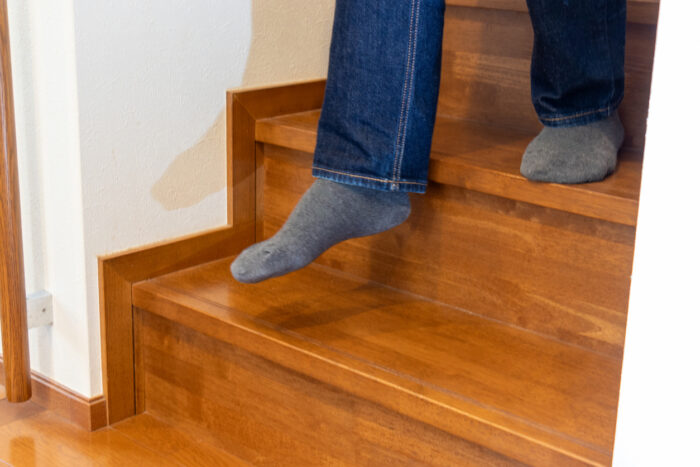
On April 1st, 2024, after an invigorating workout at the gym and a quick-but-satisfying hot shower, my spirit still soaring high on endorphins, my mind racing through the names of congregants on my must-call list as my body bounded down the stairs; my right foot slipped.
In an instant—one that I recall in super slow-motion when I recount my blessings and repeat how grateful I am for excellent reflexes—I was consumed by the most intense physical pain of my life. A pain that stole my breath, a pain that radiated from tuches to toes on my left side, a pain so consuming it masked the pain in my right hand, the one still grasping the wooden railing. The hand that prevented a more serious injury.
After a few minutes spent trying to control and slow my breathing, I managed to ease my right foot down to meet my left foot on the step where it had broken my fall. I was still crouched over in pain, afraid to sit. So I forced myself to stand and continued to the bottom of the stairs.
April 1st, 2024: the day my mind rebelled against my body stubbornly insisting that I was fine, when, in fact, I was an April Fool.
I berated myself for rushing in stocking feet on the carpeted stairs. Then, ignoring the pain in the left side of my body, I slipped my feet into dress shoes, folded myself into my car, and drove to work.
For the next few days, I sat in denial on heating pads and convinced myself I was healing. At my doctor’s insistence, I went for an X-ray to rule out a fracture in the ischium or sacrum. The radiology report showed no damage to the pelvic cage, but the pain in my tuches persisted.
It took nearly three weeks for the mind to concede the body was broken, the spirit shattered.
I called the Foundation Therapy Center, where I’d recovered from previous injuries, and within minutes I had an appointment for April 17th.
* * * * * * *
I knew I was in good hands as soon as I met Anna. As she located the source of the pain and skillfully applied pressure, she explained what she could do to alleviate it, and what I needed to do to heal myself, to improve my agility and strength.
Anna and I connected on a metaphysical level as well. She told me she was spiritual-but-not- religious and offered, if I was open to the idea, to incorporate meditative breathing exercises into our healing sessions. After one session in which she taught me about diaphragmatic breathing, I went directly from her table to a spiritual poetry writing class and wrote a poem about the experience of lying still on the table for five minutes, concentrating on deep breaths instead of on the pain, listening to my body tell my mind I was alive:
I place my hands on my belly, refocus my attention on my breath,
Imagine the Divine breath entering and exiting my lungs,
oxygenating my blood:
Now I know about diaphragmatic breathing.
Now I feel the healing spirit rise and fall deep within me.
For three months, I recited daily blessings of gratitude for my body.
Praised are You, Adonai our God, who rules the universe, fashioning the human body in wisdom, creating openings, arteries, glands and organs, marvelous in structure, intricate in design. Should but one of them fail to function by being blocked or opened, it would be impossible to exist. Praised are You Adonai, healer of all flesh, sustaining our bodies in wondrous ways.
(translation from Siddur Sim Shalom for Weekdays)
I also thanked God for my good fortune to have health insurance that covered physical therapy.
* * * * * * *
In June, 2024, as I was packing boxes for my upcoming move to New Jersey, Anna told me that I could return to the gym with some restrictions: no inclines on the treadmill and limited rowing.
“Pay attention to your body,” she said, “and if you feel pain, stop and do your stretches.”
At our last session in mid-July, she performed the same assessment she’d done at our first and calculated that I was 90% healed. “The remaining 10% might come over time; keep doing the stretches,” she said.
A week later, I moved to New Jersey. My HMO only covered routine care with my doctors in Atlanta and, while I could’ve purchased coverage on the health insurance marketplace, I chose to wait until the switch to a point-of-service plan took effect on January 1st.
My adult children were vexed by my imprudent decision, rebuking me any time I so much as mentioned my back pain. My eldest called me out on behalf of the three of them: “Ima, if we were walking around without health insurance, you would tell us we were being irresponsible. You’d be relentless.”
She was right. I was not adulting.
When I returned to Atlanta for a week in December, I visited my primary care doctor for my annual exam. He asked me about my back and whether the physical therapy helped. I joked with him that I’d graduated PT with an A minus and told him about the intermittent tingling in my left foot. It didn’t hurt; it was mostly annoying. He chastised me for not telling him sooner and wrote me an order for an MRI.
In my defense, I really believed this was just my body at almost sixty—knobby knees and knuckles, achy joints from Osteoarthritis. I’d long ago accepted this as my genetic inheritance. Whenever I glimpsed my reflection in a mirror and saw my salt-and-pepper curls and crow’s feet, I’d smile wider, whisper “Hi, Grandma,” and miss her a little less.
Still, I returned to New Jersey and asked everyone I knew if they could recommend an orthopaedic surgeon. I waited less patiently for New Year’s Day.
In February, 2025, I finally received a diagnosis: severe spinal stenosis, which wasn’t caused by slipping on the stairs, nor was it healed by Anna’s ministrations. The doctor reassured me I might never need surgery, since I was young and physically active, and recommended another three months of twice-weekly PT with traction.
With a targeted treatment plan, I learned how to sit, stand, and walk. My posture and balance improved, as I practiced carrying myself and my groceries.
Now, when I lift weights at the gym, my spirit is uplifted. I listen to my body and exercise my mind, making modifications to my workout when necessary.
* * * * * * *
On the evening of April 1st, as we begin the Seder, I’ll sit at one end of the dining room table, leaning slightly toward my left side while ensuring my lower back is supported by a lumbar pillow. My spouse will sit at the other end. Surrounded by our adult children, we’ll lift our cups and sing kiddush: “You have given us, Adonai our God, in love, festivals for rejoicing, holy days and seasons for joy, this day of the festival of matzot, the time of our freedom…”
I imagine this moment, two years since my journey into the narrow straits began, feeling grateful for this season of joy, this festival of spring and renewal, this time of freedom.