
It is 6:00 am two Monday mornings ago. I walk the sunny street to the subway, heading uptown to encounter my first dead body. Rituals help with my understanding of many profound moments. I have been trained in the specific rituals of encountering this holy person, and I know many rituals await me. For now, I rest in the quiet of the number 2 train, the steady rocking of my body along with the subway car—not too empty, not too full. I commit to not looking at emails or social media in order to prepare myself for a different day than usual.
I decide to check my text messages and send off a good-day wish to my son, who will soon be on his way to school. I get sidetracked by a WhatsApp group; my colleagues in Nigeria are reporting perhaps 40 students and teachers have been abducted from two different schools. We would later learn that some of those children are two years old and that one teacher was beheaded. As I type, I quickly edit. I cannot tell these colleagues, a majority of whom live in Nigeria, that I am off to encounter my first dead body.
Suddenly, this additional privilege is blindingly clear to me. As a woman in her forties, I get to choose to invest my time and emotional, spiritual energy into preparing a holy body for burial. A man who lived to old age, with medical support and sustenance. My colleagues know too intimately of children, teens, and adults who encounter gruesome, sudden, man-made death at far younger ages and far more frequently, with far less choice than I do. Instead of giving a brief explanation about tahara, I say that I am up early in NYC to do “something,” and I will be offline for the morning, and when I return, I will see what I can offer. I check my son’s texts. He is safely off to school. He wishes me good luck.
I am part of a chevre kedisha: a holy group or sacred society. The idea of taking care of those who have died as a “chesed shel emet,” an act of generosity that is true, or never repayable, shows up in our oldest Jewish narratives and is clarified in stories found in the Mishna and Talmud. The Chevre Kedisha became codified as a distinct group in the 16th century. I am part of an egalitarian chevre kedisha, thanks to my teachers, colleagues, and friends Sharon Shemesh and Mindy Sherry. Sharon has been serving since the inception of the group, and Mindy has been studying all year with and been inspired by the Shomer Collective’s educator fellowship about Judaism and death.
In February, I had joined volunteers of all ages, backgrounds, and reasons for finding our way to the chevre kaddisha at HUC in Manhattan, where we received our training. Now it was June 1. Would I remember anything? Nervously, I walk into Plaza Chapel, a funeral home, on the Upper West Side. A hand pokes out from a doorway and motions for me to head downstairs. My colleagues are already suited up in their PPE. I am warmly welcomed by the Rosha, head of the team, as I join volunteers, some of whom had been in this room and others like it several times before. There is one other new member like me.
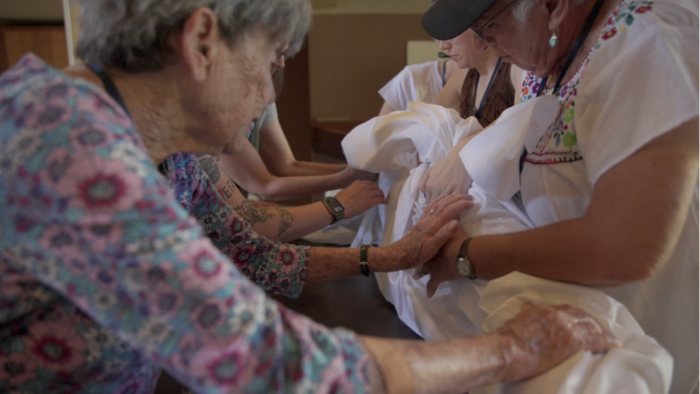
I get dressed in my PPE. We ritually wash our hands. We walk into the room. The person we are here to serve is waiting for us. His face and genitals are covered. The Rosha immediately gives us directions and recites a prayer of forgiveness, acknowledging that as humans, we will make mistakes along the way, even while trying to do everything for the sake of his kavod, his honor. We sing and hum as she recites words said all over the world in holy moments like these.
Belatedly, I am hit with a deep wave of sadness, realizing that three years ago, the holy men of a Passaic, New Jersey chevre kaddisha gathered around my father to perform the same kindness. Some were his dear friends. His community was not an egalitarian one, and I could not attend to him in this way had I been emotionally able. I also could not stay nearby his body to recite Psalms to accompany the soul, thought by some elements of our tradition to linger near the body in the days after death, figuring out its new place and purpose (Babylonian Talmud Shabbat 152b-153a).
At this moment, standing in my PPE and my sadness, I know I am here not only as a rabbinical student who wishes to be able to viscerally and specifically tell people who ask me how their loved ones’ (or their own) bodies would be cared for when the time came. I know I have come to “pay it backward” for all those who performed the chesed shel emet for my abba (father) when I could not.
As a sometimes squeamish person who is also a super-smeller, I am prepared from our February training for the idea that I might not make it through the ritual process and I might have to excuse myself. Our teachers gave us this grounding and chesed, to remind us that even if we are dedicated to the process, there are those who have come before us and who will come after us who just cannot engage in this way.
My moment might come early; I am tasked with taking a wooden nail cleaner and clearing out fingernail dirt from the met’s (deceased person’s) hands and feet. I begin with his left hand, only slightly closed. A more experienced volunteer works to release a very clenched fist on his right hand. Then we are instructed to do the same with his toes. (I write this and feel my throat clench the way it did then.) I walk to his toes. They are the kind of toes I would decorously avoid looking at any other day, but today they are my promise to the met. I look at them and remember that these toes were once baby toes, and I hope and pray that the met’s mother lovingly held them, kissed them, and cleaned them. In her honor, I decide to care for his toes like a mother. I am able to go on.
There are many more rituals, many surprises of the bodily, emotional, and spiritual kinds. What sticks with me most is dressing the met in tachrichim—the traditional shroud of undyed natural fibers, one of the many ways Jewish tradition ensures equality in burial (Talmud Moed Katan 27b). I forget how to tie the knots in the letter shin, but our Rosha helps us through. I am not prepared for the stark contrast between a body covered in bandages and tubes, the markers of hospital and end of life, suddenly transformed into the clothes of the Kohen Gadol, the high priest. He looks so simply regal; the last moments or months or years of his life and infirmities are here, beneath the linen, but he is buried as a holy man.
Because he was. He is. We all are. I know nothing more about him, despite how intimately we spent time with his body, but I know that he was and is holy.
I am grateful for all that the met (whose name we used throughout, but I am honoring him by not mentioning it here) taught me. I am humbled by the wisdom of our tradition and the calm presence and guidance of our Rosha, which enables all of us to be present to the met and to our purpose in the room.
Leaving the Upper West Side and returning to the bustling streets of NYC at 9 am, I text the family chat: “Feel like I repaid those who did the same for Abba. What an unusual and beautiful thing.” A few hours later, my brother-in-law sends the family a photo he snapped just then, on the street; we could hardly mistake a person who absolutely appeared to be my Abba in the photo, in a purple shirt and helmet, biking away somewhere. A “visit” we all got to feel.
Now it is a few hours from Shabbat. My friends in Nigeria are dealing with another round of kidnappings and executions. Children are newly awash in fear and death they should never need to encounter, certainly not without their loved ones hugging them tight—because each of them and those lost are absolutely holy. The cycle of life and death and privilege and loss continues. I am here for it all. But I cannot wait to hug my son when he gets home from school. And after candle lighting, I can’t wait to place my hands on his head, offering the priestly blessings of protection each parent can offer their child each week, because they are so very, very holy.
Dedicated to the holy families of the missing and murdered and the not-yet-buried in Oyo, Chibok, Dapchi, Kankara, Kagara, Kuriga and to the families who are still searching for and discovering the remains of their loved ones even today from Oct 7, 2023 in southern Israel.
Photo is from part of a video on Chevra Kadisha training from Kavod v’Nichum: https://kavodvnichum.org