
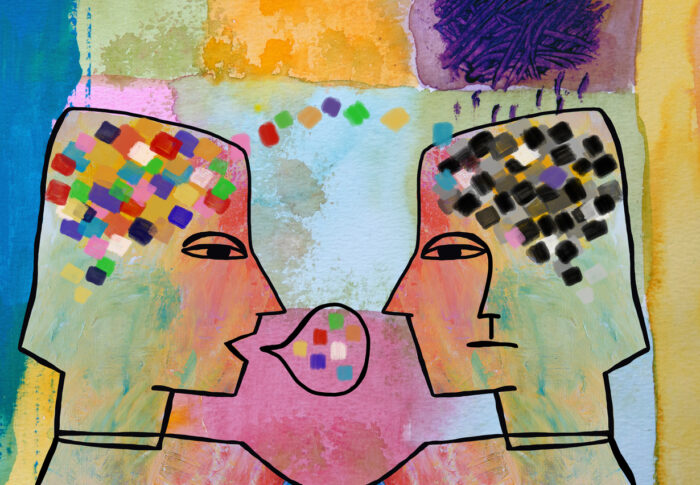
For most of a year, the holiest thing I did each day was put on a pair of headphones and listen to a woman tell me the truth.
I would sit at my desk, often late at night, with a transcript open on one side of the screen and her voice in my ears, and I would play the same three minutes over and over until I could hear not only her words but the breath underneath them, the pause where she decided whether to say the next thing, the place where a sentence changed direction because the memory still had a thorn in it.
I was supposed to be coding qualitative data. What I was actually doing felt much closer to what I do when I sit with someone at a hospital bedside. I was keeping watch over something fragile that had been handed to me. I did not expect research to feel like that. Like ministry.
I recently defended that research and finished my doctorate, an Ed.D. in Interdisciplinary Leadership, and the word doctor still feels a little borrowed when I say it out loud. It’s something I’d wanted for most of my life, and something I never quite let myself believe would happen. I felt it asked for a different kind of mind than the one I’d always relied on, and for a long time I assumed a dissertation would belong to someone else.
I have spent my life trusting the things that resist measurement. I’m a pastor and a poet. I believe in metaphor and presence, in the slow grammar of grief. When I started my doctoral work, the whole apparatus of social science felt like a language invented to keep people like me out, all instruments and inter-rater reliability. I was sure I had wandered into the wrong room and that at any moment someone would notice. Worse than the imposter feeling was a quieter dread underneath it. I worried that the method itself was a kind of betrayal, that to take a living woman’s account of her calling and break it into codes and categories was to do violence to something sacred, to press a wildflower flat between two glass slides and call it knowledge.
My dissertation is a hermeneutic phenomenological study of how women clergy in the United Methodist Church experience mentorship. The words are heavy, but the work underneath them is almost embarrassingly simple. I asked eleven women to tell me the truth about their lives in ministry, and then I tried, with everything I had, to understand what they said. More than five hundred minutes of testimony. Hours of listening, and re-listening, and listening again.
And somewhere in the middle of all that listening, the thing turned over in my hands, and I saw that I had been wrong about social science all along.
Hermeneutic phenomenology is the practice of listening to lived experience closely enough to interpret its meaning, while staying honest that the listener is part of the meaning-making. It has a founding instruction, plain underneath all its jargon: go back to the things themselves. Stop explaining the world from the safe distance of theory, and return to experience as it’s actually lived, before theory tidies it into something more manageable. When you strip away the German philosophy, I believe phenomenology is a spiritual discipline. It asks you to pay such close and patient attention to another person’s experience that your own assumptions finally go quiet.
There’s a moment in Exodus I have preached and read more times than I can count that this year I suddenly saw myself inside it in a totally different way. Moses is out in the wilderness doing ordinary work when he notices a bush that burns without being consumed. He does the small, decisive thing that the whole story hangs on: He turns aside to look. The text is careful about the order of events. It is only after he turns aside, only after he gives the strange sight his full attention, that God calls his name and the ground becomes holy. The holiness did not announce itself first. It waited on his willingness to stop and see.
That is the thing no methods course had prepared me for. The same capability that lets a scientist see what is actually in front of her, rather than what she expected or hoped to find, is the faculty that lets a person pray. Both begin by getting yourself out of the way. And both ask for a kind of reverence toward what is real. I had imagined I was setting down my pastoral self to pick up a researcher’s tools, and I had it exactly backward. The listening the research demanded was the deepest attention I have ever practiced, and attention, practiced that way, becomes a form of prayer.
There is an older word for what I was really doing with those transcripts, and it is the work of a witness. In the Christian tradition I was raised in, a witness carries a particular weight. A witness is someone entrusted with another person’s truth and forbidden to let it disappear. The women who spoke with me were not handing me data. They were giving me testimony, the account of what it has cost and what it has meant to answer a call the church has not always known how to receive. To hold that testimony carefully, to carry it somewhere it might finally be heard and might change something, is not a reduction of the sacred; it is one of the oldest forms of the sacred there is.
That is the work I already knew how to do, because it is what I have done at the graveside when I gather up the fragments of a life and speak them back to the people who are grieving. It is what I do when a student trusts me with something tender, and I hold it carefully rather than let it fall. The dissertation only asked me to do it with more discipline and on behalf of more people in one container.
For the past two years, I have been part of a fellowship called Sinai and Synapses, under the direction of Rabbi Geoff Mitelman and incubated by Clal. It’s a community that lives in the long conversation between religion and science. I joined half expecting it to confirm the quiet suspicion I had been carrying all through graduate school, that someone like me didn’t really belong in a room where science was taken seriously. Instead, I found people who understand that, at their best, science and faith are not rivals but two disciplines of devotion. Both begin in wonder. Both insist that you tell the truth about what you actually see. The fellowship gave me language for something the research had already been teaching me in the dark, that to study the world with honesty and care is itself a way of loving it.
To sit with everything that has already been written on a question is to sit down inside a conversation that has been going on for generations, much of it carried by people who are no longer here to speak. I have been sitting with a line in Pirkei Avot, the rabbinic collection of wisdom, that opens by laying out a chain of transmission. A teaching is received and then handed on, passed from hand to hand down the long line of those entrusted to carry it, each generation receiving what came before and delivering it to the next. The handing on is the whole point. You are not the origin of anything. You receive what was carried to you, you turn it over with as much honesty as you can manage, and then you add your own small turning and pass it forward, so that whoever comes next has a little more to work with than you did. Another teacher in that same collection says of the tradition, turn it and turn it, for everything is in it. That is a literature review in an academic setting. It is also a covenant, a promise that binds one generation to the next.
So here is what I did not expect a dissertation to give me, and what no methods textbook would have told me to look for. The research was never a departure from my vocation; rather, it was my vocation to wear the unfamiliar clothes of social science. Any practice that asks me to attend to another person’s life with patience and reverence, to bear their truth without flinching from it, and to carry it somewhere it might do some good is ministry, whatever building it happens to take place in. For most of the project, I kept waiting to feel like I’d set my calling down, and it turns out I’d been carrying it the whole time, tucked into the parts of the work I assumed were too ordinary to matter. The footnotes are holy ground if I am willing to turn aside and look.