
I almost never sign public letters or declarations, whether I agree with their substance or not. I am not opposed to them per se. I just don’t think they accomplish much, and certainly not if they are meant to be appreciated by those not already inclined to agree with the point being made. They pretty much always strike me as confusing cheerleading with education, and we have too much confusion between the two in our culture already.
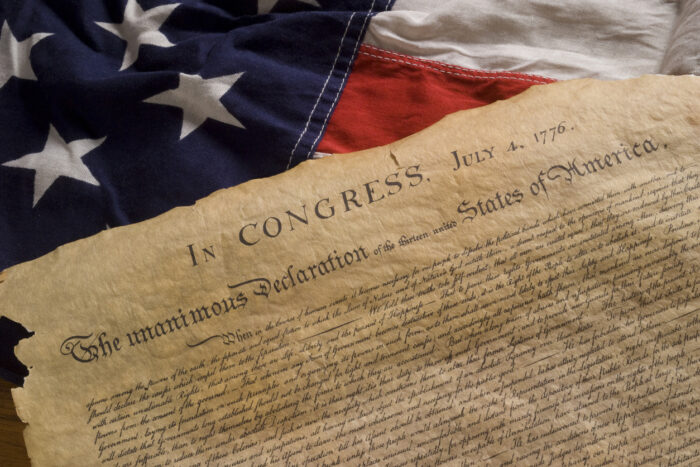
But this July 4th was different.
Truthfully, I did not expect this July 4th would be different, and I was actually not all that happy when a dear friend, who is also an admired leader in contemporary Jewish life, asked if I would sign a declaration that he was organizing. In fact, I asked him to send it along for my consideration even as I was already planning how I would tell him why I was not going to sign. Boy was I wrong, and happily so.
The letter, published in any number of media, is entitled, “Grateful We Are: An American Jewish Declaration for America’s 250th.” So why did I sign it? Not to mollify my friend, and not even because I largely agree with the declaration’s finer points, even though I do.
I signed it because the letter, rather than inviting agreement or resolution, actually redefines the currency of celebration as it is currently understood in most domains of contemporary community, culture, and politics. More often than not, the currencies that create connection today are agreement and loyalty. They may be deployed with little sophistication, or they may be deployed with greater nuance, claiming the “sane center” from the “loony left” or the “radical left”. But in all of those cases, the currency remains agreement and loyalty, with the ideas and the institutions the writer or speaker represents. Not so here.
Keying off the ancient Jewish ritual of starting each day with a statement of gratitude, “Grateful We Are” does the same when it comes to America as a whole, and to the American Jewish Experience in particular. It is not shy about its views, especially regarding what the letter sees as the “good parts,” nor does it entirely avoid what it sees as challenges, including painful ones. It points beyond them though, in ways that invite all people, whether they agree or disagree about the good parts or challenges, and it does so without minimizing those differences or trying to resolve them.
Instead, we the signers, and all of us, are invited into a larger frame which can hold many more good parts and challenges than is often the case. That frame is gratitude, and it can work at least as well at the collective level as the rabbis of long ago imagined it would work at the personal level in those morning prayers of gratitude, and it certainly is not limited to the 4th of July.
Imagine if we all simply agreed to start any conversation about America or American Jewish life with an articulation of the things about which we are grateful. Imagine if that gratitude was for things that leave room for people or ideas with whom we do not agree. Doing this is not about creating agreement, or trying to get “buy-in” or loyalty, but simply seeing things more expansively than we often do.
We can go back to fighting about issues of rightness, agreement and loyalty immediately after the expression of gratitude, and I expect that we will. Maybe we even should, as the issues are not meant to be glossed over. But I know that those fights will be less damaging than they often currently are. Why? Because the basic currency of the conversation—the ante we pony up in order to participate—will be gratitude, a fundamental human experience we can share, even when we may share almost nothing else.
So yeah, I signed this publicly, and I am grateful, not only to and for America, but for the opportunity to have done so, and hopefully, to live into the letter’s larger insight all year long.
Grateful We Are: An American Jewish Declaration for America’s 250th
Jews are guided to start each day with a statement of gratitude, and so it is fitting as the United States celebrates its 250th anniversary, we, American Jews, pause to express our profound gratitude.
Grateful are we for a nation that, unlike so many others through Jewish history, did not merely tolerate Jewish life, but made possible its flourishing.
From the earliest days of the American experiment, Jews were drawn to the promise of a nation founded not on bloodline, monarchy, or established religion, but on liberty, covenant, and the dignity of the individual. Having known the weight of persecution and exclusion, Jews recognized in America’s founding ideals something rare in human history: the possibility of belonging without surrendering our identity.
American Jews were not merely beneficiaries of this promise. We helped construct it. Jewish patriots supported the Revolutionary cause with blood, treasure, and the wisdom of our sacred texts. The Liberty Bell, commissioned in 1751, bears a defining expression of the American spirit with a quote from the Hebrew Bible (Leviticus 25:10), “Proclaim Liberty Throughout The Land… ” The conviction that we are all created equal, which was enshrined in our Declaration of Independence, was found in the Bible’s creation story, with its teaching that we are all made in the image of the Divine. Jewish merchants from the Caribbean, together with Jewish Patriots in the Colonies, aided the Continental Army by supplying arms. On July 4, 1788, Jews joined clergy and civic leaders on Independence Mall in Philadelphia to celebrate the ratification of the Constitution, a charter that offered freedoms unprecedented in the modern world.
And in 1790, President George Washington gave an enduring voice to the American promise in his letter to the Hebrew Congregation in Newport, declaring that “For happily the Government of the United States […] gives to bigotry no sanction, to persecution no assistance…”
Here, Jewish immigrants arrived with little and built lives of dignity. Here, Jewish communities established synagogues, schools, charities, businesses, and institutions of civic life. Here, Jews rose not because success was guaranteed, but because freedom made striving possible.
To us, being American means fidelity to a civic covenant.
We believe in individual liberty: free citizens must be able to live, speak, worship, assemble, and pursue their own paths, so long as they do not infringe on the rights of others.
We believe in equality of opportunity: every person should have the chance to rise through effort, talent, and perseverance.
We believe in the rule of law: justice must be impartial, rights protected, and power constrained.
We believe in freedom of conscience and expression: truth emerges not through coercion, but through open discourse, moral courage, and democratic persuasion.
We say this with clear eyes. America has not always lived up to its own ideals. Its history is marked by acts and periods of injustice, exclusion, and failures that wounded many communities, including at times our own.
Yet America’s greatness has never rested on perfection. It rests on the enduring power of its ideals and the willingness of citizens to struggle to live up to them.
That is our charge now.
At a time of division, distrust, and fragmentation, we recommit ourselves to strengthening the bonds of citizenship, renewing a culture of democratic responsibility, and modeling a patriotic pluralism that makes room for deep difference within shared national purpose. We also commit ourselves to teach these values to our children and our children’s children.
We are proud to contribute to helping America more fully realize the promise of a more perfect union.
Grateful are we. Committed are we. Hopeful are we.
God bless America.