
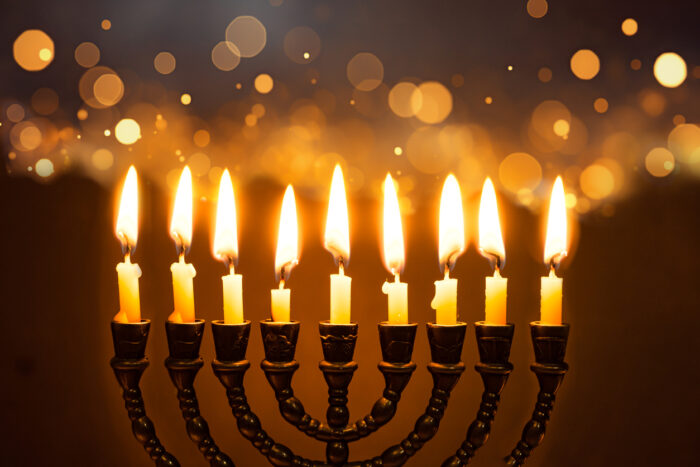
The approach of Chanukah on the twenty-fifth of Kislev offers an opportunity to pause from our busy, technology-addled world and contemplate the night sky. Observing the waxing moon at this point in the lunar cycle, one can viscerally sense the profound darkness of the season. In the Northern Hemisphere, the winter solstice brings the shortest days and longest nights. It is during this time of occluded light that many experience heightened vulnerability to existential and psychological despondency—exacerbated right now by contemporary socio-political turbulence. And it is precisely now that the Jewish calendar calls us to Chanukah, the Festival of Dedication. For eight nights, we kindle flames, symbolically traversing and transcending darkness. Jewish tradition invites us to turn toward light just when it seems farthest away.
Historical Origins of Chanukah
Chanukah’s origins emerge from the upheavals of the second century BCE, when the Maccabean Revolt responded to the draconian decrees of Antiochus IV Epiphanes, who sought to eradicate Jewish practice. Observances such as circumcision, kashrut, and Shabbat were banned under penalty of death, while Hellenistic rites were imposed upon the Jerusalem Temple.
The revolt was not only anti-imperial but also a civil conflict among Jews—some embraced Hellenism, others resisted it. Under the warrior Mattitiyahu and his sons, the Hasmoneans launched a guerrilla rebellion, reclaiming Jerusalem in 166 BCE. The Books of Maccabees recount the Temple’s rededication and an eight-day celebration modeled on Sukkot, yet they totally omit any references to the miracle of the oil for which the holiday has been best known. That tale of the oil that should have rekindled the menorah of the great Temple in Jerusalem for only one night, but which lasted eight nights, giving the Jews enough time to make more oil, only appears five centuries later in the Babylonian Talmud (Shabbat 21b). The Rabbis of the Talmud reframed the Chanukah story to emphasize divine miracle over military victory—and it is their version that ultimately shaped Jewish memory.
The Evolution of Chanukah
For nearly two thousand years, Chanukah remained a minor festival. Its modern prominence arose in the late nineteenth century, concomitant with the ideological ascendancy of Zionism. In some interpretations, it symbolized Jewish political self-determination; in others, particularly secularist circles, the miracle narrative was attenuated or dismissed. Entering Christian-majority societies in the modern West, the minor holiday of Chanukah took on new layers of meaning—and sometimes distortion. Living in a culture in which up to 40% of annual sales occur in the six weeks between Thanksgiving and New Year’s, Chanukah inevitably became commercialized (or “Chrismatized”). We live within a tension not unlike that between the Rabbis and the Maccabees: Are we cultivating the holiness of divine presence or extravagantly consuming presents? How, in our own homes and families, do we find a Chanukah that nourishes the soul?
Chanukah as Mythic Journey
To reclaim Chanukah’s depth, we can view it as a mythic journey. Myth is not falsehood but symbolic truth. To experience Chanukah mythically is to understand it as an invitation to deepen our inner life, to connect with the world of spirit and with God. We need to create a “Chanukah for Grown-Ups” beyond the usual litany of “Latkes, Candles and Dreidels – Oh My!”
Rabbi Menachem Mendel Schneerson, the late Lubavitcher rebbe, taught that the root of the word Chanukah, h-n-k, to dedicate, is also the root of hinukh, “education” or “formation.” Chanukah thus becomes a season of inner learning, a pedagogical exercise for the soul. Yet many adults approach it with the consciousness of childhood, rooted in early memories rather than mature spiritual reflection.
What if we applied to Chanukah the Passover dictum: “A person is obligated to see themselves as if they personally left Egypt.” What would it mean to see ourselves as participants in the original story—as those who are responsible for cleansing and rededicating the Temple?
The Inner Sanctuary
Reb Zalman Schachter-Shalomi taught that the ancient Temple functioned as a “broadcast center” transmitting the awareness of Adonai Echad—God’s oneness—into the world. We could log on, and through regular sacrifices receive ongoing communication signals from the source of the Divine. When the Greek Hellenists desecrated the Temple, the broadcast technology failed. It was as if they jammed the transmission of Adonai Echad—God is one—with Zeus and Hera, with the entire pantheon of Greek mythology. The Maccabees became the “Geek Squad” that rebooted the system, enabling the divine signal to radiate again.
In our time, it is the cacophonous consumer culture —loud, relentless, insistent—that operates analogously to Hellenistic interference, demanding allegiance through acquisition rather than devotion, more presents but not enough presence. What could it mean to live our lives as the Hasmoneans did? Today, without an outer Temple, we must cultivate the inner Temple, becoming spiritual Hasmoneans: cleansing and recalibrating our inner Sanctuary, lighting Chanukah candles to attune ourselves to the inner dimension of spiritual resilience and illumination, so that the spark of the Holy One may be illuminated within us. As God says in Exodus 25:8, “Make for Me a sanctuary, that I may dwell among you.” In the tradition of the Hasidic masters, today it is inside our own self, where infinite and finite meet, that we can find the altar of the Holy of Holies.
Transforming Habit into Consciousness
In the Talmud (Shabbat 21b), the Rabbis discuss until how late in the evening one may light the Chanukah candles. In that debate appears a striking phrase: “ad sh’tichle regel min ha-shuk”—literally, “until the foot leaves the marketplace,” or in a fuller sense, “until people stop walking in the street,” “until no wayfarer remains outside.”
Hasidic teachers note the word regel (foot) is related to hergel (habit). To light Chanukah candles is to step out of our habitual patterns—busyness, distraction, irritability, judgment. Habit blinds us to the miraculous. When we interrupt our patterns, the light of awareness shines through.
Ask yourself: What habitual patterns keep you from tending your inner Sanctuary? What addictions, routines, or distractions obscure your sense of the sacred? Social media preoccupation? Doomscrolling? Addictive materialistic consumption? So many easy habits of distraction are available to us.
If you cling to your familiar habits of busyness, addiction, shopping, and all the distractions that keep you numb, you cut yourself off from the miraculous—from the blessings and gifts already present in your life, from the places where you genuinely feel connected with the Divine. Disengaging from these patterns allows the reemergence of the miraculous. You start to notice light in the midst of darkness; you perceive order rather than chaos, clarity instead of confusion. Within your own inner Temple, you discover a quiet radiance that was there all along.
The Contemplative Flame
A final teaching: It is a tradition that while the Chanukah lights burn, no work is to be done. The light is holy; it is not for practical use—not for reading, not for counting money, not for anything functional. It is for contemplation.
The Bobover Rebbe would sit in silence for a full half hour each night, gazing at the flames with his Hasidim. You, too, can take this time. Look at the candles. Notice the gradations of the flame—the blue near the wick, the inner darkness, the edge where the fire becomes invisible. Let the light outside awaken the light inside.
As my teacher Reb Zalman taught: “Gazing at the Chanukah candles opens the door to the miraculous order.”
Rededicating the Inner Temple
The spiritual work of Chanukah is to repair and rededicate the inner Temple. Even the holiest spaces—outer or inner—can be desecrated. When Judah Maccabee entered the ruined Temple, he faced essential questions: What needs repair? What requires renewal? How do we rekindle the eternal flame?
As the nights grow long, we too are called inward. Beneath the rubble of pain and disappointment, we may discover the tiny cruse of oil—the divine spark implanted within us, for we are made in God’s image. When we kindle our menorah with this spark, the miracle of Chanukah happens within.
Each night adds another candle. Each night the light grows. From the smallest flame—often discovered in our darkest moments—we ignite a radiance that guides us forward, even through the longest night.
May our Chanukah celebrations this year bring a renewed spiritual light into our hearts, our homes and our communities. Hag Urim Sameach!