
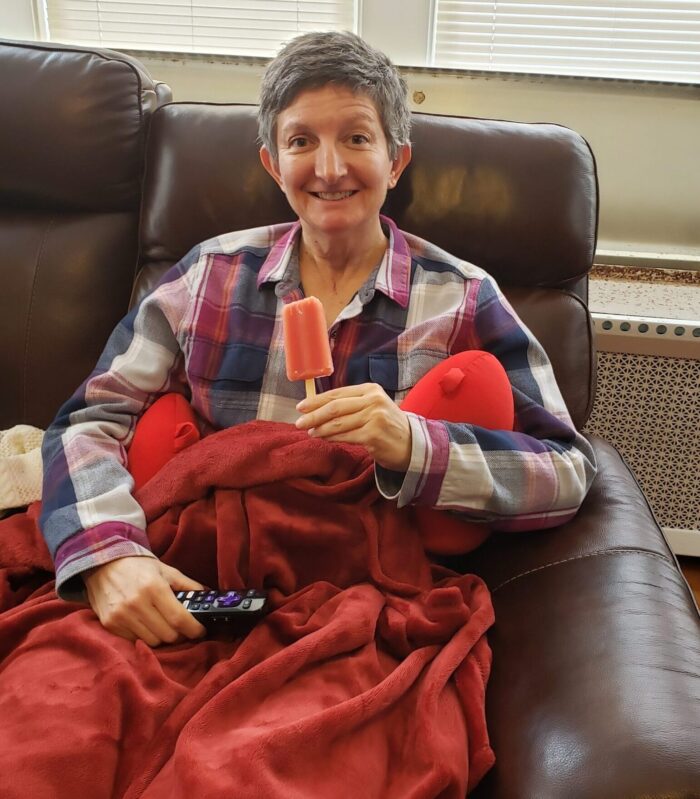
In my career as a congregational rabbi and a hospital chaplain, I have journeyed with many survivors as they battled various cancers. Watching my childhood friend Jackie do everything possible to fight ovarian cancer profoundly impacted me. Jackie was my age. She was fit, practiced yoga, and had a clean, healthy diet. Yet, ovarian cancer grew in her body. Jackie’s scientific research background empowered her to seek out experimental treatments. She even relocated to Turkey to go through treatments not yet approved in the United States. Jackie willingly gave up many things in her life—even the most important things to her like being close to her family—in order to do everything possible to live.
While Jackie was surviving and blogging from Istanbul, I learned that I carry genetic mutations that give me a significant predisposition to multiple types of cancer. I began to ask myself: How do I fight for my life when I have high risks of cancer, yet no cancerous cells found in my body? How do I decide which actions I will take to prevent a cancer diagnosis? What impact could preventive treatment make on my life, and would that outweigh the cancer risks of genetic predispositions?
In 2000, the term “previvor” was coined by Dr. Sue Friedman, the founder of F.O.R.C.E.: Facing Our Risks of Cancer Empowered. A “previvor” is someone who has a PREdisposition for cancer and is a surVIVOR without the diagnosis of cancer. For me, the term itself and the vast resources available on the F.O.R.C.E. website gave me the hope I needed.
In 2020, I had decided to initiate genetic testing at the Bass Breast Center of my local hospital because, as an adoptee, I had no family medical history. In the previous six months, I had two health scares that concluded with a clean bill of health, but the words “precancerous cells” appeared too many times for my gut to tolerate.
I’m grateful I followed my gut instinct because the genetic testing revealed that I carry two genetic mutations: BRCA-1 and ATM. Both carry an elevated risk of many cancers, including breast, ovarian, and pancreatic cancer. I remember leaving the hospital feeling like I was walking around with a ticking time bomb in my body. I observed others going through their normal life tasks and all I could think of was: Why did everyone else look so normal when I felt like my world was falling apart?
Next, I consulted with my doctors on the most effective way to minimize my cancer risk. With the BRCA-1 & ATM genetic mutations, the risk of getting ovarian cancer before the age of 70 went from 1.1% to a 39-58% chance. The risk of getting triple negative breast cancer went from 12.5% to 60-72%; my risk of pancreatic cancer went from 1.7% to 5-10%.
Although these mutations significantly elevated my risks of cancer before the age of 70, my doctor reassured me that they were not necessarily a death sentence. Yes, the information was scary and overwhelming, but there are a number of strategies available to monitor and lower my cancer risk.
With my family’s support, I made the decision to go through elective surgeries that could lower my risk of breast and ovarian cancers to single digits. A preventative total hysterectomy would remove my ovaries, fallopian tubes, uterus, and cervix. Because my children were in college and my husband and I had no plans for more children, why did I need these organs anyway? A preventative double mastectomy would remove as much breast tissue as possible, and reconstructive surgery would enable me to retain some sort of breasts with the help of silicone implants. While I grew up during the time of leaking silicone implants, the doctors assured me that medical technology had advanced and the risks of leakage were exceedingly low.
Although I easily made the decision to have the surgeries, it was not an easy road to walk. Initially, I focused on the details, data, and decision-making. Eventually, I realized that I was using the planning process to divert my attention from feeling my feelings. Knowing I might have a shorter life than I expected might demand a shift in my priorities and how I live this new version of life.
My first worries revolved around my children. I felt guilty that there was a 50% chance I passed these genetic mutations to my children. Only two weeks previously, I was helping my son accept a diagnosis of a chronic illness that we now share. How could I now tell him that just as he inherited Crohn’s disease from me, he might also carry these high cancer risks? And how could I tell my daughter that she potentially has genetic defects that she could pass to future biological children, or that she potentially has genetic mutations best treated by removing her capacity to have children?
When I focused on myself, my feelings flip-flopped between fear and anger. It all felt extreme and unfair. How could it be that the way to save myself from these cancers was to remove the organs that make me a woman? I had a breast MRI that showed my breasts “look great” medically. I should have been grateful that I didn’t have any cancerous cells, yet my first thought when I received the results was, F***! Really? They look great and we’re going to cut them off?!
At this point in my life, after my children were both in college, I was supposed to be focusing on more time with my husband and more time for myself. I was angry that my foreseeable future involved nerve-wracking decisions about my body that all involved risks. What would sex be like if I went through with a total hysterectomy? My gynecologist was incredibly supportive and named all the risks of sexual discomfort and hormonal imbalance and assured me she had multiple approaches to any negative outcomes like vaginal dryness or hot flashes. And it all sounded awful.
Two things that helped me most in my decision-making and recovery involved speaking with people outside my family and my doctors. I had a few friends who connected me with their friends who had double mastectomies because of cancer diagnosis and cancer prevention. It was helpful to have a patient’s perspective and their tips for enduring the physical and emotional rollercoaster ride.
It also helped me to speak with Jackie about her journey and her perspective on mine. We talked about the debilitating treatments for ovarian cancer and the impact it all had on her family. She told me that if she had been able to make the choices in front of me, she would do the surgeries. I felt a strong obligation to do everything I could to live in honor of Jackie, who did everything she could to fight ovarian cancer.
I considered Jewish approaches to the question of whether to get the surgeries. I was concerned about mutilating my body and removing healthy organs, because there is an idea in Jewish law that if there is no immediate threat to your life, you should not mutilate your body or risk your life with surgeries. At the same time, Jewish law is clear that you can violate the law in order to save someone’s life or protect them from someone set on murdering them. Does a genetic mutation meet the criteria?
With modern medicine and advancing genetic studies, I believe that the time-frame of a threat to life is expanded beyond a momentary episode. If I have knowledge of a 70% risk of life-threatening ovarian cancer, how am I not obligated to do something that would lower my risk to 4%?
I believe that the command to “choose life” (Deuteronomy 30:19) is one of the core ethics of Judaism and it directs the way I choose to make life decisions. Yes, one would not usually remove a healthy part of their body, thereby mutilating the sacred vessel on loan to us by God. But, because I do not require breast tissue or a uterus to survive, I decided I would have them removed and “choose life.”
Going through three surgeries in eighteen months was challenging. I had my hysterectomy in Whitefish, Montana where I live, and that first surgery was my training in releasing control to allow others to care for me. It was also a lesson in patience and the power of my body to let me know when I had overdone it and needed rest.
The total hysterectomy immediately put me into menopause, and I was restricted from the standard hormone replacement therapy because estrogen feeds the particular breast cancer I was at risk of developing. Interestingly, the physical symptoms were minimal compared to the menopausal brain fog, which brought memory problems, difficulty bringing names to mind, and mysteriously losing my train of thought mid-sentence. No one seems able to tell me when my brain will return to normal and I will stop feeling like I’m losing my mind. Additionally, hot flashes and fatigue continually trip me up and make me fearful that my body will remain my enemy rather than my superpower.
For my breast surgery, I chose to go to Northwestern Medicine because both my children were in school at Northwestern University. This required arranging time off of work, renting a place to stay for six weeks, driving from Montana to Evanston, Illinois, and therefore leaving my social network to be in a new location. Luckily, the social network of the greater Jewish community, especially the rabbinic community, supported my family and me as we were far away from home.
The first Shabbat, a rabbi of a very large congregation in town showed up at my doorstep with a challah. We knew each other when we were in seminary, but nonetheless it was a powerful gesture. I know how difficult it is to put one more task into those busy pre-Shabbat Fridays! When we needed a portable heater, a recommendation of a doctor, or a taste of kosher barbeque, our expanded Jewish network took care of us.
The double mastectomy, the reconstruction surgery, and the procedures to remove the surgical drains all taught me about the depth of my strength, my capacity for pain, and my expanding tolerance for “not knowing what the future will bring so just remaining in the present.” The pain was serious. It was difficult to move my arms, to sit or lie down without lots of props, it was even difficult to pump the soap dispenser. Who knew that little action requires chest muscles?!
In the moments when I was terrified and doubting my decisions, I would ask my husband to repeat the percentage risks of cancer for my pre- and post-surgery body. While that logic had some power, what kept me going and gave me the greatest hope was remembering my “why.” Just as I tried to eat healthy food, exercise frequently, and practice mindfulness meditation for my health, I went through these surgeries so that I could do everything in my power to be present for my loved ones, as long as possible. I want to explore the world with my husband and watch my kids start their careers and maybe even families. I want to spend more time with my parents and siblings, and I want to continue my work teaching and nurturing Jewish community.
It took three years to feel fully recovered from the surgeries. I’m no longer “building back;” rather, I’m now building up my strength for a good, long, healthy life. I continue to regularly scan for skin and pancreatic cancer. I continue to look at my new slightly-bigger-since-I-got-a-choice breasts and wonder whose they are. And I continue to be grateful and awe-struck that I was able to go through this entire process and come out the other end with an altered yet safer body than before. I could not have made it through this experience without the support of quality health insurance and an amazing ever-expanding Jewish family that took care of me wherever I was on the journey.
With genetic screening, medical research, and access to medical care, I was able to take responsibility for my health. Claiming the identity of a previvor honors my journey. I have been through some very serious, difficult procedures. I have known fear, vulnerability, and body-shattering pain. With my physical transformation I have also evolved in my understanding of what truly defines me from the inside-out. And, as a previvor, I am an advocate for myself so that I can do all that I think is best to prevent the occurrence of cancer in my body. Jackie would demand nothing less of me.