
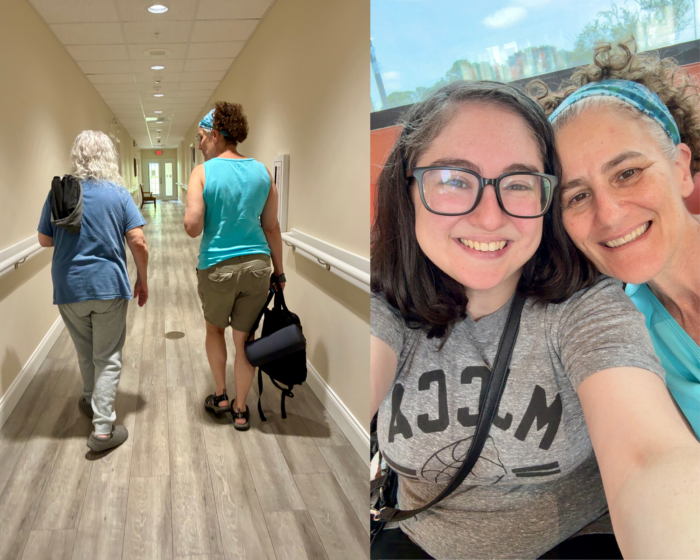
I first learned the social media slang of “trauma bonding,” a psychological diagnosis adopted by millennials to describe the intense closeness of “besties” who share a negative experience or chaotic event, from a member of my congregation. We were discussing the close relationship of Ruth and Naomi, both widowed and traveling together because Ruth refused to leave her mother-in-law’s side. When speaking about the challenges of being human, this congregant is both hilarious and an open book. She reminds me a lot of my eldest child, Maital, also a millennial, who regularly makes me laugh so hard that I gasp for air.
Last month, I embarked on a mother-daughter trip with my eldest, Maital, to visit my mother, who lives in the memory care wing of an assisted living facility in Florida. Back in February, I wrote about my guilt over not having seen my mother in almost two years. When she read the piece, Maital called me to suggest that we travel together: “I’ll go with you to visit Savta,” she said. “We can stay at a hotel by the beach, so it won’t be a total loss.”
I purchased airline tickets for the flight from Atlanta to Daytona Beach, rented a car for the drive from the airport to the facility, and reserved a room at the Sea Vista Resort and Tiki Bar. We’d be just a few steps from the ocean. This mother-daughter trip would be, at the very least, a partial win.
* * * * * * *
We landed in Florida mid-morning and drove directly to see Mom. We planned to sit with her during lunch and visit for a little while before checking in at the Sea Vista. But when we arrived, we found her resting in her room, claiming that she had no appetite. I sat on the edge of the bed and tried to coax her to join us in the common room. Maital, who worked in an assisted living facility before the pandemic, stood at a distance and assessed the situation.
I looked over Mom’s shoulder and saw Maital motion toward the door. In the hall, she gently-but-firmly stated our next steps: “Ima, we need to find an aide or nurse.” I began to argue that they were all busy serving lunch to the other residents, but she knew exactly how to comfort me and strengthen my resolve. Taking my hand, she led me back toward the nurses’ station.
“Our Sages taught… honor means that the child must give them food and drink, clothe and cover them, and lead them in and out.”
After what felt like forever, an aide led Mom to a table and brought her a drink. As I sat down next to her, Maital slipped quietly to the other side of the room, giving us time to get reacquainted, and taking the time to meet the staff and gather information about her grandmother’s health.
When Mom finished eating, Maital joined us and we three chatted about nothing in particular. I suggested that we all take a walk through the rest of the facility, as it was too hot to walk outside in the courtyard. Mom eagerly agreed and we began our first circuit side-by-side, Maital following a few paces behind us. Every few steps we met someone who recognized Mom; many greeted her, saying how nice it was to see her, how great it was that she had family visiting.
Our first visit lasted more than two hours, longer than we’d intended. The rest of the day would be spent decompressing, debriefing our day, dissolving into laughter through tears at the Tiki Bar, wading in the waves, and people-watching in the pool.
After a filling dinner at Norwood’s Restaurant and Treehouse, a New Smyrna Beach landmark that opened the year after my mother was born, we fell into our respective beds for a night of fitful sleep.
* * * * * * *
Our plan for the second day was to visit twice, not staying for more than 90 minutes each time.
After breakfast, we had a pleasant morning visit and then we stopped at a discount department store to pick up some clothes for Mom. She’d developed a rash on her foot, and I was frustrated at not finding rubber-soled slippers to replace the oversized ones she’d been wearing. Maital talked me out of buying canvas sneakers, insisting, “She won’t wear them, Ima.” Instead, she helped me choose a few shirts and suggested that we buy chocolates to thank the nurses and aides.
We decided to drive back toward the beach for a leisurely mother-daughter lunch before returning for a late afternoon visit, when we’d say our goodbyes.
* * * * * * *
Sitting at Beachside Pizza and waiting for our individual pizzas to arrive, we discussed our morning visit. I commented that Savta recognized neither of us, nor did she remember having seen us yesterday, but she seemed pleased to see us nonetheless. Maital agreed.
I marveled at the ease with which Maital navigates the mostly incomprehensible conversations with her grandmother. I was awed by her confidence and professionalism as she interacted with the staff. I told her she’s an amazing daughter, and I confessed to her all the ways I believe I have failed my mother.
She reassured me that I hadn’t failed, explaining that we both have Eldest Daughter Syndrome, and began reading some defining characteristics of this condition from her phone:
- Eldest daughter syndrome is an informal term describing the pressure firstborn girls often face to act as caregivers, mediators, and role models from a young age.
- Your identity is tied to feeling productive, achievements, or feeling needed: If you’re not succeeding in your endeavors or doing something useful, you feel lazy, or like you’re failing or wasting time.
- While daughters who find themselves in this role often cultivate resilience, empathy, and leadership skills at a young age, it can also come at the expense of their own needs and identities.
“Slow down,” I pleaded, scribbling furiously.
“Oh, Ima, I’ll send it to you. You can read it later.”
After lunch, we spent another hour and a half sitting companionably with Savta on the green couch watching The Carol Burnett Show. I thought about how not doing anything in particular with Mom was the point of being there.
* * * * * * *
Later, walking along the shore, we compared notes about what was the most challenging thing about this visit. Both of us were saddened by my mother’s cognitive decline, reflected not only in her speech as an inability to retrieve names of objects—she rarely used nouns, saying “it” and “this” to refer to things we couldn’t always identify—but also apparent in her disinterest to look at pictures in a magazine. Maital remembered visits from twenty years ago, when my mother would take her to the public library and they would read for hours. She said the saddest thing was that Savta couldn’t read anymore.
For me, the saddest thing wasn’t that my mother doesn’t remember who I am. It was realizing that my mother doesn’t remember who she was. Despite feeling reassured that she is safe and in good physical health, I’m still weighed down by grief.
If not for the compassionate presence of my eldest daughter—who invited me to share my feelings of loss and to confront my fears about ending up like my mother—I’m not sure how I would have fared.
During one of our discussions, I told her, “If I ever get to this point, I don’t want you to feel guilty about putting me in a facility. You don’t have to visit me if I don’t know who you are.”
She replied, “But I’ll know who you are, Ima. I’ll know who you are.”