
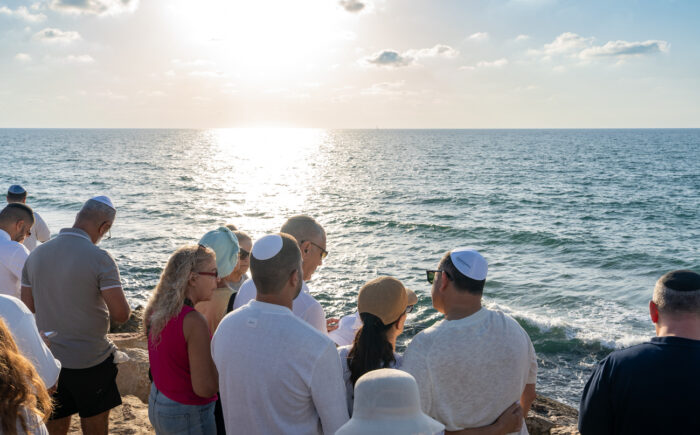
There is no synagogue building in my community. There are in other cities in Montana, but the Glacier Jewish Community in the Flathead Valley is a synagogue-without-walls. High Holy Days in the conference center of a hotel, or at the Unitarian Universalist Fellowship Hall. Purim in the northwest Montana history museum, socials at breweries and trailheads, and our annual ShabbaBQ at the beach.
Non-religious venues for religious gatherings can relieve the anxiety of those who are worried about “not knowing enough” or “doing the wrong thing” in a sacred space. Breweries, museums, and hiking trails are places people already enjoy, so it doesn’t seem like a far stretch for participants to meet the Jewish community there. Being a synagogue-without-walls also relieves us of spending the time, money, and human resources that a building requires.
Without a central brick-and-mortar meeting place, we do require a different kind of commitment from a congregant, however. Sometimes the meeting place is a ten-minute drive and sometimes it’s a forty-five-minute drive. Sometimes there is a catered meal, and sometimes you need to bring your own chair and a dish to share with others. Most often your attendance demands a significant amount of your time and engagement before you even arrive at the event—spreading the word, setting up the space, or hiring security.
I acknowledge that it is no easy task nowadays to “just show up.” Whether you are heading to a potluck in the park or a service in a church or synagogue, “showing up,” in and of itself, demands commitment. You need to protect that time on the calendar and dedicate yourself to the task of getting yourself, and maybe your family, to the gathering. There are many recreational activities competing for our time, and time with one’s religious community often gets placed in the recreation (vs. work) bucket.
In my synagogue-without-walls, we encounter the tradition in many settings–secular and sacred, indoors and outdoors. As a rabbi, I have tried to show people that the tradition can be accessible to them and play a meaningful role in their lives, no matter what—whether they are intermarried or secular or never had a bar or bat mitzvah or don’t know how to read Hebrew. For some reason, I have observed that many non-Orthodox American Jews have internalized a self-hatred that judges their nontraditional lifestyle as unworthy and valueless. Why dedicate time and energy to a venture that “isn’t really the authentic way” to live a Jewish life? I have found that a synagogue-without-walls is the perfect model for a community that is uninterested in conventional congregations and uncomfortable with a traditional, non-egalitarian Chabad service.
A synagogue-without-walls shows people how to create a Jewish life that travels with them wherever they go.
Life cycle moments are the easiest places to have this spiritual impact, to teach people how to carry their Judaism with them. At the transitional moments in life, I don’t have to convince people they need a ritual. They are looking for one, and I could either say: No! We don’t have a mohel (someone trained in Jewish ritual circumcision) in our state, so you can’t have a brit milah ceremony. Or, I could get more creative and say: Yes! I will meet you at the pediatrician’s office on the eighth day, and we will have a ceremony appointing the doctor as your agent so that we can bless your circumcized baby and welcome him into the covenant of the Jewish people.
The other end of the life cycle also presents opportunities for adaptation and empowerment. When a beloved member of the community was moved to hospice in the local hospital, he was surrounded by his family and friends. A constant vigil of 8 to 10 people fed him matzah ball soup, sang to him, massaged his arms and legs, and just sat in silence witnessing his journey. Like many people nowadays, “R.” chose cremation over burial. In Jewish tradition, the final act of care for a person is to perform their burial. I had to figure out how I could offer R.’s community a way to care for him in death even though he had chosen cremation, so that they could show their love and respect for his being and soothe their own souls.
With the support of compassionate nurses, I led our group of loved ones in the Jewish tradition of ritually washing and purifying a dead person’s body, taharat ha-met. R’s bed was covered in plastic sheets, and his unclothed body lay under a clean white sheet. We began with the traditional prayers, setting our intention to honor him with this sacred service and asking his forgiveness if we were to err in any way. Each person helping was positioned beside R. and bathed him with warm water and blessings. One at a time. They uncovered an arm or leg and washed it with tenderness and respect. We used the Jewish tradition as a structure to help R.’s community—Jewish and non-Jewish—care for him, love him, and honor him.
There is also a Jewish tradition of never leaving a deceased person alone called shmirah, guarding. With the support of the (non-Jewish) funeral home and a funeral director who once worked in New York City, I organized two-hour shifts for people to sit in the chapel and recite prayers, read psalms, or whatever meditations helped them feel connected to R.’s spirit.
Through these experiences, Jewish and non-Jewish friends, family, and neighbors learned about these Jewish traditions dedicated to caring for the dead. The non-Jewish nurses and funeral directors learned about traditions they could offer to the Jewish community. And R.’s family and friends learned that ancient Jewish traditions could actually speak to their spiritual longings, support their grief, and stand up in non-traditional settings.
This past Shabbat, we celebrated the bat mitzvah of a girl who studied with me and her mother for the past two years. Mom joined the Jewish people before their family moved here, and she always wanted to learn to read Hebrew but hadn’t found her way to it, raising two young girls and working full-time. While we do not have an ongoing religious education program for children, individual families who are committed to giving their children a Jewish education and ceremonially marking their b’nai mitzvah can make a private arrangement with me to be their guide and teacher.
Before Shabbat, workers arrived to set up a spacious white-canopied tent between their garden and the old barn. The chairs faced east towards the looming, green-covered mountains and the big Montana sky. Our portable ark and Torah scroll stood behind me and the bat mitzvah girl as we led services and read from the Torah.
What was most important to me as this family’s guide was to give them an experience that helped them claim the tradition as their own. I wanted this girl, who lives in Montana as a religious minority and in a time of outward hostility toward Jewish people, to be proud of her achievements and comfortable showing her peers what she learned. I taught the bat mitzvah and her mom how to read from the Torah scroll without vowels. I didn’t teach them the cantillation system; rather, I taught them the meaning of the words they were reading so that when “K.” was puzzling over a word, I could say “tent of meeting” and she could interpret the letters to correctly read ohel moed.
I saw that my teaching took root and flowered when the bat mitzvah girl in her speech compared the Israelites wandering in the desert to herself and her classmates on a camping trip. She put herself into the narrative, understanding what it was like to be hungry and tired and to want someone else to do the hard work for you rather than doing it yourself. She understood Moses’ frustration with the Israelites and learned the importance of asking for help sooner rather than later.
I blessed her by challenging her to be like the Israelites who approached Moses (Numbers 9:6-12) asking to be included in the tradition of Passover when the law was excluding them. Because they articulated their own exclusion and their desire to be included in the community’s sacred life, a new law was given—the Second Passover, one month later, for those who couldn’t observe the first.
While a synagogue-without-walls relieves the congregation of a significant financial burden, the congregation demands significant volunteer hours to create meaningful Jewish experiences wherever the community happens to find itself. I believe that the role of spiritual leadership in our time is not as priest or performer, giving over tradition to passive recipients. Judaism began as a portable religion as the Israelites wandered the desert on their way to the Promised Land. And Jewish people have maintained and adapted Jewish tradition since the destruction of the Jerusalem Temples and the dislocation experienced from generation to generation.
The most important vessel is not the building itself or even a Torah scroll. Rather, it is a willing heart that desires connection and belonging. Our challenge is to demonstrate the importance and legitimacy of every person who claims a Jewish identity through loving engagement.
Living in rural America, even without a synagogue building, doesn’t mean you can’t be Jewish. You can be Jewish and do Jewish anywhere, if you have the desire. There are small, volunteer-driven congregations throughout the Western states, and they are always happy to welcome guests. Just be warned: You might fall in love with the community and move there like my family did!