
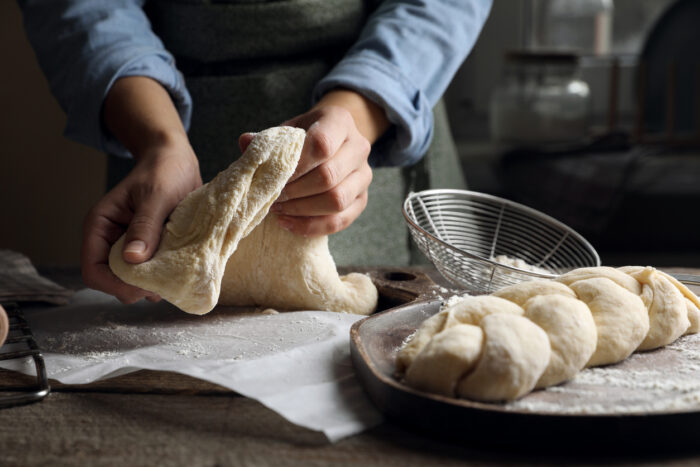
Many years ago, a friend taught me how to make challah for the first time. Just as we were finishing kneading a gigantic batch of dough, she took out a tiny ball of dough, held it in her hand, and said “We need to burn this!” At the time, I recall feeling aghast. I asked her, “Why would we destroy perfectly good dough when it will taste delicious?” She said, “Tradition!”
Challah is the most distinctive bread of Jewish tradition. Nowadays it is braided into beautiful loaves, sometimes with folks adding things like honey or raisins. It is hard to imagine a Shabbat dinner without challah. For many Jewish bakers, challah isn’t just food – it is a form of art.
Jews have been kneading and baking challah for thousands of years. It is one of the offerings made in the original Temple of Jerusalem. In the Bible, the term challah has two distinct meanings: it can mean a loaf or a cake of bread. Or it can mean the portion of dough that is taken out to be donated to the Temple.
This second meaning of challah (a piece of dough set apart) occurs in this week’s Torah portion, Parshat Sh’lach. In Numbers 15:18-21, Moses instructs the children of Israel to bring offerings to the Temple:
Speak to the Israelite people and say to them: When you enter the land to which I am taking you and you eat of the bread of the land, you shall set some aside as a gift to Adonai: as the first yield of your baking, you shall set aside a loaf (challah) as a gift: you shall set it aside as a gift like the gift from the threshing floor. You shall make a gift to Adonai from the first yield of your baking, throughout the ages.
Like other “first fruits” such as fruits, vegetables, livestock, and even firstborn children, the first yield of baking was understood as belonging to God. It needed to be offered to God as a gift at the Temple. Only priests could eat this consecrated bread.
Of course, the Temple was destroyed long ago, several times, in fact. The ancient rabbis understood that it was impossible to bring first fruits to a destroyed temple, so they suspended the practice. However, the practice of removing part of the dough (challah) continues even today.
When observant Jews make a large enough batch of dough, it is still customary to take out a small portion of the dough, wrap it in foil, and then burn it. If the batch is larger still, this ritual also requires a blessing. This practice is called “taking challah” or hafrashat challah.
For me, the meaning of this practice is not obvious. If we don’t burn our first fruits (or otherwise offer them up to God beyond saying a blessing over them), why do we burn the first parts of our dough? Is there something that makes bread different than any other kind of first fruit?
I believe the difference between bread and other first fruits lies in the nature of bread itself. Bread can serve as a broader category for something we harvest that we transform into an edible, delicious dish. After all, bread does not occur naturally in the world, but it is one of the “first fruits” of human production and creativity.
Thinking of bread in this way makes me think of other things we prepare from our gardens and / or farmers’ markets for the first time each year: homemade strawberry ice cream from fresh-picked spring strawberries, gazpacho soup with summer cucumbers and tomatoes, or butternut squash soup from squash harvested in the fall. Human ingenuity has enhanced the natural yumminess of all of these fruits and vegetables.
The rabbis understood that we humans need reminders that human creativity also originates from God. As a gardener, despite the intense effort involved in gardening, I have an intuitive sense that anything that manages to grow out of the ground is a divine gift. However, when I bake, I tend to focus on my own efforts. Perhaps the rabbis have kept the requirement to take challah (chafrashat challah) so that we would remember that human creative endeavors also have their source in divine good will.
Of course, making bread is not the only way that human beings take raw, unattractive materials and turn them into something beautiful. We can do the same thing with everything that happens in our lives. We can use the raw materials of our own tragedies and suffering to make meaning, connections, love, joy, and peace. Our human capacity to take the rough materials of our lives and transform them into beauty is one of the most profound gifts that God has bestowed upon us.
I must admit that I am still bothered by the idea of taking perfectly good bread dough and burning it, even in small amounts. However, upon reflection, I’m not sure if my discomfort stems from my aversion to wasting food. Instead, I may be averse to remembering that even when I’m baking, my entire existence is dependent on divine good will.
The practice of taking challah invites us to pause and consider how we can consecrate the “first fruits” of all of our creative endeavors. It invites us to remember and recognize the divine goodness present in all that we do and make.