
As I prepare to spend three days attending a professional convention in Philadelphia, I feel unsettled. Since moving to New Jersey, I’ve been trying to adapt to what was once a familiar landscape, while simultaneously attempting to reconstruct my network of haverim—colleagues.
Two years ago, attending the same convention, I navigated Atlanta’s public transit system with ease, striding with confidence from the MARTA station across Centennial Park to the hotel. I try to remember who I was then and wonder whether I left that version of myself in Georgia.
I worry that I’ve lost my sense of purpose.
* * * * * * *
On the second day of the convention, after the morning plenary session, a group of us gather to make signs. We’re attending an Interfaith Prayer Vigil outside the local ICE office, sponsored by the New Sanctuary Movement of Philadelphia.
It’s overcast and unusually warm for early March. With each step toward 8th and Arch, I feel a growing sense of excitement. I remember walking through the streets of Nogales, Mexico more than seven years ago, bearing witness to the suffering of refugees and asylum seekers, feeding migrants at the border and listening to their stories.
Arriving at the crowded sidewalk—there are more than seventy of us waiting for the cue to raise our voices in prayer—I find myself standing shoulder to shoulder with a tall man with a neatly trimmed, white beard and wire-rimmed glasses. He wears a hat with the word ARMY across its front and a kind expression on his face.
Without hesitating, I introduce myself and ask if he is a veteran. Sheldon, I learn, is a veteran and a member of the West Philadelphia Mennonite Fellowship, who attends the Wednesday vigils every week. I tell him I was involved in the New Sanctuary Movement of Atlanta before the pandemic, accompanying immigrants to court hearings, but since moving to South Jersey, I hadn’t participated in any kind of advocacy or spiritual accompaniment work.
For the next forty-five minutes, we stand together in silence and in song, in solidarity and in support of immigrant families and communities. We pray for the people being detained inside the building to be treated humanely. We pray for the people working inside the building to recognize the humanity of those they detain.
I feel as if I’ve found my way back to myself—recovered what I’d lost—though I still can’t name it.
As the vigil concludes and the crowd begins to disperse, I turn to Sheldon and tell him how good it was to meet him, how much I hoped we’d meet again. In a manner that is both matter-of-fact and warmly enthusiastic, Sheldon tells me that his community will be leading the prayers on April 29th and that I’m welcome to join them.
Suddenly, I realize what I’d misplaced in the move to New Jersey: not my way, nor my faith, and not, God forbid, my hope. In leaving my interfaith hevra (group of friends) in Atlanta, I had somehow lost the memory of how vital this connection to a community of friends-in-faith is to my Jewish identity. I pull out my phone and enter an event in my calendar: “Sheldon, Mennonite Fellowship leads NSM vigil.”
As we head in opposite directions, my head fills with plans. I will invite some of my congregants from the Social Action Committee to join me on April 29th, we’ll ride the PATCO train together from Cherry Hill to 8th and Market. My heart fills with hope, a hope that I’d find a path back to who I was, or a path forward to who I was becoming.
* * * * * * *
On the morning of April 29th, Sylvia—one of my congregants who planned to meet me on the train—called to let me know that the PATCO timetable I’d shared was not accurate and suggested we catch an earlier train. I promised to text her when I boarded the train in Cherry Hill so she could find me when she boarded at the next station.
I was already running late when the ticket machine’s credit card reader failed to process my transaction. As I touched the screen to start over, I heard a train pulling into the station. Janet, another congregant, texted me from the platform that she was boarding the train.
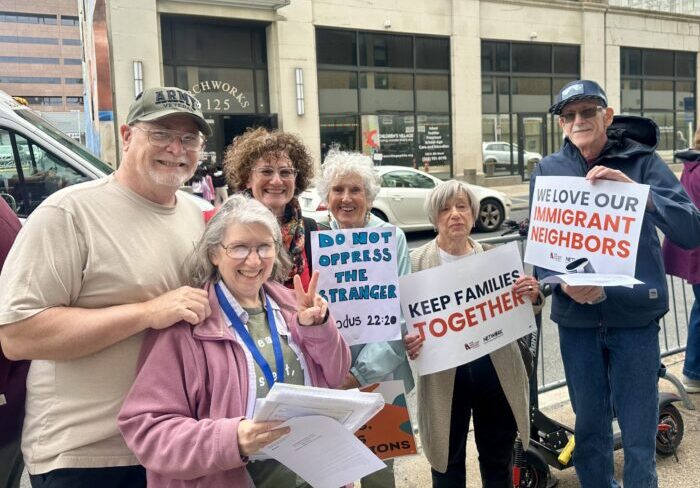
By the time I jogged across the intersection of 8th & Arch, everyone had already assembled with their signs and song sheets. I pressed on, smiling through gritted teeth, wondering how I’d find my people in the crowd. Suddenly, I saw Sheldon and four of my congregants, and a colleague I knew from the convention.
The hour of prayer passed quickly; we had time to snap a few photos together before heading home.
* * * * * * *
Two weeks ago, I returned to the sidewalk in front of the ICE office to pray with my new friends-in-faith. It was the 27th week of the 40 Weeks of Interfaith Prayer Vigils for Immigrant Justice and the members of Rodeph Shalom, an historic Reform congregation in West Philadelphia, were leading the prayers. There were more than seventy souls standing together on the sidewalk.
After Cantor Brad Hyman led us in “This Land is Your Land,” we were asked to introduce ourselves to someone we didn’t know. I turned to the woman beside me, who told me her name was Aurora. She was an immigrant from Mexico, and we spoke for a few moments in Spanish and English. I told her I was Jewish, that my grandfather was an immigrant, that the sign I held in my hands expressed a core value of my faith: “Do not oppress the stranger.” (Exodus 22:20)
Afterwards, I found Sheldon and told him I was planning to write about finding my people at these vigils. He texted me his email so I could share the article with him.
Walking back to the PATCO station, I sang Woody Guthrie’s words softly to myself.
I rolled and rambled and I followed my footsteps
To the sparkling sands of her diamond deserts
All around me a voice was sounding
This land was made for you and me.
I remain steadfast in my hope that we “friends-in-faith” can reclaim what it feels many Americans may have lost: Human connection, compassionate action, listening to each other’s stories and being grateful for our ability to stand together and support one another. This is what will sustain us as we do justice, love kindness, and walk humbly with God. (Micah 6:8)