
The first time I put on a wedding dress, it felt like it was suffocating me, and I told myself it was the corset.
I was twenty-something and standing in a bridal shop with women who loved me, and I remember the satin pulling tight across my ribs, and I remember thinking, this must be what brides feel. This must be normal. The body sometimes knows things the mind hasn’t caught up to yet. I didn’t have language for what I was sensing, only the flush of heat at my collarbone and the small private thought that I might not be able to breathe in this thing all day.
I wore it anyway. I walked down the aisle. The season that came after is a story for another beer, friend, not this page. What I will tell you is that what came after taught me what I had already half-learned somewhere along the way, the kind of thing that teaches a girl to leave herself before anyone else can. I became a shell of a person. The shell still smiled in the right places. The shell still showed up where it was supposed to.
People ask why a woman doesn’t leave a bad situation, and the question carries a whole worldview inside it—the worldview that says that steady, reasonably intelligent women don’t end up there. But the truth is no one walks into those rooms. You wake up there. The door closed so slowly behind you that you didn’t hear it, and by the time you noticed the lock, you no longer trusted your own hands to work it.
I tell you this because the dress was the first covering, but it wasn’t the last.
I have spent a lifetime putting on garments that didn’t fit me, and another lifetime learning to ask why. Some I wore because of the season I’m still making peace with, the one that taught me how to disappear. Some I wore because of the job, the pulpit, the expectation that the woman holding the bread should have her own house in order. And some I wore for the same reasons everyone wears them: because being a person is hard and the world is loud and the soul, untended, is a tender and exposed thing.
I think this is what I most want to say: that the coverings are not an intentional misdirection, but the survival.
We put them on because we had to. The faux-holy one, the “smile-and-quote-scripture” one, the “I’m-fine-thank-you-for-asking” one. The angry one, sharpened into a blade because softness wasn’t safe. The apathetic one, because caring had cost too much and we were rationing. The self-medicated one, the extra glass, the scroll, the small numbing rituals that let us get through Tuesday. The intellectual-superiority one, the credentials worn like armor, the “well-actually…” that keeps the heart at a comfortable distance from the conversation. The productivity one, where being busy is how we avoid being still. The caretaker one, where helping everyone else means never having to look at ourselves.
You know which ones are yours. We all have them.
There’s a song by Derek Webb called “Wedding Dress” that I keep coming back to. It’s a confession set to a melody, and the line that wrecks me every time is the one about being a prodigal with no way home, putting God on like a ring of gold and running down the aisle anyway. I have been that prodigal, and have run down many aisles in many garments, some of them sacred-looking and some of them not. All of them attempting to be something more presentable than the trembling, tired, half-believing self underneath.
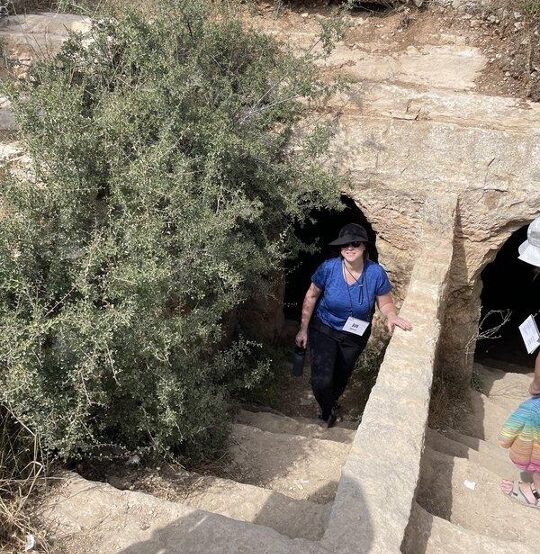
A few years ago, I was in the Holy Land with Clal’s Stand and See program, and we stopped at the ruins of an ancient mikveh.
I was standing in someone else’s holy place, and I have learned by now to take my shoes off in rooms that are not mine. Our guide, a rabbi, walked us through what the basin had once held. I learned that a mikveh is a ritual bath, fed by mayim chayim, living water, water that has to come from a flowing source rather than poured from a vessel. People immerse, he explained, in seasons of transition. Brides before weddings. People moving from one state of life into another. Converts coming into the tradition. Men and women across a lifetime, marking the turn from one season into the next. And the part that stayed with me, the part I have been turning over ever since, is that people go to the mikveh more than once. We don’t transition only once. It’s like the structure and the water becomes familiar with the person entering. Almost like we’re named by the water.
I walked down the stone steps. They were warm under my hand, smoothed by centuries of bodies that had made the same descent. The basin was dry. The living water that had once gathered there had moved or receded or simply gone, and the stone was empty, and the imagining was real and palpable. I stood at the bottom of an empty mikveh and tried to feel what it would have felt like to enter into water that knew my name.
I didn’t learn it then—I learned it later, slowly, the way I think most spiritual things get learned—but the empty mikveh was teaching me something my own tradition had told me in a different vocabulary, and standing in someone else’s holy place was, somehow, how I finally heard it.
My tradition has its own water. Christians are baptized, and I have been, and I love that water. But the way I had been taught to think about baptism was once-and-done, a single immersion that stood for the whole life. The dry stone basin in the Judean hillside was telling me something my baptism, by itself, hadn’t quite gotten through. That the immersion is once, and also again. That the dress comes off, and goes back on, and comes off again, and the water gathers each time, and the moment is holy each time. The Hebrew word mikveh means a gathering of water, and it is also, in the prophets, a word for hope. The same word. A pool and a hope. As if to say, the place where we go to be made new is also the name of the thing we feel when we immerse, trusting that what gathered before will gather again.
I am still descending. Most days I think I’m just now learning where the steps are.
Some of what I know about my own faith, I learned because a tradition not my own opened a door and let me look through. That’s the gift of pluralism. Not that we become each other; that we see ourselves, sometimes for the first time, by the light of a lamp someone else lit. The mikveh did not stop being Jewish when I stood in it. I did not stop being Christian when I entered. What happened was that I borrowed, with permission and reverence, an image my own tradition had been trying to give me, and only when I heard it in someone else’s language did I finally understand what my own had been saying.
The garments, friend, can come off. Not all at once. Not on a schedule. Not by anyone’s force but your own, when you finally believe you’ll still be loved without them.
The basin is there. Sometimes the water is there too, and sometimes you descend and find it dry, and you stand in the empty stone and trust that what gathered before will gather again. Both rituals count. Both are holy. The body that’s been suffocating in the dress, the one that knew before the mind did, the one that’s been waiting a long time to breathe, that body is allowed to walk down the steps. As many times as it takes. For as long as a life is long.
Photo: Coming up from the stone, on a path the patriarchs walked, from Rev. Jill Harman