
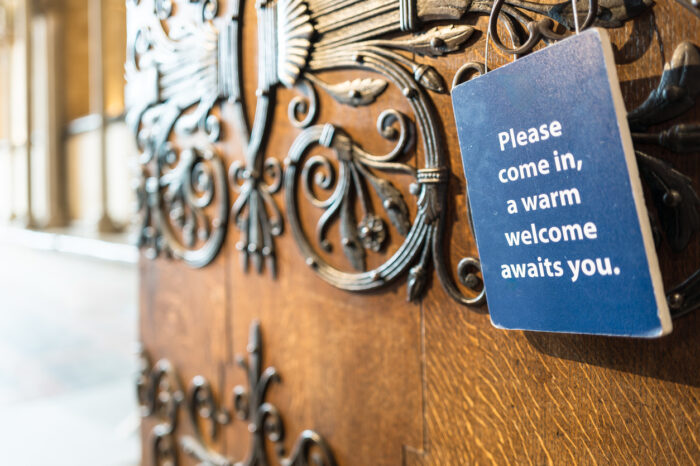
The most important thing I’ve learned about welcome, I learned from a girl named Marcella and a moment I almost got completely wrong.
She’d come to the front desk of the community center where I worked as a restorative justice coordinator, and she’d said some choice things and made some choice gestures, and I’d been called down to sort it out. I told her I wanted to hear her side of things, that her voice mattered, that I wasn’t there to prosecute her. But she kept her eyes fixed on the floor, her heels dug in, her whole body braced for whatever was coming next. I asked her to look up at me. She refused. So I told her we could try again tomorrow and left it at that.
I didn’t see Marcella for weeks. When I finally ran into her cousin and asked what had happened to her, he told me she was afraid to come back. I remember thinking, afraid of what exactly? I mean, all she had to do was show up and talk to me. It’s not like I asked her to sign over her firstborn child or anything. I said, “What do you mean?” and he said, “You asked her to look you in the eye.” I was still processing why that was a problem when he told me the rest. The last time an adult had asked Marcella to look them in the eye and she did, it was her mother telling her she was leaving, that Marcella couldn’t come with her, and that she was never coming back.
Marcella didn’t know how to be in a space with adults because every adult space she’d ever inhabited had been rooted in fear and disappointment. She came in braced because that was the only thing her experience had taught her to do. And what did I do? I judged her for it. I decided she was being difficult before I ever got curious about why.
As the great Ted Lasso might say, “Be curious, not judgmental.” I used to think that was a great TV line and a good way to maneuver through life, but now I’m convinced it’s more than that. It’s good theology. And it’s the lesson Marcella taught me without knowing she was teaching me anything at all.
I eventually found her and apologized. And I’ve carried what she gave me into every circle, every classroom, and every hard conversation since.
In a culture that moves fast and judges faster, we’ve learned to perform certainty, because uncertainty looks like carelessness, and carelessness invites verdict. So we brace ourselves before we even walk through the door, the way Marcella did, the way I imagine most of us have done in spaces where the warmth of the room was still an open question.
Some spaces welcome presence. Other spaces welcome conformity.
I’ve been turning that over in my mind for a long time now, because I think it names something I felt long before I knew how to say it. I’ve felt it in religious spaces and professional ones, in communities I love and communities I have left. There are spaces that open their doors and make me feel received, and then there are spaces that open their doors but already have a shape in mind for who I should become once I step inside. That difference isn’t always obvious at first. Sometimes a place feels warm and generous and full of good people, and sometimes it really is all of those things. And still, over time, something in me begins to notice that the welcome is leaning somewhere. It has a direction to it, a quiet belief that closeness will eventually soften you into someone easier to claim.
That’s where the ache begins: Even when that pressure is gentle, it changes the feeling of the room. Something in me stops being able to rest, because I’m no longer sure whether the kindness is meant for who I am or for who someone hopes I’ll become. That makes it very hard to stay.
Marcella sent me back to my own tradition looking for an image that could hold what I had learned in that community center hallway. I found it in the Gospel of Luke, in the story of Jesus and Zacchaeus. Zacchaeus was a Jewish tax collector for Rome, widely considered a traitor to his own people. He overcharged his neighbors and pocketed the difference. Not exactly popular. Yet Jesus looked up into a sycamore tree to where Zacchaeus was perched and, out of all the crowd that had gathered to see him, told Zacchaeus that he would come to his house that day. The crowd whispered openly that Jesus had chosen to be the guest of a sinner. It was a scandal.
And Jesus went anyway, without conditions, without a checklist, before Zacchaeus had changed a single thing about himself. Jesus didn’t judge Zacchaeus from the ground. He looked up at him. And it’s precisely that reception, being seen and claimed before any transformation, that undoes Zacchaeus from the inside out. He stands up and gives away half of everything he owns, repaying everyone he cheated four times over. The welcome comes before the change. The change comes because of the welcome. Curiosity, it turns out, is its own kind of grace.
I’ll be honest: When I first stepped into Jewish spaces through my work with Clal, I wasn’t sure how I’d be received. I’m a Christian pastor, and I come from a tradition that has not always been a kind neighbor to the Jewish people. I didn’t know what my presence would mean in those rooms, whether it would be welcomed or merely tolerated. And truthfully, I wouldn’t have blamed anyone one bit. I walked in carrying that uncertainty the way you carry something you’re hoping no one will notice.
One of the first people I was dropped into a Zoom room with after my introduction to Clal was Rabbi Elan Babchuck. I was just hoping for the best. And I sure got it.
Elan is the kind of person who makes room for things without making a fuss about it. Which is probably why, after enough Zoom calls and enough honest conversation, I declared him my best friend in an email. He took it in stride, as he does. (Maybe just don’t ask him about it…) He has never once tried to persuade me toward his tradition or suggested that what I believe is misguided, even though he’d be well within his rights to raise an eyebrow. He listens to what I bring and honors it, stays genuinely curious about what I carry, and lets me stay genuinely curious about what he carries. Together, we’ve spent a lot of time working on Coming Home to Covenant, a Jewish-Christian dialogue curriculum we’ve been building alongside a remarkable team of rabbis and pastors at Clal.
Elan didn’t hand me a clipboard or steer me toward a volunteer list. In many Protestant churches, welcoming a visitor and putting them to work are practically the same gesture—you’re barely through the door before someone needs you to staff the potluck. Instead, I was met with genuine curiosity and care, asked real questions about my own tradition without any agenda attached to them, and given something I didn’t know had a name until I experienced its absence elsewhere: the permission to not know. In those conversations, not knowing wasn’t a deficit to be corrected or a gap to be quickly filled. It was simply where we began, and it was treated as something sacred rather than something embarrassing.
I think all of that curiosity and all of that grace makes it possible for something holy to happen.
That kind of welcome feels different in the body. It lets a person unclench, lets the spirit stop bracing itself, and feels less like being handled and more like being trusted. When a person or a community is so rooted in who they are, they don’t need you to become them. That rootedness creates spaciousness. Unlike the welcome that requires you to become someone else at the door, this one simply stays open and lets you remain intact while still being genuinely changed by the encounter. We need to cultivate this kind of welcome.
Marcella taught me that judgment closes a room before anyone has had a chance to settle into it. Elan and the community at Clal taught me that curiosity does the opposite; it opens the windows, lets the air in, and creates enough space for two people from completely different worlds to find something true and shared between them. Both of those lessons live in me now, and both of them shape the kind of space I’m trying to build wherever I go.