
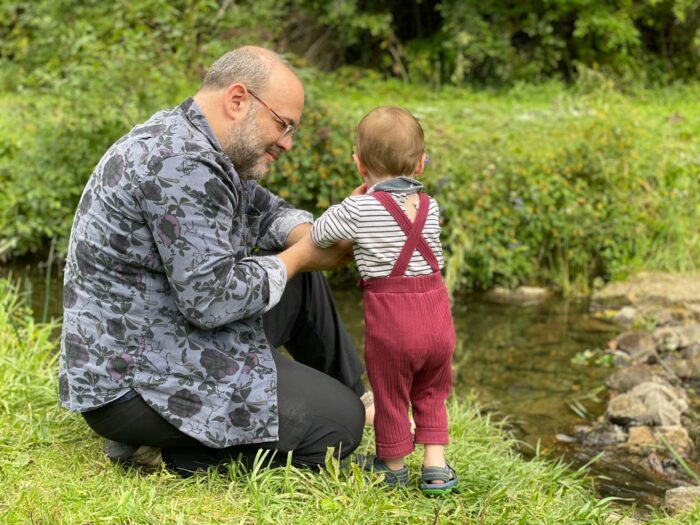
I never wanted to be a father.
People can offer explanations if they need them. Perhaps because I grew up in an Ultra-Orthodox family and, as the second of seven children, I raised my five younger siblings. In that sense, I had already played the role of father. Or perhaps because I believe this is my first incarnation in a male body after many lifetimes as a woman. As a Jewish religious woman, I was measured solely by the children I brought into the world and how I raised them. My worth existed only in that role—a mother, not a woman. This time, being born as a man meant I could finally be for myself, not defined by my role as a mother. There was a deep fear that a child would take that from me—would strip away the self I was only beginning to claim.
There is something else: from our fourth date, I knew with absolute faith that Annika and I were meant for a deep partnership. And I knew she needed to be a mother—it is her essence. I lived with this knowledge for nearly a decade—waiting for the day Annika would say the words I knew were coming: I need to become a mother now. And I knew that when she said those words, life would demand that I become a father.
This is what faith means to me. The knowledge that deep in my core I do not want to be a father, coupled with the absolute certainty that I must be with Annika, teaches me that life itself knows I need to be a father. Faith is not surrender of self—it is learning to be a father from a place I have never known in my past incarnations, a place that demands my whole self, not my absence.
When we began preparing for the pregnancy, I made a specific request. I asked Annika that we bring the soul of Rabbi Zusha into the world. To some this might sound esoteric, but having grown up in the Hasidic-mystical world, it made sense to me. Because I knew what my task in fatherhood would be. I knew I needed to ask for the soul of an ancestor who would match the unique journey of fatherhood I was meant to travel.
Unlike most Hasidic Tzadikim (saints), whose names are given to countless children, very few are named Zusha, after the mystic Rabbi Zusha (1718–1800). His personality was not typical because he could not learn Torah in the traditional way. When he tried to study, he would become transfixed by a single letter or word—so moved by its uniqueness that he would dance, unable to contain the intensity of his physical response to the text. The study hall would expel him. To the community, he was disabled. But his disability was his gift. He saw the world—and each person—as utterly unique. He recognized the singular beauty in those whom society had rendered invisible.
Zusha chose to live as a wanderer for twenty years, wearing no clothes that marked him as a rabbi, living simply in nature. When he arrived in towns with Jewish communities, he confronted wealthy Jewish households where servants—poor women, both Jewish and non-Jewish— were being exploited physically and sexually and were unable to speak against their abusers. He fought for the vulnerable, insisting they be allowed to be who they were, when no one else would.
During the pregnancy, I met an Ultra-Orthodox mystic who, without knowing me, shared that Rabbi Zusha had chosen to return to the world after many generations—as my child. Later, in one of my mystical journeys, I encountered the souls of women from the eighteenth century—the very women who Rabbi Zusha had protected and fought for—and they taught me the secrets of the energy of each letter in his name. This energy is the gift my little Zusha carries into the world. My duty as his father is to honor it, nurture it, and step aside so it can unfold.
But my fatherhood demands an even greater leap of faith. My son, little Zusha, was born with a brain injury. I was given the task of giving him the best possible chance to grow. Yet I am unsure what growth means. He will grow with me and without me. I want him to have every physical tool, every cognitive and emotional resource possible. But how much should I push? And how much should I have faith in life that he is exactly who life wants him to be?
For the first two years of Zusha’s life, I wore a military mindset. In the first weeks of Zusha’s life, when he was fighting for survival, I stepped back into the mental uniform I knew from my years in the Israeli military, when I stood close to death. I established a command center in the hospital. In Philadelphia, it isn’t customary for parents to stay overnight in the NICU, but I informed them I was moving in. Zusha’s body was covered in bandages, electrodes, tubes. I kept my fingers on the small patches of exposed skin on his stomach so he could feel his father, feel my belief that he would survive. For two years, I operated as commander of a military unit, managing the endless list of doctors, tests, insurances, treatments.
But now I realize that this way of being—which I thought was required of me—does not serve me or allow me to be the father Zusha needs. I am learning, with great fear and trembling, to take off my uniform. The military posture protected me. It allowed me to function in an unbearable situation—to fight for Zusha, to navigate his care, to secure what he needed. But it also allowed me to believe I could fix his brain injury, that through hard work and faith in life, he would become a standard child. This mental armor was impervious to despair, but it prevented me from feeling the grief of fathering a child with special needs.
There is a story about Rabbi Zusha. According to Zusha’s teaching, after his death, the Divine will not ask him why he wasn’t sacred and a leader like our father Abraham, our mother Rachel, Maimonides, or any other great one. Instead, the Divine will ask: Why weren’t you yourself, Zusha? I think this story is also about Zusha’s father, and perhaps all fathers. Like every Hasidic Jewish father, Reb Zusha’s father prayed his son would be a great scholar, a genius like his brother, Rabbi Elimelech. But the story teaches something else: I must not want my Zusha to be anyone but himself.
Maybe he will be a Zusha who speaks with some words. Maybe he will be a Zusha who speaks through a gaze, through touch. He may never quote poetry or Talmud. But he might teach me how to treat trees and animals with compassion. He just needs to be Zusha.
Now I work on believing in him. I am learning to open my clenched fist—the one that wants to hold a specific dream of who he should become—and let it go. Every night, as I lie down beside him, I practice a meditation inspired by Rabbi Chaim of Sanz, of letting go. I imagine that tomorrow morning Zusha might not be with me. That Annika might not be with me. The pain of that thought breaks me open.
This nightly practice insists that I face my deepest fears. It teaches me that despite everything in me that did not want to be a father, this small boy is the greatest teacher I have ever met. He is teaching me what it means to be a father who finds faith in the messy, broken, beautiful reality of a son who is exactly who he is meant to be.