
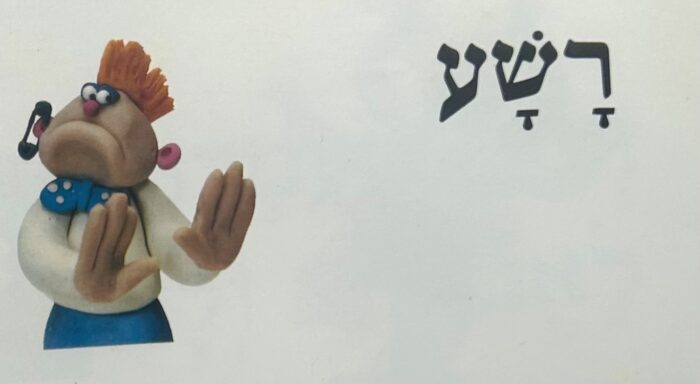
Photo of the “Wicked Child” from Rony Oren’s “The Animated Haggadah
The conversation that starts this story may be familiar to you if you observe the High Holidays and also a) have ever had a teenager, or b) have ever been a teenager.
Yom Kippur fell on a Monday this year, in the very first weeks of the school term, and our youngest daughter had just changed schools. She was starting tenth grade, the first year that report cards count toward college applications in France. The idea of missing class left her feeling anxious and upset.
Her lobbying not to go to Yom Kippur services began early and went hard. This was new for me. Sure, she’s done her share of grumbling about going to synagogue, but she’d never suggested that she might just skip a holiday entirely. But of course she’s never been about to turn sixteen. As Yom Kippur approached, she was more and more adamant. Things came to a head in the Paris metro on the way home from Kol Nidre. “This is important to you, not me,” she kept saying, “I just don’t care that much about missing services—I care about school! Look, what if you just tell me about it afterward?”
By the time we got home, we were both steaming. “Anyway,” she tossed out at me, right before she stormed into the bathroom and slammed the door, “if I do just get up and go to school in the morning, it’s not like you can stop me.”
Standing alone in the silence she left in her wake, I was forced to admit to myself that she was right. What was I going to do, physically tackle her and drag her to shul?
Tears pricked my eyes. I had a moment of longing for years gone by, when all of this was simpler. A colorful memory of Passover popped into my mind, of watching my daughter chant the four questions for the first time ever, clutching a beloved children’s Haggadah, which you may know if you grew up in the 1980s: It’s called The Animated Haggadah, and it is illustrated with Rony Oren’s delightful Claymation figures. It had been my favorite as a child and it was also hers. Now, a decade later, the joy and astonishment I had felt at hearing her sing the four questions felt tinged with frustration and regret—would I have kvelled so much if I had known what lay ahead, if I had understood there’s no guarantee at any point along the way that any of the traditions I try to pass on will actually matter?
The words my daughter had said on the way home from Kol Nidre replayed in my mind, now against the backdrop of the Passover seder, and something awful occurred to me. Tonight, she had said, This is important to you, not me.
Oh my God, I thought, I have the wicked child.
In my mind’s eye, I pictured the Rony Oren illustration of that particular page in the Haggadah, with the four children: wise, wicked, simple, and unable to ask. Gloomily, I recited the part about the wicked child to myself.
The wicked child says, “What is this service to you?”
“To you,” he says, not to him.
With this, he sets himself apart from the community,
and you must set his teeth on edge and tell him,
“Because of this the LORD acted for me when I came out of Egypt.”
“For me, and not for you; for had you been there you would not have been redeemed.”
I do not think I have ever cried around my daughter, certainly not like I wept as those words ballooned into my mind. I’ve failed, I thought. Somehow, I have failed to transmit any of this to her.
My daughter heard me weeping and burst out of the bathroom. “Mom, what’s wrong?” she cried. My sweet daughter—who even in her anger and rebellion had held onto her rachmones, put her arms around me and repeated, “Mom, what’s wrong?” I searched for the words to answer her question. The memory of the Animated Haggadah was still in my mind, and all of a sudden I remembered something marvelous about Rony Oren’s illustrations: He does not depict different children for the story; he shows the same child each time. The stance and facial expression change, but the child does not. As I thought about that funny little clay figure, the story of the four children hit me in a new way.
Haggadah commentaries frequently note that the four children are supposed to represent facets of our own selves, but it had never occurred to me to think of them as facets of our own children. If you’ve ever read this part of the Haggadah aloud at a seder, it’s likely you put on a scolding, serious tone when you read the parent’s response to the wicked child. It’s natural. We’ve all been there. Your kid is acting like a jerk, you’ve got a whole seder to do, so you snap at them.
But is that really how we wish (in the loftiest parts of ourselves, at least) to speak to our children? Looking at that kid Oren depicts, in his little blue bow-tie and special-for-the-holidays button-down shirt, my parent heart melts. Sure, the wicked son looks pretty cranky; he’s spiked his hair up into a mohawk and there’s a safety pin in his ear, but he’s had the rachmones to make his family happy and put on his tie; he’s still somebody’s sweet boy.
Had you been there, you would not have been redeemed. I rewound the lines in my head and spoke them to myself again, but gently this time. Suddenly, I saw the thread of my own sadness stretching back further and further through our people’s history, all the way to Egypt. Imagine, if you will, being a parent on that day: After a lifetime of brutal bondage, you are given the opportunity to stand up and leave, to depart for a new life of freedom. You are given the opportunity to walk toward freedom with your own beloved child. But that child is no longer a little kid; you cannot pick them up and carry them. Each one of you must choose to go. Imagine a parent in that moment, beckoning toward freedom, and hearing the child say, “This is not for me.”
The text is usually translated as to “set your child’s teeth on edge,” but a more literal translation is to “blunt your child’s teeth.” The verb used, 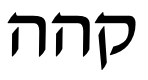 , khh, can mean “to blunt,” but it can also mean “to refute, to break the power of, to [cause to] grieve.” I love this. Your teenager is angry, they’re anxious, they’re annoyed… but there’s something important at stake. You’ve got a sacred thread of freedom to pass on to the next generation, in the form of a jangly, gangly, chompy teenager who doesn’t measure time like you do—who’s in fact just discovering how to live. So how do you keep them from snapping the thread? How do you take away the bite?
Rabbi Yehuda Aryeh Leib Alter of Ger, a 19th-century Chasidic Torah commentator also known as the Sefat Emet, wrote that the wicked child’s rejection is rooted in his pragmatic attachment to an idea of himself as nothing more than flesh and blood: He does not feel he has sechel k’rau’i 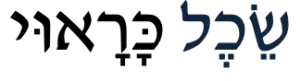 — which you can translate as the proper intellect, but also a calling, a message. In other words, the “right” connection to the Divine. The child’s main feeling, in the eyes of the Sefat Emet, is one of unworthiness: What lump of a human could possibly merit divine
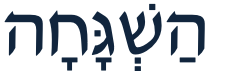 hashgacha, God’s infinite and individual attention and presence to every living thing in the universe?
My daughter and I were both stuck in this flesh-and-bloodness, she because she’s at a phase in life where the pragmatic, flesh-and-blood considerations of her existence are calling to her loudly (what should I study, where should I go, who should I hang around with, what should I look like, etc.). As for me, I’m definitely also at peak lump: a mom, trying to get her kid to do a thing. And failing. And we together? Well, in moments like these, the question of the “right” connection to the Divine becomes kind of gigantically scary and too big to cope with, thank you very much, Rabbi Yehuda Aryeh Leib Alter of Ger. Feeling God’s infinite and individual presence is hard when you are a teenager or trying to parent one.
To this, the Sefat Emet has a gentle response: He teaches that precisely by virtue of being flesh and blood, and not having the ideal intellect, and trying to be of service anyway, we are more precious to God than the holiest angels.
Standing there with Rony Oren’s lumpy, expressive bits of clay in the back of my mind, I looked at my beautiful, rebellious daughter and gave in to my own lumpiness. I dropped all of my excellent arguments and instead attempted to blunt the bite with my own, honest feelings. At heart, I believe these are a version of the words of the parent of the wicked child, reframed only in tone: “Maybe not you, but this is what the LORD does for me.”
I admitted I wasn’t sure I had all the words to describe why Yom Kippur is so special that it’s worth missing school for. And I admitted that that was actually my point. Sure, I could explain the experience in a million ways—okay, fine, I had explained them in a million ways—but really, the thing I wanted her to experience sat somewhere beyond words and explanations. Recalling , that root for the word of blunting, as also a form of grief, I admitted my grief to her. I hadn’t ever wanted to make our Jewishness about the losses of the past, but we are from a family of Holocaust survivors, and I am tormented by the fear of letting that thread drop—not only for our own ancestors, but for everyone who has been oppressed and yearned for freedom. Remembering 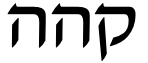 as blunting, I clumsily shared my conviction that the point of Yom Kippur is to blunt the threat of that loss, to hold still for a day and remember the real point of our existence: tiredly, hungrily, to participate in the project of building a world that prizes each and every human’s lumpy, flesh-and-blood self as equally precious.
And then, like the parent in Egypt, I stood back and admitted the scariest thing of all. Yes, my beloved child, you are no longer just my child. You are a bat mitzvah, a religious adult. Right now, and every day, these choices are yours.