
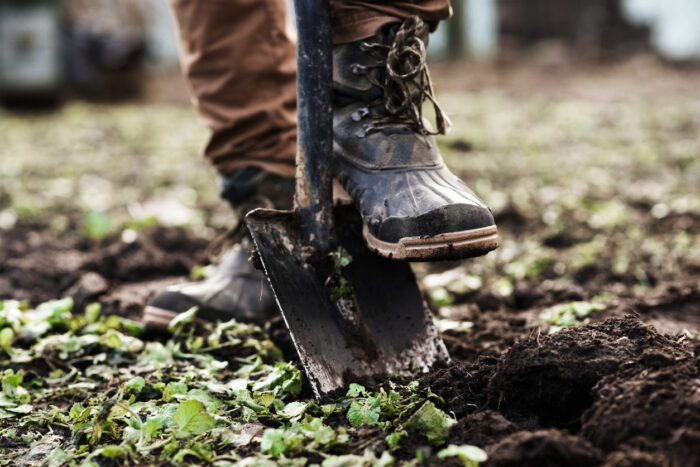
It was a cold winter day during my first few years as a rabbi, at one of the most heartbreaking funerals—a young mother unexpectedly killed by a rare postpartum complication. I found myself struck by one of the simplest and most beautiful traditions in Jewish life. As we stood together at the graveside, I invited those gathered to take turns shoveling earth into the grave.
In Judaism, this act is considered chesed shel emet—an act of true, unconditional lovingkindness, offered without any expectation of return. There is something profoundly moving about asking people who are grieving to take a shovel in their own hands and participate in laying their loved one to rest. An ordinary shovel becomes an instrument of mitzvah, a tangible expression of one of our deepest Jewish commitments: caring for the deceased with tenderness and dignity, even in death.
In this week’s Torah portion, Toldot, the shovel also becomes an instrument of a different but related sacred work. We encounter Isaac, the bridge patriarch. Like his father before him and his son after him, Isaac experiences famine and must journey in search of sustenance. God instructs him to settle in Gerar, a familiar place to Isaac because his father Abraham had once lived and dug wells there. But upon returning, Isaac discovers that the Philistines have stopped up those wells in the years since Abraham’s death. Rather than abandon them, Isaac takes up the work of his father and begins to dig again:
“Isaac dug anew the wells which had been dug in the days of his father Abraham and which the Philistines had stopped up after Abraham’s death; and he gave them the same names that his father had given them.” (Genesis 26:18)

Commenting on this verse, the nineteenth-century Torah commentator Malbim offers a fascinating interpretation. He explains that the wells Abraham dug were not merely sources of physical water; they also carried a hidden spiritual dimension. The wells Abraham dug were earthly expressions of those spiritual channels through which divine blessing could flow into the world.
Isaac’s decision to dig these wells again, then, was about much more than reclaiming a source of water: He was restoring a spiritual inheritance. Through the most ordinary of physical acts—digging into the earth with a shovel—Isaac reconnects with the spiritual legacy of his father, recovering the blessings that Abraham had brought into the world.
The material and the spiritual are not separate realms in this understanding. The work of our hands can become a way of accessing and transmitting the deepest gifts of those who came before us into our souls and onto the next generation.
But Malbim goes further. He writes:
“Isaac drew forth the waters of lovingkindness from the depths through the power of Abraham, and restored the channels of blessing to their proper places. He perceived the workings of God…”
Isaac does not simply recreate what Abraham had done. He brings something of his own to the work. Drawing on Abraham’s spiritual legacy, Isaac is able to restore the flow of divine chesed into the world. He takes what he has inherited and makes it alive again. The wells may have been dug by his father, but it is Isaac who must reopen them. Legacy, in this reading, is not simply something we receive; it is something we must actively tend and renew in our own unique way in order to pass it down.
Let’s return to the image of the shovel at a graveside. There, too, we take up an ordinary tool and perform an extraordinary act. Anyone who has grieved knows we cannot undo the loss, nor can we change the past. But we can take responsibility for the sacred work that remains before us in a very literal and embodied way in the dirt, just as Isaac did before us.
Perhaps this is what it means to inherit well. We do not simply stand beside the wells our ancestors dug, grateful that they once flowed. We have to be willing to pick up the shovel ourselves. Sometimes the work of holiness is not about creating something entirely new, but about reopening what has been closed, restoring what has been interrupted, and allowing the waters of blessing to flow once again. That is the work of our hands, and the responsibility of each generation.