I recently visited my father who suffers from dementia and is living with hospice care. I initially approached my visits with the question, “What needs to be done?” Very quickly I realized that there is nothing to be done except to be present. I can’t change the physical situation in which he lives. Those are decisions I have not been involved with for years.
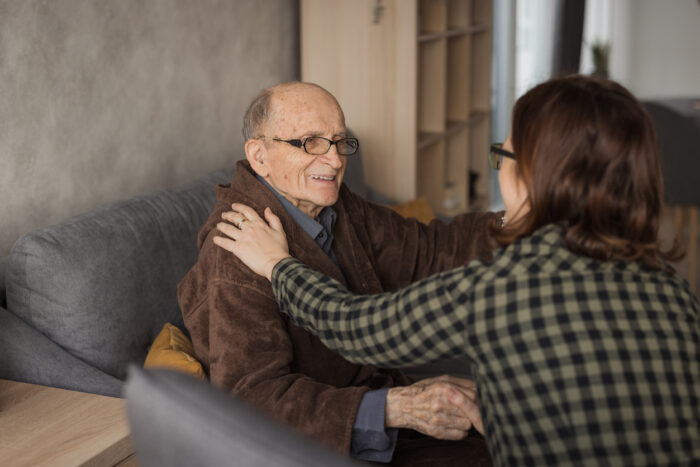
I could only show up. When I brought my father some candy that I knew he would like and held his hand, I felt like I was doing something that mattered. I was present and I believe my presence brought him joy. At least it felt that way when I looked into his eyes and felt him squeeze my hand.
There are stories in the Talmud about healthy rabbis visiting rabbis who are ill and miraculously healing them. The fifth page of Tractate Berachot is my favorite and I hold it close as I wrestle with my feelings about my father’s suffering.
On the first side of the folio page (BT Berachot 5a), a discussion of the suffering of the righteous concludes that suffering with no explanation is “yesurin shel ahavah,” or “afflictions of [God’s] love.” This is an extraordinarily difficult theological position. Which is it? Because God loves us we are suffering? In our suffering, somewhere, we can find God’s love? It is unclear and challenging.
Then, one turns the page and on the back side are three different stories of rabbis falling ill and being visited by other rabbis. Each story follows a pattern. First, the visiting rabbi asks the sick rabbi something like, “Are you enjoying your suffering?” Next, the sick rabbi rejects the theology of the previous page. He answers: “I don’t want the suffering and I don’t want its reward!”
The visiting rabbi does not then argue with the other, even though this would be the usual Talmudic approach! The healthy rabbi doesn’t try to teach the ill rabbi about God’s ways and wisdom or the gifts of suffering. Instead, the visiting rabbi responds with a request to hold the other rabbi’s hand. And then the vignette ends with the statement that the visiting rabbi “lifted up” the ill rabbi. You can interpret this in one of two ways: Either the healthy one helped the other to literally stand up or change his position, or, as it is traditionally interpreted, the healthy rabbi healed the sick one.
In another tractate in the Talmud, we have this statement: “Rav Acha bar Chanina said: Anyone who visits an ill person takes from him one-sixtieth of his suffering” (BT Nedarim 39b). Of course, another rabbi follows up with the question of why don’t we then send in sixty rabbis and heal any ill person? No, answers Rav Acha, each person takes one-sixtieth of the suffering that is present.
It’s not magic. It’s not miraculous. I interpret this as a truth of life. Companionship and dedicated presence bring people relief. There are many times when I am the sick person lying in a dark room, focused on my pain and unable to see anything beyond my own suffering. When my husband comes in to bring my tea, or one of my adult children climbs into bed beside me to watch a video or read to me, my attention shifts. At that moment my pain recedes. It is still present. I am not miraculously cured, although that would be really nice. My visitor refocuses my attention. The life and love of the person visiting me in my suffering lifts me up. They lift my attention from the place of pain to a place of pleasure and vitality.
That first page of Talmud—Berachot 5a—relates the stage of diagnosis and treatment. “If a person sees that suffering has befallen him, he should examine his actions”(BT Berachot 5a).
The first thing we do when we are not feeling well is reflect on our actions: What did I do, or what did I neglect? When there is no clear-cut answer leading to a cure, then the rabbis offer the phenomenon of “sufferings of [God’s] love.”
Sitting in front of a book and around a table, it is easy to philosophize on the meaning of life events. Yet, it is troubling, even for the rabbis, to say that human suffering is a result of divine love. They make the statement and then reject it when they are no longer in the study-hall but at the sick-bed. Each sick rabbi states: “I don’t want the suffering and I don’t want its reward [of God’s love].”
The only meaningful interpretation of “yesurin shel ahavah” that I know is the experience of being in physical pain and feeling loved at the same time. Where there is no cure, there can still be relief.
As someone who lives with Crohn’s disease, whenever I feel ill, the first thing I do is ask myself, what did I eat? What did I do that caused this flare-up? I’m seeking out diagnosis and treatment. As I wrestle with the results of Crohn’s disease, I become isolated. It seems like it is my burden alone to carry and no one can help me relieve it. So I move from my bed to the bathroom and back. Often plans get canceled. I stay home alone.
My resistance to the pain causes my suffering. I’m working to shift from blaming myself for my suffering to remembering that I have a disease. There is nothing to be changed about that. It is currently incurable. All I can do is shift my attention to practices that bring me relief.
Receiving a visitor shifts my attention to the world beyond my interior life. Remembering that there are many people in the world who suffer from inflammatory bowel disease helps some. Remembering that I am loved by many people in the world and my suffering will subside when I connect with them is the best cure. Now, to me “yesurin shel ahavah” means: Suffering attached to love. Suffering overshadowed by love. Love stronger than suffering. Love stronger than death.
At this point, my father’s condition has no cure. No care or medical treatment will change the trajectory of his life. He is dying. He is cared for and loved, and he is dying. The only thing I can do is hold his hand, try to make him smile and laugh, and remind him that he is loved.
I could visit sixty times and it wouldn’t change the course of his life. Except, as Rav Acha taught, every visitor he receives will relieve his suffering in the moment. Every visit can be an expression of divine love and the power of life’s blessings to bring relief—even to a terminal condition. No magic cures. Just love. Human love or divine love—call it what you want. My dad never believed in God but I know he believed in family. I pray that each time a family member or friend visits, my father remembers he is loved. May love relieve the suffering of all who are ill. I don’t pray for miracles. I pray for love.