
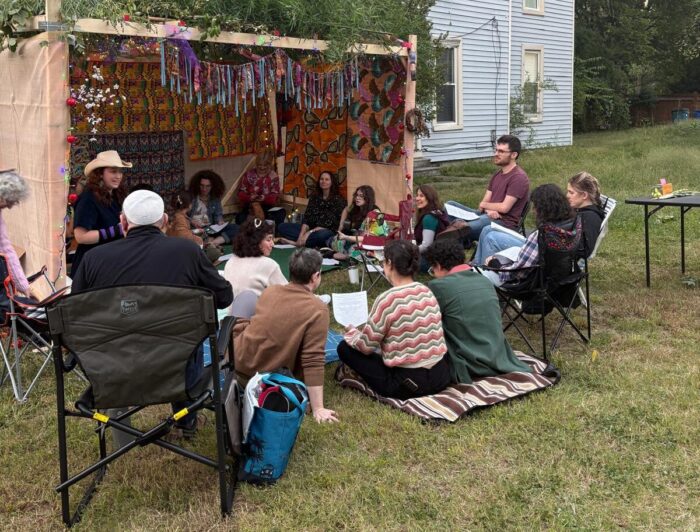
Last week, I led a song circle after Kol Nidre at my home synagogue. My friend and I set up a classroom with lanterns, fake candles, tapestries, and pillows. The vibe was cozy, warm, and welcoming. After the two services in the building ended, people trickled in for an extra hour of heartfelt song. It felt truly magical. There was one person, however, who wasn’t singing along. This friend, whose wife brings her to many a song circle of mine, and has never opened her mouth to sing a single note at any of them. In my early songleading days, this one person not singing in a room of forty people would have driven me mad. Last night, though, it didn’t bother me at all.
In my early years as a songleader, I’d feel like a failure if fewer than 100% of participants were singing. I had learned the tricks and the lingo: call-outs, call-and-response, body cues (a raised eyebrow, a shrugged shoulder), varying my volume and my tone. If people still weren’t singing, what was wrong with me? I wasn’t doing my job! I’d leave those rooms defeated, sure that I let everyone down.
Especially “that guy.” There was always at least one person, usually male but not always, who would spend the whole service or song circle arms folded, body stiff, looking bored or downright hostile. The negativity bias in my brain always drew me to that guy. Why couldn’t I “crack him?” Why did he refuse to sing? It would devastate me, even if he was the only quiet one in the bunch.
But I started to notice: That guy would almost always come up to me afterward and tell me how much he enjoyed it. The more it happened, the more I started to rethink my whole metric for measuring success. Because wasn’t the singing a means to an end, and not the end itself? Singing is a tool to get to the heart. That’s what we’re actually aiming for. And there are other ways to get to the heart, including listening.
In her book The Awakened Brain, researcher Dr. Lisa Miller describes a study which included participants describing spiritual experiences while being scanned by fMRI. The results of the study are fascinating (and you can read about them here) but what participants shared is equally as important. Most of the stories, she explained, fell into two categories: 1) in nature, with a focus on sight, and 2) religious experiences, with a focus on sound. (The rest were mostly experiences of “collective effervescence,” such as concerts, sports games, etc). Cathedral organs, Tibetan singing bowls, gospel choirs; the way to the heart in these instances is through listening. Expressive, devotional, virtuosic music can cut through the inner and outer noise, bringing the listener into the depth of the present. If spirituality is, as Dr. Miller defines it, “a transcendent experience of something bigger than oneself,” surely hearing such sounds can be a pathway to the spirit as much as seeing a beautiful sunset or hiking a mountain.
But in the Jewish prayer settings where I often find myself, there aren’t so many opportunities to listen. Not intentionally, anyway. While for some communities, and certainly in a different era, Jewish prayer meant listening to a chazzan vocalize beautifully, I wonder if the pendulum has swung too far in the other direction. In some spaces I pray, people feel like if they aren’t singing, they aren’t praying, so they sing along with everything. Even the parts that are “listening moments,” like nusach, the musical modes that change with the time of day, week, and year. Nusach is like the recitative in an opera—the spoken parts that weave between the melodies, more spoken in nature. Each prayer leader has their own style, given that they are expressing from their own hearts. When folks try to sing along, however, part of the magic of nusach is lost. It becomes another melody, with predictable meter and rhythm, and the chance to feel spirit through listening falls away.
This, I must admit, frustrates me, both as a leader and as a pray-er myself. Before the singing circle, I attended Kol Nidre, where my friend led beautifully. The melody of Kol Nidre is haunting and powerful, more heart-opening, at least to me, than the liturgy itself. I wanted so much to hear my friend sing these words, in her own way, from her own soul, and let her beautiful voice bring me into the sacred present. I couldn’t do that, however, because a third of the room tried to sing along!
So, on the one hand, we have the challenge of folks who don’t, or won’t, sing in prayer spaces, no matter how many songleading techniques are brought to the fore. On the other hand, we have the challenge of folks singing along in moments where listening might actually be the more spiritual mode of engagement. Both challenges can be addressed with a change of thinking, a change in what we think “participation” and “praying” actually is. Because the song is not the prayer. The melody is not the prayer, the words of the prayer book aren’t even the prayer. Prayer is heart-work. This is what I remind myself and those I pray with every time I lead. Prayer is heart-work, the act of opening and softening the heart, and you already have everything you need to do that.
So while I do encourage people to sing along, even if they don’t know the words or melody (which is a whole different set of shtick I do, perhaps for another essay), I also know that even with all my songleading techniques, there are people who won’t sing. Looking out at their faces, lips unmoving, I remind myself that prayer is heart-work, and I let the frustration go. I cannot judge their inner life, thank goodness. That is for them alone. Singing is not the only way to pray.
And I also make it clear when it is time to listen, inviting pray-ers to let the sound bring them into the present. Clear instructions can help put people at ease, to unclench and loosen—the necessary posture for an open heart. Whether someone is prone to sing all the time or not at all, these invitations and permissions make it clear: You are welcome here. You can participate in whatever way you want. You can even pray, just as you are. No prayer experience needed.
After the song circle last night, people came up to me to share how meaningful it was to them. I of course was so grateful for their kind words, But out of all the kind words, the ones that meant the most to me were from the one never-singing friend. On her way out, she looked at me with a huge smile on her face and said, “You can participate by listening! Best thing you’ve ever said.” I beamed.
May the songs we encounter, whether we sing them aloud or let them fill our ears, be passageways into the present moment, into a more open heart, and into the sacred.