I hate lying to my kids.
Last night, we were on our way to a temple on the East Side of Providence to celebrate Havdalah with my daughter’s school community. We were looking forward to singing together, good food, and familiar faces. A joyful and communal way to welcome the end of Shabbat.
That’s when a flurry of texts started coming in on a thread of moms from my preschooler’s class, some of whom work at Brown University. They shared the alerts:
“BrownUAlert: Urgent. There is an active shooter situation near Barus & Holley. Brown and Providence Police are on scene… Lock doors, silence phones, stay hidden until further notice… RUN if you are in the affected location. HIDE if evacuation is not possible, take cover. FIGHT as a last resort.”
A shelter-in-place order went out for Brown and the surrounding neighborhood.
“Wait, we’re on our way to dinner over there right now!” I shared.
“The shooter is still active, I wouldn’t go there!” shared another mom.
Carefully, I showed my husband the message, keeping my phone angled away from my girls. Then came the automated calls from the school, first mine, then his. The event would continue as planned. Be cautious. Park in back. Use the side entrance discreetly.
I opened Google Maps. The temple was ten blocks from the large red marker indicating the active shooting area. It was too close for comfort.
Meanwhile, the first-grade parent thread was buzzing. Are you still going? What’s happening?
Before kids, I might have gambled on a fun night on the periphery of danger. With children, the calculus changed instantly. The decision was easy.
“So,” I said lightly from the front seat, “what are you guys in the mood for?”
“Thai food!” my first grader exclaimed.
“But, what about Havdalah?” she asked a beat later.
I nearly choked on my words. I hate lying to my kids, but I also knew I had to say it with confidence.
“Oh, they just cancelled,” I said. “Too many people are sick.”
It wasn’t entirely untrue. At least five kids in her class have come down with the flu, including one of her best friends whose birthday party had just been cancelled for the following morning.
At dinner, I sat over a bowl of tom kha I could barely eat. We chose the table farthest from the door, and I kept watch. My insides twisted up and paralyzed; anxiety that comes when danger is lurking one neighborhood over.
It was the same dread I felt years ago, as a Pratt student in Brooklyn, watching the towers fall on 9/11, and as fiancés living just up the hill from Watertown, locked down in our small apartment during the five-day manhunt for the Boston Marathon bombers. Back then, it was just my husband and me. We watched through the windows as armed troops roamed through our yard, and on the news, my beloved Arsenal Mall turned into a base for armored vehicles. I was in touch with my company’s HR Director who was concerned for my safety, and I learned that our Watertown headquarters had been required to turn over security footage to the FBI after capturing one of the bombers running through the parking lot, hopping a fence, and later being found hiding in a boat next door.
I could handle that kind of fear then. I could sit with it, lock my doors and feel somewhat protected. I could trust the authorities had things under control. I just had to look out for myself.
But everything is different with children.
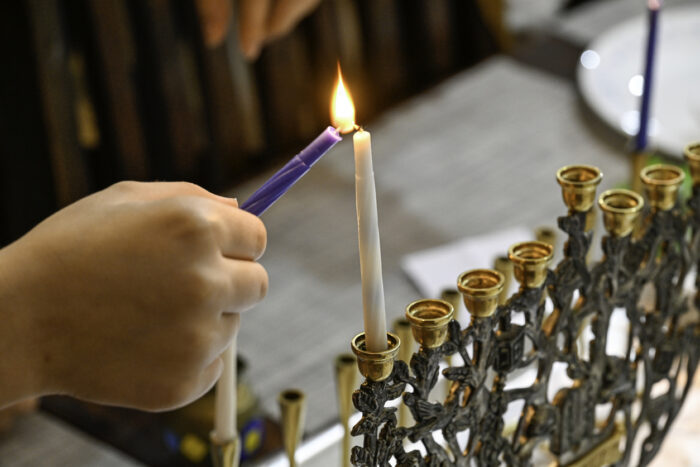
Now, fear and anxiety are not just something I feel. They are something I must metabolize, translate, and manage while keeping the momentum of every day life going. Dinner still needs to be eaten; baths still need to be taken. And keeping the excitement for our special weekend still matters. Tonight, we will light the first Hanukkah candle with my family.
Last night, after my girls were asleep, I followed the news as the search continued for a suspect. And this morning, I woke up to another horror. News from Australia of a mass killing at Bondi Beach, a massacre on the first night of Hanukkah. It’s certainly a first of its kind there, and proof that this kind of violence and sickness is reaching every corner of the globe.
“Look! It’s snowing!” I said, and my girls jumped off the couch with shrieks of joy. This morning, Providence woke to the embrace of a soft white blanket. The city felt quiet and peaceful. The snow offered a moment of reprieve after a night of violence, giving our nervous systems a chance to settle before the world rushed back in.
How do I give my children a childhood that feels safe when it feels like so much tragedy presses in on us from all sides?
I take a deep breath and return to this moment, our first night of Hanukkah, and what the practice of lighting the candles offers me.
Hanukkah does not deny the darkness in our world. After all, the story begins with destruction, desecration, and loss, something even my first grader came home from school talking about. My children already understand that there is evil in the world, whether it shows up as the Big Bad Wolf, Maleficent, or Darth Vader.
My daughter has a newfound love of Star Wars, her first sustained encounter with a story of good and evil. She is trying to understand how both can exist at once, and learning that joy can coexist with grief. Lighting the menorah offers a way to talk about that. We don’t pretend evil isn’t real. We show her a way to respond to it. That regardless of what is happening outside, we bring light and hope into our living room, anyway.
Jewish hope has never been simple optimism, and it has never denied danger or history either. We know what exile feels like. We know pogroms, expulsions, and targeted attacks. And still, our people have survived. Our hope lives through our actions. Checking on neighbors. Protecting one another. Teaching our children. Insisting that Jewish life continues visibly and unapologetically. Lighting the menorah links us to our history and communal memory, saying: We are still here.
The mitzvah of lighting the candles is intentional, giving us eight chances to practice. Whether we’re feeling hopeful or hopeless, it’s a way to acknowledge that fear does not determine who we are. We let the candlelight fuel our courage. We light again and again, each night deliberately brightening the darkness. The world doesn’t flip a switch, but as the brightness grows, the darkness begins to recede, reminding us that change happens incrementally. As Jews around the world place menorahs in their windows, we teach our children what courage looks like in a world that is sometimes dangerous, and where the plot is still unfolding.
This Hanukkah, lighting candles will not just be a prelude to presents or a distraction from the news. I want my girls to know that light is not something we wait for. It is something we choose to bring. Because being Jewish is not about sitting on the sidelines and pretending the world is safe. We must bring our light and voices into action, shining a light on truth, and fighting for what is right no matter the circumstances. Lighting itself is a form of resistance.
**This piece was written on Sunday, December 14th