
Every year, as the Jewish calendar gets within shouting distance of the High Holidays, a familiar feeling sets in for me. No, it’s not dread for all of the sermon writing to come. And it’s not a wistful sadness for the waning days of summer. Believe it or not, it’s a sense of excitement for one of my favorite rituals of the year—my process of seeking atonement throughout the month leading up to Yom Kippur.
Starting some time around Labor Day—whether the holidays are “early” or “late” this year (are they ever just “on time”?)—I make a list for myself; not a laundry list of my missteps, exactly, but of people I should reach out to as Yom Kippur approaches. The ones who are close enough to me that I might have, somewhere in the blur of the past year, said something careless, or shown up distracted, or simply failed to show up at all. And then, one by one, over the course of the next few weeks, I pick up the phone and call them. I try to arrive at each conversation having thought carefully about what I might owe them—not a generic “if I’ve wronged you in any way,” but something specific, something I’ve actually sat with.
For the first time in two decades of doing this ritual, this past Elul, despite my greatest intentions, I didn’t make my way to the end of the list.
The month got away from me, and not in an ordinary way. The world felt like it was fraying at the edges—antisemitism rising in ways I hadn’t seen in my lifetime, the political ground shifting under our feet in this country and in Israel, the particular exhaustion of trying to hold a community together when you yourself are not sure where you stand. And then there was the inner work of trying to find something true to preach about, that could actually reach people who were frightened, or angry, or numb, or some combustible combination of all three. Sermon drafts piled up in my trash folder. Unexpected fires popped up throughout the month, each one requiring my urgent attention, and each one violently rearranging my priorities further out of order. And somewhere in the middle of all of it, the list just sat there, and the days ran out.
By the time Yom Kippur was imminent, just an hour or two before sundown, it finally dawned on me that I hadn’t finished the real work of preparing for the holidays. Yes, the sermons were finally ready, the liturgy was in order, but my affairs were not. And then, just as quickly as this realization came to mind, I came up with the perfect way to quell the concern: I told myself that this year was different. That I had been so immersed in the very words of atonement that I would soon offer my congregation, so deep in the liturgy of return, that surely the immersion itself counted for something. Atonement by osmosis, I told myself. The preparation was the practice. Surely, God would understand.
It was a very convincing argument. I’ve always been good at those.
What I was really doing, I eventually had to admit, was granting myself an exemption; I quietly decided that my teshuvah operated under different rules than everyone else’s. The rabbi preparing to lead Kol Nidre, I reasoned, could have his unfinished relational accounting waved through, like a special TSA Pre-Check line for people like me to speedily greet the clear conscience that awaited us on the other side of the gates.
Which is, of course, exactly the kind of self-exempting behavior that the Torah explicitly forbids.
This week’s parashah, Tzav, contains a verse that looks, at first glance, like a straightforward superlative. Describing the sacrificial offerings brought to the altar for a variety of purposes, the Torah calls them kodesh kodashim—the “most holy” (Leviticus 6:18), the highest rung. The thing set apart from all other things.
It’s worth pausing there. The phrase kodesh kodashim appears eighteen times in the Torah, enough to signal that this is not a throwaway modifier. The rabbis have always taken it seriously, and they have generally agreed: it means exactly what it sounds like. The most holy, a category unto itself.
And then Ibn Ezra, the twelfth-century Spanish commentator, subtly notes: “It is like (all of) the other holy things.” In other words, one cannot in good faith declare eighteen different items the “most holy,” just as one cannot have eighteen “best” friends or eighteen “favorite” songs (both of which I have been unsuccessful in convincing my children). A superlative is definitive. There can be only one, and in this case, Ibn Ezra makes clear that this particular sacrifice is not “the one.” Yes, it is holy, but no, it is not the “most holy”; it is holy just like other holy things are holy, and the same rules apply to them all.
I’ve been sitting with that comment for weeks now, and I keep seeing it play out in unexpected ways.
I find it, of course, in the story I just told you. The rabbi who is too deep in “holy” work to do the actual work—that’s a kodesh kodashim move, if ever there was one. I was exempting myself beyond the reach of God’s standard accounting, insisting that my circumstances were extraordinary enough to warrant a different set of rules.
Rather than a rebuke, though, Ibn Ezra’s comment is actually a relief. Because if my baggage—the unfinished phone calls, the exceptions I afford myself—is “just like all of the other holy baggage,” then it is also subject to the same search procedures as they are. And rather than experiencing that as a painful constraint, I’ve learned to see it as a liberating structure, just like the other Jewish holiday that inspires an admixture of profound anxiety and gleeful excitement: Passover.
Which brings us to the question that so many of us will ponder over the coming few days of harried cleaning: What exactly are we prepared to get rid of?
Of course, there will be bread. And crackers, and any other leavened items we keep in the pantry. And to be clear, the tradition is dead serious about finding and eradicating the physical chametz: we sell, we search, we burn, and then we nullify everything that we didn’t catch in the first three steps. But the rabbis have always understood that the real cleaning runs deeper than the kitchen.
As a metaphor for spiritual clutter, chametz represents anything that we’ve allowed to expand beyond its proper place. The mystics are remarkably specific about what this looks like in a human life. Anger that began as a legitimate response to a real wound and then fermented slowly and quietly into something that now takes up far more space than the original offense ever warranted. The grudge that has wrapped itself around our soul, slowly suffocating us with its wrathful persistence — the one we bring to dinner, the one that always earns a sympathetic nod, the one we’ve quietly decided is too righteous to release. The habit we excuse with “just this once,” for the forty-seventh time. The constant reminders to our children about their screen time limits, mindlessly lobbed in their general direction between our own endless scrolling; “Yes but it’s my work email!” It’s what Rabbi Arthur Waskow calls the “swollen sourness in our lives.”
The wisdom of these searching and nullifying rituals, of course, is that we are on the opposite end of the Jewish calendar from Yom Kippur. We’re half a year past that sometimes painful but cathartic time of soul-searching and yearning for fresh starts, and more than likely we’ve fallen off the path we set out for ourselves back then. Perhaps we’ve even justified our straying: “just this once,” or “but this time is different,” or—worst of all—“but I’m not like them.”
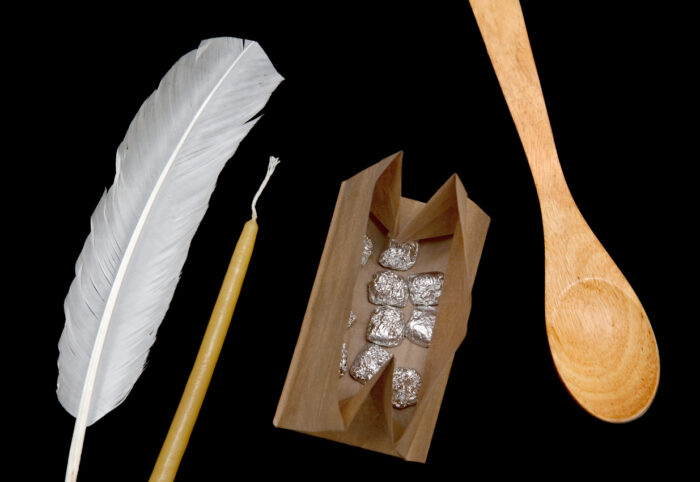
In just a few days, on the night before Passover, millions of us around the world will search the house for chametz by candlelight (bedikat chametz), gently feather-brushing the last few morsels of challah onto a paper plate. When the search is complete, we’ll recite an Aramaic formula nullifying whatever we found: all chametz in my possession that I have seen and removed is hereby annulled. Good. We did the work, and now we release what we found.
But then, on the next morning, before we burn what remains, we recite a second, almost identical formula (biur chametz) and this one goes further: It nullifies not only the chametz we found, but the chametz we didn’t find. “Whether I have seen it or not, whether I have removed it or not.” The tradition isn’t just tidying up loose ends here. It’s anticipating something specific about human nature: that even after a sincere and thorough search, there will be chametz we couldn’t bring ourselves to see. The formula doesn’t shame us for that. It simply makes room for it, and releases it anyway.
If that structure sounds familiar, it should. Six months later, on the eve of Yom Kippur, we gather to recite Kol Nidre, and the formula is strikingly similar. All vows, all prohibitions, all oaths. The ones we remember and the ones we’ve forgotten. The ones we’ve addressed and the ones we haven’t: annulled, released.
The rabbis built the same escape hatch into both holidays, at opposite ends of the Jewish year, because they understood that the work of self-examination is never fully complete. We will always have chametz we haven’t named. The question isn’t whether we searched perfectly; it’s whether we’re willing to admit that to ourselves, and to accept the generous release the ritual is offering: to stop treating our remaining exceptions as special cases, and to step forward as one of many, a divine image among countless divine images.
Which, as Ibn Ezra might quietly remind us, is exactly what everyone else has to do too.
In the words of Rav Avraham Kook: “What makes us truly free? When we are able to be faithful to our inner self, to the truth of our Divine image — then we can live a fulfilled life, a life focused on our soul’s inner goals.” Freedom, in other words, isn’t the absence of constraint. It’s the liberation that comes when we stop pretending we’re exempt from the human condition — and start doing the work that everyone else is doing too.
There is a reason Shabbat HaGadol—the Great Shabbat—falls on the last Shabbat before Passover. It is one of two pivot points in the Jewish year, the final pause before crossing into Passover. The Israelites hadn’t yet left Egypt; they were still carrying everything that had accumulated over four hundred years of bondage. And yet the tradition asks us, in that liminal moment before liberation, to begin the preparations for freedom—not after you’ve resolved everything, not once you’ve achieved sufficient spiritual readiness, but now, while you’re still in the thick of it.
I think about those phone calls I didn’t make. The people on my list who deserved more than they got from me last Elul. I had convinced myself that my circumstances were exceptional, that my chametz was somehow different in kind from the chametz I was asking my congregation to release. It wasn’t. It was ordinary chametz: the swollen, self-justifying kind that our tradition has been diagnosing and treating for centuries. Ibn Ezra knew it. Rav Kook knew it. And now I do, too.
The formula doesn’t ask whether you’ve earned the release, or whether your search was thorough enough, or whether your circumstances were ordinary enough. It simply says: whatever is left, whatever you couldn’t see or wouldn’t face, let it be like the dust of the earth. Not because it didn’t matter, but because holding onto it will only make it swell up even more.
That is what Passover is actually asking of us. Not a spotless house or a spotless soul, but the willingness to stop treating our particular chametz as an exception to a rule that applies to everyone else. And to take our next steps in faith, just as Nachshon ben Aminadav once did, stepping into the sea before it split; to cross over anyway, into whatever awaits us on the other side.
Now, if you’ll excuse me, I have some long-overdue phone calls to make.
Wishing you and yours a chag kasher v’sameach—a healthy, joyous, and liberating Passover!