
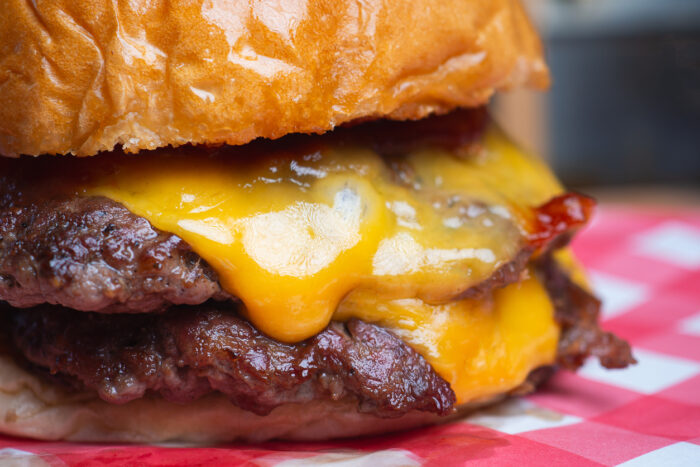
In Rabbinic school I was once given an assignment: write a new blessing. I asked my professor if I could write a blessing over eating a cheeseburger. He looked at me for a moment trying to determine if I was serious. I assured him I was and he said absolutely not. I don’t recall what blessing I created or his stated reasoning for saying no. But I still remember the assignment, and, in my heart, it remains incomplete.
You see, at that time, I had never had a cheeseburger. It would be another eleven years before I did. But I also did not at the time feel connected spiritually through the laws of keeping kosher that I had kept my whole life. As I look back to that time, I believe I was beginning to wonder how eating could be a sacred act even if my actions were not based in Jewish law.
And now, now I want this blessing to exist not only for my own spiritual well-being, but as a bold act of inclusion and invitation that indeed, all are welcome here. At a time when division is the cudgel tearing apart our humanity, let coming together across difference be the balm.
In the intervening years, I have learned so much about the nature of Jewish blessings. When my Christian friends offer blessings, they say something like Dear God bless us, bless our family and friends, bless this country and so on. The formula is calling on God to bring blessing to us. As if blessing is in the air and we grab it and bring it down to ourselves and those around us. Very few Jewish blessings are structured this way. The priestly benediction calls on God to bless us, but the vast majority of blessings follow a different pattern. We say

Baruch atah Adonai Eloheinu Melech ha’olam…
Blessed are you, Adonai our God…
When Jews bless, we bless God. Not the other way around. It’s a little peculiar but spectacularly Jewish. We aspire to live meaningful lives and by doing beautiful, caring, thoughtful, loving things we bless our creator and the source of all life. In many ways, our blessings are thank you notes to The One.
Now let’s think about food blessings, specifically the motzi, which is the blessing over bread. It says, “Blessed are you, Adonai our God, who brings forth bread from the earth.” You might notice that God does not, in fact, bring forth bread from the earth. There are no proverbial bread trees. In Bereishit Rabbah, a fifth-century collection of midrash on the book of Genesis, Rabbi Z’ira suggests that in the Garden of Eden, bread did in fact grow on trees, making the blessing an expression of the Jewish longing to return to Eden. There is also a great debate in the Talmud about a finer grammatical point on the blessing, in which our great sages consider if the blessing is about that bread from Eden or about the bread we will eat in an Edenic future. Either way, the blessing is not, in the rabbinic imagination, about the bread on the sandwich at the table in front of us right here and right now. At the end of the argument, the blessing becomes a reminder of the coming of the Messiah.
As a congregational rabbi, however, for decades I have taught that the blessing is a reminder of all the people involved in bringing bread from grain to table. Not just the people now, but the ingenuity necessary to build a world where bread is so readily available it is as if it has grown on trees.
Traditionally, bread makes the meal. If bread is in your meal, then you would say the motzi blessing, which also serves as blessing for everything else on your plate.
By that logic, we could say motzi over a cheeseburger.
But in my gut, that just doesn’t feel right.
In The Way into Jewish Prayer, Rabbi Lawrence Hoffman writes, “It is normal for blessings over food to refer to the means, or ‘delivery system,’ by which food comes to us. Apples, for instance, call forth the blessing ‘Blessed are You … who creates the fruit of the tree.’ Potatoes get ‘Blessed are You … who creates the fruit of the earth.’” In other words, we say a blessing based on where the food we eat came from.
So, let’s think about cheeseburgers and the cheeseburger delivery system. Yes, cheeseburgers are the aggregate of bread, cheese, and meat. Those delivery systems, like the ways bread comes into being, are complicated and multivaried. But the historical delivery system, the story that brings cheeseburgers into being, is an interesting one. It is unclear who first thought up the meat-cheese-bread combination we know today as the cheeseburger. We know hamburgers came to America with German immigrants in the late 1800s. The cheeseburger maybe first appeared in 1904 at The World’s Fair in St. Louis or maybe in 1924 at The Rite Spot in Pasadena, CA or maybe Bob Wian in 1936 at Bob’s Big Boy. While the idea of putting cheese on something is not novel or interesting or creative to us today, this was a wild innovation in the early 1900s. Money was tight—the Great Depression encompasses these years. Today, excess is an expected norm in restaurant food. But back then, this was different thinking and genius.
Before continuing, I want to address whether we should have a Jewish blessing for cheeseburgers, which are not kosher. My answer is yes, we should. Because there are Jews who eat cheeseburgers. Because Jewish blessings are about blessing God through our actions and about being grateful. Because following halachah, Jewish law, is not required to be Jewish, so then it is also not required for all the Jewish pathways for accessing the Divine.
But we also would not have a blessing about flouting Jewish law, because although observing Jewish law is not required for being Jewish, Jewish law is the backbone of the history of the Jewish people. The Judaism we know today—which warmly welcomes Jews who do not believe in, follow, or even know very much about Jewish law—only exists due to the evolution of Jewish law. So, if we’re looking for a blessing for eating a cheeseburger, we need one that does not spit in the face of the traditions which have kept us Jewish to this day. We instead need a blessing to say when eating a cheeseburger that sanctifies the act of feeding our bodies without overtly calling attention to the fact that cheeseburgers are not kosher.
Here is what I propose: If food blessings are based on the delivery system of the food we eat, and bread, the main identifier of what makes a meal, praises the ingenuity of humanity, then I would like for us to have a food blessing that celebrates human creativity. Whereas bread celebrates our industrial nature to make machines which let us turn grain to flour, the cheeseburger celebrates our ability to take what is and transform it into new incredible creations. Like Jews who eat cheeseburgers.

Baruch atah Adonai eloheinu melech haolam sh’bara koach y’tzirah b’adam.
Blessed are you Adonai our God, who is masterful in the universe that created creativity within human beings.
Amen.