The magic of the High Holiday season is that we stand in the liminal space between the year that has passed and the next one—which is wide-open and unrevealed.
While this season calls us to celebrate fresh beginnings and regain a sense of hope and possibility, for some of us, this feels harder than in years past.
Some of us, perhaps many of us, sit in this sanctuary this evening feeling thoroughly unmoored.
We may be feeling the heavy exhaustion of a deeply distressing, chaotic, and anxiety-inducing year—from the terrifying resurgence of antisemitism to the cruel, relentless fear inflicted on immigrant communities by ICE, to rising extremism, encroaching fascism, and the steady erosion of our democratic norms. Compounded by the weight we carry from our individual experiences of pain, loss, and struggle, the gap between how we want to feel tonight and how we actually feel may feel like an ocean we cannot cross.
At this season of Renewal, how might we find a way forward—to truly embrace the spirit of these holy days and move toward renewal?
I want to offer an answer to this question through a story from the Talmud, which I hope will be a balm for our hurting souls. Its ancient wisdom has never felt as urgent or relevant as it does tonight.
It is the story of the great scholar Rabbi Akiva surviving a shipwreck.
According to the Talmud (B. Talmud Yevamot 121a): One day, Rabban Gamliel, a great sage and Jewish leader, was traveling on a boat in an expanse of water. From a distance, he saw that another boat had been swept up in a storm and shattered into hundreds of pieces. Rabban Gamliel realized that on that shattered boat was the great scholar Rabbi Akiva. Assuming his friend, student, and chevruta (study partner) was dead, Rabban Gamliel became overwhelmed by immense grief and loss.
But when Rabban Gamliel disembarked from his boat onto dry land, he looked ahead in the distance. Could it be? Was he seeing correctly?
It was none other than Rabbi Akiva himself—completely unharmed—and running toward him.
When Rabbi Akiva came close, he immediately began debating with Rabban Gamliel about the intricacies of a particular Jewish law.
With equal parts shock and delight, Rabban Gamliel asked Akiva: “My son, who brought you up from the water? Who saved you?”
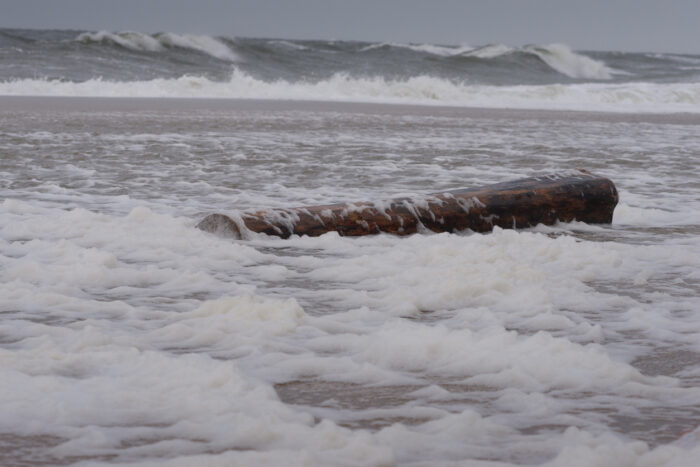
Rabbi Akiva replied: “When the boat broke, a daf—a plank—from the boat appeared before me. I grabbed onto it. And with each wave that came my way, I bowed my head.”
***
The story of Akiva and the ship was written over 1500 years ago, yet it is a parable that speaks to our very moment, offering us tools for how to cross raging and turbulent waters—to move us from fear to faith.
The ship that shattered beneath Akiva represents the living in a climate of uncertainty and brokenness. Today, it can represent the systems, the norms, and the comfortable assumptions we took for granted—the belief that history moves forward, that democracy is an unquestionable bedrock of our society, that our safety is guaranteed. The stable place we once stood on has broken apart beneath our feet.
But the heart of this story—the secret to Akiva’s survival—is the wood plank he held in his hands. Notice that when Rabban Gamliel sees Rabbi Akiva alive, he asks “who” saved you. But Rabbi Akiva doesn’t answer with a “who” rather a “what.”
Rabbi Akiva says, “A plank—a daf—came before me, and I grabbed onto it.” In Hebrew, the word daf ( )—is the very same word we use for a page of Talmud. That is no accident. The daf represents the pages of our sacred text and the symbol of our tradition. The daf is what saves Rabbi Akiva from life-threatening harm and enables him to reach the shore safely. It is not God Godself or a supernatural intervention; it is the “stuff” of our tradition that saves him.
Let’s notice what a plank is, and what it isn’t. A plank is not a brand-new ship. A plank is not something luxurious or comfortable, like a modern flotation device.
But a plank keeps your head above the water line. It gives you a surface to hold onto so that fear does not pull you under.
Our tradition is that daf.
It is our Torah, our Talmud, and the way we center debate, intellectual growth, and spiritual deepening through learning. It is Shabbat and holidays—the cycle of time that provides a sacred rhythm to our lives no matter what is going on around us. It is our Jewish rituals, practices, prayers, ethics, and actions that help us remember that life is pulsating with meaning and potential, and that all we have to do is pay attention and take steps towards chesed (compassion) and tzedek (justice).
The daf is the steady, time-tested inheritance that has carried our people through every storm, even the darkest chapters of human history. Even when it seemed all hope was lost, tradition helped us maintain our sense of pride, dignity, and faith when that felt near impossible.
There is a story from the Holocaust of the Bluzhover Rebbe, Rabbi Israel Spira, who became the spiritual leader to his fellow prisoners in the Janowska concentration camp. In a place designed to strip away every shred of humanity, the Rebbe understood that the first thing the camp tried to steal was time itself. So, secretly, quietly, he kept track of the Jewish calendar, inside his mind.
When Rosh Hashanah arrived in the camp, he gathered his fellows in a wooden barracks. They had no shofar, no machzor, but the Rebbe whispered words of Rosh Hashanah prayer from memory. And they knew that despite the horrors of what they were experiencing, a new season was beginning.
The calendar was their plank—the thing that allowed them to hold their heads just a bit above the water, reminding them of their dignity, calling to them not to give up
Time and again, in extreme circumstances like these, as well as in everyday life, our ancestors held tenaciously to tradition and it helped them find their way in the dark.
In this light, here is my invitation for this Yom Kippur: Let’s consider how the daf of Jewish tradition can help us move away from the fear of what is and might be toward the possibilities of a brand new year.
Can we let tradition hold us?
Or, to use the metaphor more precisely, can we grab hold of it for dear life and let it carry us to shore? As our prayers say, it is an Etz Chayim—a tree of life—to those who cling to it. Can we grab hold of it, just as Rabbi Akiva took hold of that plank?
Holding onto your daf can mean letting the High Holidays and the dappim (pages) of this machzor become your anchor. When your own words fail, instead of tuning out, we can lean into the liturgy, knowing that these ancient prayers have carried generations through their own dark nights.
Holding onto your daf could mean allowing our favorite melodies not only to uplift us, but remind us that joy is available to us, no matter what has gone on in the past year or what lies ahead.
This invitation to find our own dafs of Jewish tradition does not need to end with the Days of Awe.
For this coming year, I invite you to consider: Is there a particular plank of this multifaceted tradition that you want to cling to—a new commitment to hold you steady in the storm?
Lighting Shabbat candles regularly? Pausing to say a prayer upon waking or going to sleep or eating? Reading the weekly Torah portion?
And if you think committing to a Jewish practice is out of reach, remember: Rabbi Akiva didn’t even begin studying Torah until mid-life. He started from scratch, with no prior knowledge, before he ever found his way to the beit midrash. It is never too late and you are never too inexperienced to embrace new Jewish practices to ground and anchor you in the chaos of life.
I invite this not only to help you enrich your spiritual lives, but rather because I believe in the power of our tradition to be a lifeline when things feel unyielding, out of control, or too much to handle. A lifeline that can give us calm, patience, and faith.
Just like with Rabbi Akiva’s plank. Let’s remember what he told his friend: He grabbed onto the daf: “To every wave that came toward me, I bowed my head.”
Because of the plank, Rabbi Akiva did not try to outmuscle the ocean or fight the waves in panic. Instead, he found the strength to endure the scary uncertainty coming at him, wave after terrifying wave.
Imagine the physical agony and mental fortitude it took to stay afloat—his fingers cramping, his body shivering—holding on long after his strength should have given out. He bowed his head not in surrender to defeat, but in faith—letting the wave pass over so he could rise again.
Empires have risen and fallen, tyrants have come and gone, and every age brings its own storms. But the daf remains.
Let us hold fast to our traditions to help us be more open to renewal and hope as we continue to move into this new year. And though we do not know what waves will break over us in the months and year ahead, let us know what we hold in our hands. Hold fast to your plank. Bow to the wave. Hold fast again. Bow again.
May we have the courage to cling to our tradition, the patience to ride the waves, and the faith that we will reach dry land.