
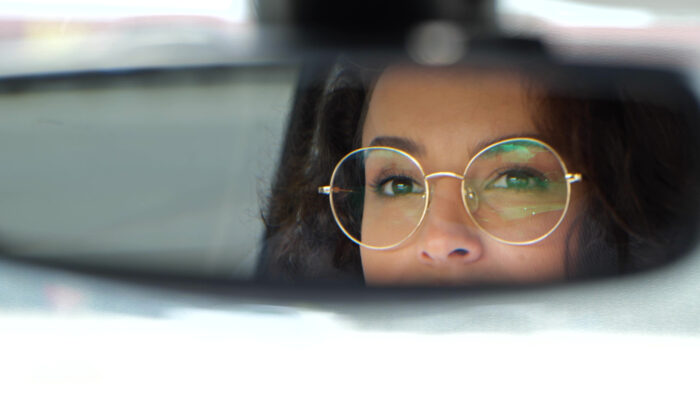
In mid-August, I took my daughter on a girls’ trip. It was a classic road trip. She is eleven, and a half, so I was the only driver, for nearly two thousand kilometres.
So that I would not have to listen to Taylor Swift for the entire drive, before we left we built a playlist together, of both her music and mine. The rule was simple: you could only ask to skip a song that you had added to the playlist. I can safely say she now knows a little ditty about Jack and Diane. And I know a few more Love Story lyrics than I did before. That’s the song about Romeo and Juliet.
Think about the last long drive you took, whether up to cottage country or out to see family, wherever it was that put you behind the wheel for a few hours straight.
At some point the road empties out and settles into a rhythm, and you start doing something almost without noticing: your eyes flick up to the rearview mirror, hold there for a second, and drop back down to the road. Up, hold, down. Over and over, for the whole drive. You are never not checking behind you.
You are also never, if you’re driving well, only looking behind you. The mirror gets a glance. The windshield gets your eyes.
Now imagine a driver who couldn’t stop looking in the mirror — who kept the rearview in focus a beat too long, replaying the on-ramp they merged onto twenty minutes back, the exit they maybe should have taken.
We know exactly what happens to that driver. The car drifts. The following distance closes. Something in front of them arrives before they’re ready for it.
The mirror is not a bad tool. But it becomes dangerous the moment it becomes where you live instead of somewhere you glance.
* * *
I want to suggest tonight that Yom Kippur is built like that drive, and that it knows, better than we usually give it credit for, exactly how long of a look in the rearview mirror a human being is allowed.
Immediately after I conclude this sermon, we will sing a piyyut, a liturgical poem, that we will not sing again until next year. It is only sung once this entire day.
May our supplication rise up at evening, our pleas arrive with the dawn,
our songs be seen until the dusk.

Nearly a thousand years ago, Ya’aleh was written by someone whose name nobody remembers, somewhere in medieval Ashkenaz.
It is built as a reverse acrostic. Instead of running aleph to tav, the way most of our alphabetic poems do, it runs backward — tav, shin, reish, kuf, and on to aleph. The tradition calls this ordering tashrak. It isn’t unique to this piyyut; you’ll find it in a handful of other places.
The three verbs in this piyyut “ya’aleh, v’yavo, v’yeira’eh” are borrowed from the paragraph we add to the Amidah, the main standing prayer, on Rosh Chodesh (the first day of each Hebrew month) and festivals that starts with the words “ya’aleh v’yavo,” asking that our remembrance rise before God.
Whoever wrote this piyyut took that formula and stretched it across the length of an entire day, from this evening all the way to the evening of Ne’ilah, the closing service of Yom Kippur, tomorrow.
No one recorded why the author chose to run the alphabet backward. But sit with it for a minute, and it starts to feel less like a technical flourish and more like the point. There is nothing to trace, no poet’s biography to hold onto, nothing but the words themselves and the backward walk they take us on.
The glance we’re permitted tonight was never supposed to be about the person who wrote the prayer. It’s about us, the people praying it.
An anonymous poem, for the night when the point is not to dwell on who we were, but simply to look once, honestly, and then let go.
* * *
It is actually important that we recite Ya’aleh once, tonight, right at the start of this holy day. It is essential. We need it. It is a kind of kickstart, meant to get us ready to move forward.
Ya’aleh quietly turns us around first, to make sure we’re actually ready for that annual march that Ashamnu, the Yom Kippur confessional, leads us on, over and over, forward on through the alphabet.
We are given one really good glance back in the mirror, held for the length of one piyyut, and then the drive continues.
Compare it to the confession we will say again and again over the next twenty-five hours. It is an alphabetical acrostic confession — aleph, bet, gimel, all the way through to tav. The first line you might know by heart, even if you’ve never thought about how it’s built: Ashamnu, bagadnu, gazalnu, dibarnu dofi — we have trespassed, we have dealt treacherously, we have robbed, we have spoken slander.
It runs, word by word, letter by letter, straight through the alphabet, the final letter repeated three times so that nothing is left uncounted.
The Talmud, in Masechet Yoma, tells us that in the time of the Mishnah there was no fixed text for this confession at all. Each person said whatever their own heart required (Yoma 87b).
It was the later rabbis, the Geonim in Babylonia, who gave the confession its alphabetical shape, and Rav Amram Gaon who placed it into the machzor, the high holiday prayerbook that would travel from Baghdad outward to every community that came after.
By the time the medieval machzor had settled, we had inherited a confession that moves the way we imagine a full accounting ought to move.
It is in order, without skipping, from the beginning of the alphabet to its end. Aleph to tav. Nothing omitted.
* * *
The commentators explain that when we find all of the alphabet together, that teaches completeness. We confess from beginning to end because no part of our lives is exempt from examination. There is nowhere we cannot search. The confessional Ashamnu is an inventory or a grocery list of the self. It walks us carefully through our lives, one letter at a time. Aleph to tav. A to Z. Beginning to end.
Letter by letter, we will name our failures in the order the alphabet gives us, moving forward, never circling back to a letter we’ve already passed.
Every time the ark opens today, every time we strike our chest, we walk that same road again: aleph to tav. Forward. So why does the liturgy allow itself, on this one night, to run in reverse — and then spend the rest of the day insisting we run forward?
The Talmud gives us the language for this in an entirely different context: Beit Shammai and Beit Hillel disagree about how to light the Chanukah candles.
Beit Shammai says we should begin with eight lights and count down to one, mirroring the bulls offered on Sukkot, which diminish each day.
Beit Hillel says that we should begin with one light and build to eight, on the principle ma’alin bakodesh v’ein moridin — “one ascends in holiness; one does not descend” (Shabbat 21b).
We follow Beit Hillel. Not because the math is prettier, but because Jewish time is not supposed to run downhill. Every day of a holy count should be bigger than the one before it, not smaller.
You can feel that same instinct, less explicitly named but just as real, in the way we count the Omer each spring. We count Hayom yom echad la’omer, today is the first day of the Omer. Hayom shnei yamim, today is two days. There is one mitzvah for forty-nine nights, and the count runs only one direction. If we miss a night, tradition does not let you fix it by counting backward from where you stand.
We simply continue forward, because the counting itself is the practice of ascent.
The Talmud doesn’t attach the phrase ma’alin bakodesh, one ascends in holiness, to the Omer the way it does to the candles. I want to be clear about that. But the mitzvah is built on the same principle: forward is the only direction it knows.
Ashamnu is Beit Hillel’s candles in the form of a confession. It is aleph to tav, forward, adding one more letter, one more piece of honesty, one more step. It is not a spiral back into the year we’re trying to leave, but a road being built, letter by letter, toward tav, toward completion, toward whatever we become on the other side of this day.
Ya’aleh, on the other hand, is the time we’re handed Beit Shammai’s candles: permission to count backward, from where we are now all the way to where the year began.
Our Torah has a famous and fascinating repercussion for a person who looks back. When angels pull Lot’s family out of Sodom, the instruction is almost absurdly simple: ”Al tabit acharecha—Don’t look behind you” (Genesis 19:17). One direction, keep going, don’t turn around.
Lot’s wife turns around anyway. The text doesn’t even give us her reason, only her fate. “Va’tabeit ishto mei’acharav va’t’hi n’tziv melach—And his wife looked back and became a pillar of salt” (Genesis 19:26). She becomes a pillar of salt, frozen exactly at the moment she chose the view behind her over the road ahead.
It’s a strange juxtaposition to contrast with Ya’aleh, but I think it sharpens Ya’aleh‘s goal. We are given a single, bounded, liturgically supervised glance before the instruction returns to what it always was.
Don’t look behind you. Keep going forward.
It is honest, and it is necessary, and it is over quickly.
Because starting the moment we finish singing Ya’aleh tonight, we go back to driving and staring ahead out the windshield. Aleph to tav. Ma’alin bakodesh. Ascending.
When you first learn to drive, there is this instinct to keep glancing at the rear-view mirror instead of trusting the road ahead. New drivers have to be reminded, again and again, that the small rectangle is not where the journey happens.
* * *
We are not so different, as we engage in introspection during these Days of Awe.
We know how to check the mirror. Many of us have spent the last month doing nothing else — replaying conversations, recounting the year’s failures, running the alphabet backward in our heads without any liturgy telling us to stop.
Ya’aleh gives that instinct exactly one moment. One appointed hour. And then it asks us to look up, look forward, and drive.
And here is the thing about a good GPS, which I relied on for the entirety of my road trip, the kind we’ve all come to rely on without thinking twice: when you miss the turn, it doesn’t scold you, and it doesn’t make you drive back to the exit you should have taken. It says one word. Recalculating. And then it builds you a new route forward from exactly where you are.
That, more than anything, is what teshuva asks of us. Teshuvah is a different GPS, God’s positioning system, helping us to calculate as we move forward.
It is not a U-turn back to the person we were before we went astray, which is impossible anyway. The road behind us is closed, the year is over, there is no driving back into 5786.
Without a map, we start a new route, forward, from this exact spot, aleph to tav, one turn at a time, toward a destination we won’t reach for another year.
This, I think, is the architecture of the whole day. Yom Kippur opens with a single backward glance and closes, at Ne’ilah, with the gates about to close and a congregation standing to ascend one last time before they shut.
We are not asked to forget the year behind us. Kol Nidre would not exist if forgetting were the goal.
We are asked to look at it once, honestly, completely, tav to aleph, and then to spend the next twenty-five hours proving that we know how to build forward: aleph to tav, one letter at a time, one small ascent after another, until, please God, we arrive at Ne’ilah as people who have gone up and not down.
* * *
So in a couple minutes from now, when Ya’aleh rises and falls backward through the alphabet, let it do its work.
Let yourself look in the mirror fully, for this one appointed hour.
And then be ready as Ashamnu begins again at aleph and we start walking forward together, one confession, one letter, one small act of holiness at a time.
May we drive the way this day was built to teach us:
eyes mostly on the road ahead,
checking the mirror only long enough to know where we’ve been,
and trusting that we are a people commanded, always, to ascend. Maalim Bakodesh.
May this be a meaningful Yom Kippur for us all.
Look ahead my friends, look ahead.