
I want to take us back in time to the ancient kingdoms of the Jewish people.
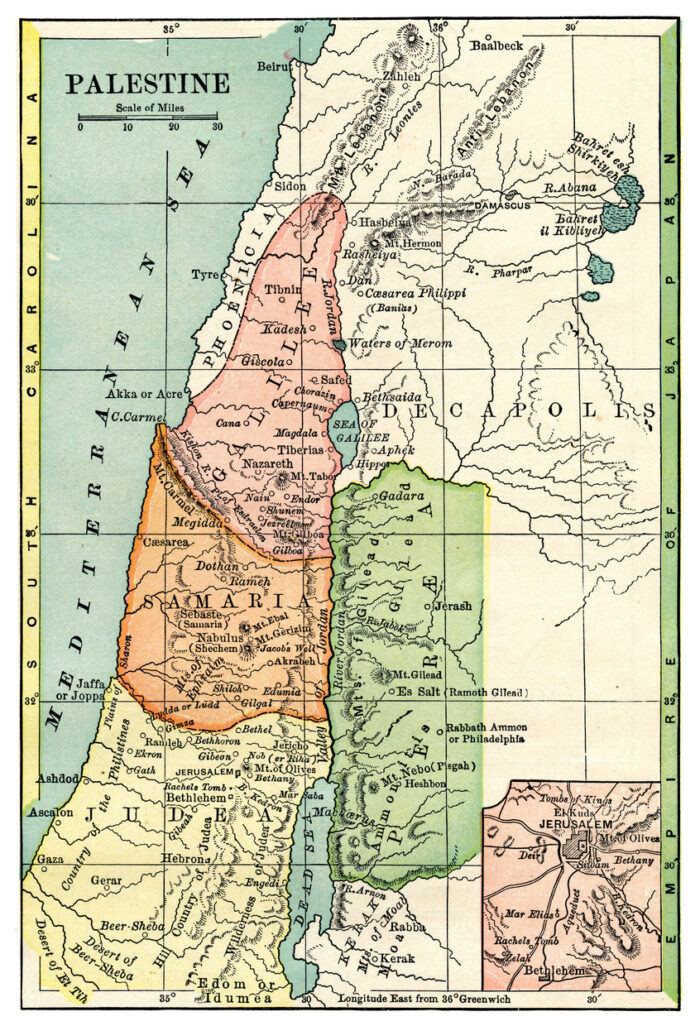
Kingdoms, plural. Because for more than 200 years there was a Northern Kingdom of Israel and a Southern Kingdom of Judah. Two separate kingdoms existing side by side for almost as long as the United States has existed.
The Northern Kingdom called Israel was larger, wealthier and more fertile. The Southern Kingdom, called Judah, was smaller, rockier, centered around Jerusalem, its Temple and its monarchy. And one of the fascinating things scholars have uncovered as they have peeled back the layers of the Bible is that the Jewish people were not originally the single, united people that our biblical story might lead us to imagine.
In 722 BCE, the Northern Kingdom of Israel fell to the Assyrian Empire. Some of its population disappeared into exile. Others remained. And some moved south into Judah. They brought their stories with them and then something remarkable happened: The leaders and scribes of Judah could have said, “Those are not our stories. Those people worship differently. Their history is not our history.”
Instead, they incorporated many of those traditions into an emerging shared story of Israel. They certainly edited them and they interpreted the destruction of the Northern Kingdom through their own theological lens. Often they told those stories in ways that made the South look rather better than the North, and they understood the falling of the Northern Kingdom as both a moral failure and as a punishment for turning away from God.
But they did not erase them. They made them part of the story of us.
That process helps explain something our Torah study group encounters almost every Saturday morning: The Bible does not really speak with one voice. Once you notice it, it becomes difficult not to notice. There are competing accounts of the same events and there are different theological assumptions. Different traditions remember the past differently. Sometimes one biblical text appears not even to know a story that another text regards as central.
The very idea of twelve tribes descended from twelve brothers can be understood as part of this extraordinary act of creating shared ancestry. Groups with different traditions and different histories are eventually woven together as children of one family. But we were not a people who had always been one. We are a people who learned to tell a story in which we belonged to one another.
Even the books of Samuel, which our Torah study group has been studying this past year, contain echoes of competing traditions about Saul and David, about kingship, about which leaders are worthy and which are not. The editors who compiled these books do not smooth out all the contradictions that we find in the text. Rather, the different voices remain for us to uncover.
Rabbi Amichai Lau-Lavie has been exploring this history and what it might mean for us now. He provocatively suggests that perhaps the Jews have never really been “one people” — at least not if by “one” we mean uniform, speaking with one voice, believing the same things and practicing Judaism in the same way.
From the beginning we were a mixed multitude. Separate tribes with different histories and practices. While two kingdoms stood, they expressed competing traditions in where and how they worshipped. This, in turn, reflected different approaches to how power was more centralized in Jerusalem and less centralized in the Northern Kingdom of Israel.
For those of us who love to geek out on the history of the Bible, all of this is fascinating. But so what? Why does it matter to us on Yom Kippur in 2026?
Perhaps because we, too, are living at a moment when Jewish peoplehood feels unusually fragile. Lau-Lavie argues that Jewish history has repeatedly been a story of rupture followed by attempts at repair. And one biblical story offers a particularly striking example. After the destruction of the Northern Kingdom, the book of II Chronicles tells us that King Hezekiah of the Southern Kingdom of Judah sent messengers northward. But first he got the agreement of the priests in Jerusalem to delay the celebration of Passover by one month. This was essential for what he was about to do. The message he sent was: Come to Jerusalem. Come celebrate Passover with us.
The messengers traveled through the territories associated with the Northern tribes, inviting the remnants of Israel to return to Judah and celebrate together. According to the text (II Chronicles 30:10), some people laughed at them for such an idea. Some mocked them. But others came. The Kingdom of Israel had been destroyed. People had been displaced and communities had been scattered. For generations, North and South had lived apart. And the response to the ultimate destruction of Israel was an invitation: Come. You still belong.
By delaying the celebration, Hezekiah provided time for the messengers to deliver the message and for the people in the North to make pilgrimage to Jerusalem. I find this remarkable. The Torah actually speaks of a “Second Passover” that is permissible a month after the actual date of Passover, but this is likely an insertion that comes about because King Hezekiah had already innovated with this shift in the calendar in order to welcome the Northerners to Jerusalem.
But then there was a problem. The people who arrived from the North had not followed the ritual requirements properly. They had not purified themselves in the way expected for participation in the Passover sacrifice. This could easily have become the moment when the gates were closed again. Last night, on Kol Nidre, I invited us to imagine gates—the gates through which we enter into this sacred season and into relationship with the Holy. This morning, our story brings us to the gates of Jerusalem. And people are arriving there by different roads, carrying different histories and different ways of being Jewish. The question facing Hezekiah is whether there will be room for them once they arrive.
The leaders of Judah might have said: “You are welcome — but only if you do it exactly our way. You may join us — but only once you have met all of our standards.”
Instead, the leaders allowed the ones who had traveled to Jerusalem from the North to participate. King Hezekiah prayed on their behalf to atone for the ways that they deviated from the norms of the Temple practice in Jerusalem and the Chronicler tells us that Jerusalem was filled with rejoicing — rejoicing unlike anything that had been seen there for generations.
Lau-Lavie draws attention to what Hezekiah is willing to do in order to make that gathering possible. “Sometimes, you shift the date. Sometimes, you bend the ritual,” Lau-Levie suggests. Not because ritual does not matter. Not because there are no standards. But because sometimes another Jewish value is demanding our attention. Repair what has been broken. Gather what has been scattered. Remind people that they still belong to one another.
I share these ancient stories with you this morning because perhaps they have something urgent to say to us.
We live in a time today where we are witness to powerful forces that are pulling the Jewish people apart. Within the State of Israel there are profound disagreements about what kind of country Israel should be, what Judaism should look like in the public square, and what values should guide its future. Within the Jewish world beyond Israel, we are experiencing many of those same tensions — and others. We disagree about Israel. We disagree about religion. We disagree about politics and the ways in which some of the ethical principles derived from our tradition should be applied to our civic lives in the country in which we live. We disagree about what Judaism demands of us in relation to the wider world.
None of that is new. But I am worried by what I am witnessing in our wider Jewish world. It is the increasing temptation to respond to disagreement by writing other Jews out of the story.
Not simply: I think you are wrong.
But: Your Judaism isn’t authentic. You don’t care about the Jewish people. You have betrayed our values. There is no place for people like you in my Jewish community.
We retreat into our own kingdoms and we speak mainly with those who already agree with us. And from within our own tribe, the people on the other side begin to look less like fellow Jews with whom we have a profound disagreement and more like strangers — sometimes even enemies.
Our ancestors knew something about that. For generations, North and South had been separate with different histories and traditions and had even fought one another. They did not suddenly discover that underneath it all they had agreed about everything. Instead, over time, they did something more difficult. They created a story that was rich and multilayered enough to hold their differences. Your ancestors became our ancestors. Your sacred stories became our sacred stories. Your memories became our memory.
Our ancestors chose to become a people who belonged to one another. I want us to think about this as a more useful understanding of Jewish unity. Unity does not require uniformity. Belonging does not mean endorsement. Peoplehood does not require us to stop arguing. Judaism has never asked Jews to think alike — something that should be apparent to anyone who has ever opened a page of Talmud or attended a synagogue committee meeting.
These principles of belonging have been core to the listening circles that we held about Israel earlier this year. They will continue to underpin the way we bring educational opportunities to engage and learn more about Israel to our congregation, and I hope they will also continue to underpin how we do everything as a congregation. How we run a board meeting. How we respond to the upcoming mid-term elections. How we discuss issues that are relevant to our lives not only as Jews but as US or as world citizens.
The central spiritual practice of this season is teshuvah. Return. Hezekiah’s messengers carried that very invitation: Shuvu — return. Return to God. Return to community. Return to a people whose members may frustrate us, anger us, disappoint us and see the world in ways that we simply cannot understand. Teshuvah does not mean that we abandon our convictions or that we cannot speak them loudly and clearly. But can we hold those convictions and still remain in relationship with one another, continuing to honor the plurality that is contained within our Jewish community and within the Jewish people?
Cynthia Ozick once described the story we inherited of our ancestors being 12 tribes as metaphors for our diversity: different ways of being human held beneath “one canopy of memory.”
This is the challenge before the Jewish people now. We don’t have to pretend that we are all one tribe—we never were. But can we create a canopy strong enough to hold many tribes beneath it? When that canopy tears—as it has before, as perhaps it is tearing now—can we remember what our ancestors sometimes had the wisdom to do? To gather the scattered. To open the gates wider. To tell a story large enough to include people whose stories are not exactly our own.
And to say to one another: Come. You still belong.
Let us return together.