
I expected to be meeting this year in Jerusalem. I had thought that the process of making Aliyah—of immigrating to Israel, of getting that Aliyah visa attached to my passport—would be completed by the beginning of July. I had registered for classes, my husband and I had given our furniture to our children, sold the house, and put our remaining belongings afloat on the ocean. But you know, anything worth doing is worth doing with the maximum number of steps and as much bureaucratic stalling as possible. My Aliyah paperwork is not complete, and apparently, the only thing more difficult and time-consuming than completing it from within the United States is actually completing it from within Israel.
So we went ahead and spent the summer in Jerusalem, and then returned to the States to stay with our children and grandchildren while awaiting the final approvals. Watching our own children struggle with their children has been quite an emotional process. We all have a theory of parenting—and then we have the reality of parenting the children that we actually get. We all struggle.
Our youngest child is 19. He spent a very long four weeks with us in Jerusalem this summer. His first Shabbat with us—before I was sure he knew his way around—he and I shopped at the Shabbat takeout place and prepared quite a feast. We cleaned the apartment, laid the table, and set up the Shabbat warming plate. And my husband and I were feeling pretty smug! Because in that moment, we knew for sure that one of our six children was celebrating Shabbat. And that’s a win in my book.
So we lit the candles. And somehow immediately started fighting about something. No idea what. And our kid, our child, our dear one, whom we love, stormed off into the Jerusalem night. He’s not a child. We did not go running after him. We sat at the dining table, with the chicken and the rice drying out on the hotplate, and the quiet of Jerusalem descending. We sat there for hours. And just about the time when I had started wondering when I should try to get police help, we heard the front door of the apartment building thump closed, and our son’s steps coming up the stairs.
He walked into the apartment, and he was glowing. He had leapt, and Jerusalem had caught him.
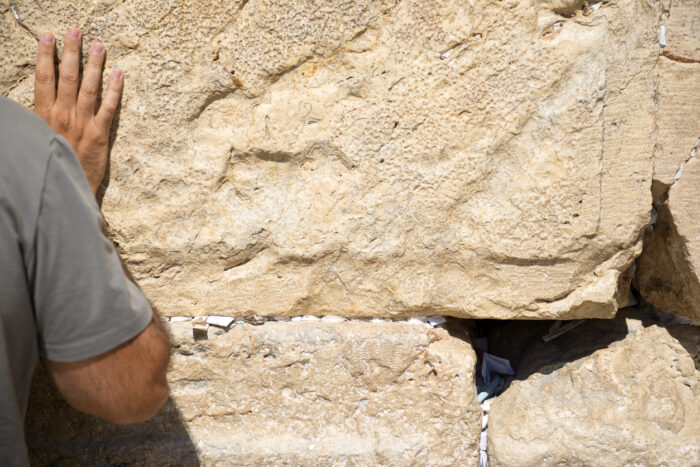
He had walked the 2.5 miles from our apartment up to the Western Wall. When he got there, strangers had gathered him in, had helped him find a siddur with transliteration, and had helped him push through the crowd to lay his hands on those stones, polished smooth by generations of other hands. This child, this dear one, who had explained to me that very day that he couldn’t imagine having an emotional or spiritual attachment to God… This young man tried to explain to us the sensation of standing there weeping and pouring out his heart to God. He was lit with a Holy Fire. Suddenly, he knew what his life was for. And it wasn’t what we had in mind.
His Ima sat at that table blinking back tears so she wouldn’t break the spell.
And his rabbi was thinking, “Ooof, great intro for a drash!” Because a strong theme running through the Torah and Haftarah readings for Rosh Hashanah is parents and children. In our Haftarah today, the Jewish people are compared to a beloved child who has become estranged from his parent and who has suffered because of it. But even moreso, in the stories we have in the Torah readings and in the Haftarah for the first day we see parents handing over their children to Fate—to possible death.
First, Sarah and God require Abraham to exile Hagar’s son into the wilderness with only a single canteen-ful of water. Next, Hagar places her son under a bush because she can’t bear to see him die. Then, the most notorious, God requests and requires of Abraham the literal sacrifice of Sarah’s son. How can we make sense of this?
I think a possible key to this lies in two things. The first is a single word, “na’ar” or youth, and the second is the story of Hannah and her child, which we read yesterday.
Let’s deal first with na’ar. A careful reading of the stories of Ishmael and Isaac can leave you very confused about the ages of these characters. Their parents sometimes treat them like infants or at best toddlers, but the narrator does not. Ishmael is at least 14 when he is exiled, and he is described as a na’ar – a youth, yet his mother places him under a bush. I know of no 14-year-old who would tolerate being placed anywhere. So there’s a disconnect here. We know he’s a teen or older, but his mother treats him like a helpless infant. In fact, when Abraham packs them up that morning, it says that he places his son on Hagar’s back. The story seems to be deliberately keeping us confused as to Ishmael’s age.
And Isaac, if we follow the logic of the story, has just been weaned when God demands that Abraham give him back. So he would have been about 3 years old. And when it comes time to slaughter him, his centenarian father picks him up and places him on the wood prepared for the sacrifice. However, Isaac too is described as a na’ar, and he is old enough to ask his father a very knowing question (“Here is the wood and the flint stone but where is the lamb?”) and strong enough to carry the wood and the flint stone up the mountain.
These are young men facing their destinies, while their parents are still thinking of them as toddlers.
Between these two stories we have the wisdom of Hannah.
Hannah, whose heartfelt prayer gave us the template for how we daven the Amidah, the main standing prayer of our service, to this day. Hannah, who begged God for a child, and who, as soon as that toddler was weaned, brought him to the priests in the Temple and turned his life over to the Holy One.
Hannah reminds us of the thing we forget every day, as we’re trying to find shoes ten minutes before school starts, or asking again about those college applications, or questioning the size of the mortgage they’ve taken on.
Somehow, we have to learn from Hannah that the Source of All Things has some kind of plan, has some intention for these unique souls we have helped to bring into the world.
Our children’s lives have their own purpose. And that purpose may be incomprehensible to us. But it is theirs. And it is holy.