
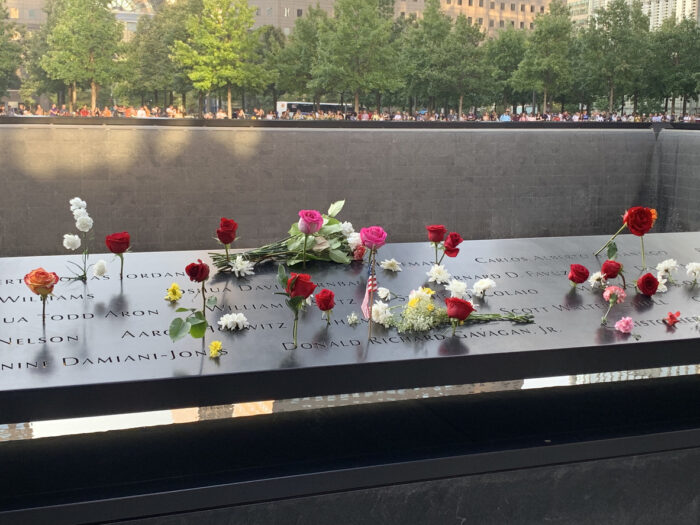
There are as many experiences of 9-11 as there are people who were alive on that day. Recently, I have been asking people about their memories of that day.
One friend’s sister overslept and missed her flight, and as a result did not crash into the Pentagon.
Another had a friend from elementary school who perished in the Pentagon.
I could fill a sermon with these stories.
I could fill a sermon with your stories.
When we look back on 9-11, we can’t help but be inspired by the heroism that so many showed that day: from the civilians who tackled the hijackers once they understood what was happening, to the first responders who continued to work tirelessly to search for survivors, to the people who opened their homes to strangers who were stranded when transportation in Manhattan and air travel globally shut down.
Compared with those who lost loved ones or were on-site, my own experiences of that day and the aftermath are fortunate, and nonetheless, transformative. 9-11 is one of the reasons I am standing here today.
On the morning of 9-11, my husband took our children to the daycare center in the small NJ town where we lived. The previous Friday, my daughter had started in the infant room at her daycare. We were just starting to familiarize ourselves and build community, but we never met one of the mothers, Kristen Christophe. Kristen was an acclaimed attorney working in the Twin Towers. She called her husband Charles when the first plane hit to say she was safe. Charles never heard from Kristen again. On September 13th, 2001, their daughter Gretchen, my daughter’s classmate, turned one.
In the days after the attacks, Americans of all faiths flocked to houses of worship. Individually and collectively, we searched for both comfort and answers. There was something both profound and ironic about looking for those answers in religious community. Those who perpetrated the attacks on the United States that day did so professing faith, claiming religious obligation.
Christian minister and theologian Barbara Brown Taylor was teaching an introduction to world religions class at Piedmont University in North Georgia. On the second Friday in September 2001, she scheduled a field trip to witness Muslim prayers at a Masjid in Atlanta. Despite the attacks, the trip went ahead. Like all American houses of worship, this one was filled to capacity. The Imam spoke in English, as Brown Taylor recalls it; among the things he said: “The actions of the hijackers exposed the falseness of their claim to being Muslims. The only sympathy possible for them was the sympathy one might have for people who have lost their minds.” Returning to his text, he explained the long lineage of Muslim scholars who have worked collaboratively for centuries to interpret the Qur’an in the most humane ways and how they are more to be trusted than those who spill blood based on their own readings and ambitions.
It is hard to reconcile the destructive Islamic justifications of 9-11 with the disavowal of the Imam in Atlanta. How can the same religious tradition hold both the seeds of evil and the seeds of good?
A year after 9-11, Rabbi Brad Hirschfield was asked for a PBS documentary if religion caused 9-11. His answer was uncomfortable but honest. “At least some form of religion did, and pretending that it wasn’t is a very dangerous lie we tell ourselves.” Hirschfield speaks from experience with violence driven by religious hatred and superiority. He grew up in a comfortable suburb of Chicago, but in the 1980s, he left to live in Hebron among religious Jewish settlers. Certain that he was doing God’s work, he walked the streets of that Arab city, intimidating the residents with a gun, once even using it.
In time, Hirschfield turned away from the violence as the core of his Jewish commitment. He went on to build a career for himself teaching from a Jewish place of inclusion and connection across differences—connecting with people of all faiths around the world. In his own life, Hirschfield has known religion as both an inspiration for violence and an inspiration for peace.
In 2001, I was working on my dissertation on Jewish domestic life in the 19th century.
I saw this work as a sacred calling. I was rescuing the stories and legacies of those murdered in the Holocaust. But as the fall of 2001 unfolded, several personal experiences shifted my sense of obligation from the past to the present. Among them were the many daily commutes with Charles Christophe, during which I witnessed his grief and broken hopes for his daughter. I began to see that I was called to tend not to the memories of the dead but to the grief and confusion of the living.
Choosing a religious calling does not necessarily mean choosing goodness.
This summer, I spoke with an Episcopal friend who was studying for the ministry back then; at that time, she explained, “After 9-11, Christian seminaries went one of two ways: some doubled down on the righteousness of Christianity over and above other religions, while others chose to build bridges of understanding.” The challenge of forming connections with others set her on a career path to interfaith work and hospital chaplaincy. I wonder who my friend may have become if her seminary had gone the path of Christian superiority.
Judaism, Christianity, and Islam—the three Abrahamic faiths—all provide their believers with a path towards goodness and connection, as well as providing us with a path towards divinely inspired chauvinism that can justify even the most horrific hate and violence.
Lord Rabbi Sacks, of blessed memory, argued that any religious justification of terrorism is a perversion of divine will. But there is no denying that the destructive impulse exists in our tradition alongside the benevolent one. Abraham encountered this dichotomy and had to choose.
Abraham was called by God to sacrifice his son, his beloved son. Nothing could be more violent, yet it was what God instructed Abraham. Abraham followed this call without hesitation. Abraham was faithful; he had always done as God asked, so even when it was hard, Abraham went ahead and did as he was asked. But at the last moment, Abraham heard another call: the angel telling him to stop. This is the peaceful side of Judaism, the one that values human life above blind obedience. Abraham heard that voice, and he stopped. He did not sacrifice his son.
It is easy to think that Abraham, the obedient man that he was, was simply following the last set of instructions. It was much more than that. With both the voice of God and the voice of the angel at hand, Abraham was faced with the same choice we are each called to make. Will we allow religion to lead us to violence, or will we allow it to lead us towards kindness and community?
In his faithfulness, Abraham was willing to follow God towards destruction. But given a divine choice, Abraham chose peace.
In the Garden of Eden, humans existed without understanding the difference between good and bad, without responsibility for our choices. That changed the moment Eve and Adam ate from the tree of knowledge.
From that moment on, our ability to choose between good and bad has been at the core of our humanity, our responsibility to each other and to God.
Though some actions may be justifiable by religious standards, we remain accountable. We must choose how we interpret religious obligation and divine priorities. If we want to move forward and grow spiritually as Adam and Eve did, as Abraham did, as the firefighters who ran towards the towers did, we need to interpret our obligations and commandments not to excuse hurt, but to foster connection, celebrate life, and bring peace.
When we justify violence in the name of God, we create chaos.
Let the profound grief that we feel on this 25th anniversary of 9-11 guide us away from that chaos and towards the best that Judaism teaches: compassion and care.
May the memory of Kristen Christophe and all those who perished on 9-11 inspire us to lift up life and connection. Let us strive to live in a world where no babies grow into women without mothers, as Gretchen Christophe had to do.
It is only by choosing good that we will ensure 5787 is truly a Shanah Tovah.