
I learned to pray, finally. On my birthday, just last month.
I have been immersed in Jewish prayer since I was born. By the time I turned double digits, I learned to lead prayer that I wanted to participate in. As an Orthodox girl, at age 11 (a year before officially becoming a “Jewish woman” according to Orthodoxy), I was banished from my Abba’s (father’s) side of the prayer service, the men’s side where things “happened.” I found myself behind the mechitza (prayer partition). It didn’t help that I didn’t like most of the meaning of the Hebrew prayers that I could understand. The God language was particularly non-resonant. It also didn’t help that everything I learned and practiced implicitly told me that my prayers as a Jewish woman didn’t and would never “count.”
As someone who loves to solve problems, I had a solution to my prayer problems. I proposed running children’s programming. My prayer would “count” for the children, and every one of them was created in God’s image, so there’s that. This plan would also take care of children running around in the hallways and in and out of adult services while letting me choose which prayers to sing, since I would definitely choose prayers to sing rather than mumble, as was common in my synagogue. I could keep the service short and joyful, focus on Torah stories that they and I loved, and then have cookies. Prayer solved. Sort of.
Then my idea of God, as sometimes happens, went through several metamorphoses. The “Dude in the sky,” as my friend and teacher Eliana Light refers to this conundrum, no longer worked for me, but I didn’t have a replacement idea that fit. Becoming a director of education also helped; I did not have to teach about prayer and could fall right back into leading services, where I once more stuck to my original formula: (1) sing, (2) what you mostly believe about God, (3) keep it short, (4) have a good story, and (5) have cookies.
In my 40s, I’ve developed an understanding of God as “Echad” / Oneness and Interconnectedness. God as such a concept is still hard to pray to in our set Jewish prayers, but the concept of God feels closer to what I feel is true to me based on my life, Jewish narrative texts, and the world. My prayer still hadn’t changed much. I learned a lot about prayer from my Christian colleagues, who wrote the most beautiful, meaningful, personal, and spontaneous prayers. I dabbled in this, but only in interfaith interactions.
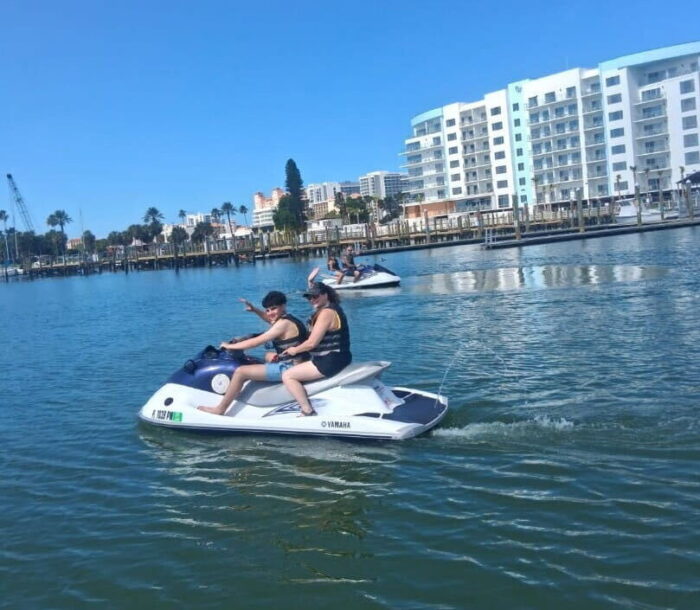
And then I found myself, on my birthday last month, on the back of a jet ski my teen son was driving. I had planned this as part of a wonderful week of vacation mixing adventures he absolutely loved and ones I loved. The only way he was allowed to embark on this particular adventure was if he had a boat-driving license (which he had procured via online learning last summer) and an adult with a driver’s license rode with him. That was me. One problem: I was worrying about this particular part of the adventure from the time we booked it. I just wanted it to happen and be over. I wanted him to have fun and also not throw me off into shark-infested water.
When we first embarked on the water, I suddenly remembered that we were going to be in the bay, with dolphins and manatees, maybe turtles. My favorite creatures. I started looking around while my hands were locked so tightly onto his safety vest that I later found bruises on my arms.
When our journey officially began, I was half-terrified, half in awe of what we might see. I focused with all my might. On what? On the water in front of us, on how safe and secure I did or didn’t feel. On how calmly I yelled, “Slower!” On learning, like with all parent-teen communications, to keep my communications much shorter, only the absolutely necessary, because if he didn’t hear me, he might have turned around to face me to hear me better. This happened once and was the most terrifying. I even learned to stop saying “sorry” as often as I do; it’s too dangerous and was more language than he needed. I focused on body language. If he leaned forward, it was a good idea for me to do so, too. The same for leaning left, then right. Focused.
About 500 hours later (or 20 minutes, I wasn’t sure) we encountered our first creatures, a pod of dolphins jumping out of the bay. Breathtaking and close. Graceful, sleek, joyous. Oh, how silly of me to forget in my fear that on my birthday I would be seeing these incredible beings! A few feet behind the dolphins, one lone stingray threw itself out of the water and arced across the sky before splashing its white belly and gray top back into the bay. It was hard to give up the spot; it was hard to return to the choppy water, calmly screaming “slower,” but off we went.
Suddenly my mind formed a prayer. “May my oneness connect with the oneness of the dolphins.” More flowed forth: “May my echad connect to my son’s joy of speed and jet power.” Then the guide slowed us with a hand motion, one I couldn’t remember or chose not to remember; he was putting his hand on his head. We looked around. There was a shark. “Let’s call it a dolphin, okay?” I pleaded with my son. “Don’t worry. If he gets closer, I will just shoot off and outrun it,” my son tried to reassure me. I answered, “And that is when I fall off the jet into his nose and upset him, so, no…” And so, I tightened my grip, and we were off again; this time my brain said, “Let me connect to the echad of the dolphin (shark) and the stingray.” I meant it; it felt right; it was a fervent prayer. I didn’t question what it meant. I was praying.
With the lone dolphin (shark) behind us, the speed portion of our trip picked up several notches. I watched the guide ahead of us as he bobbed on the foam and waves he was creating. I followed his lead, moving along, left, right, and forward. Only the guide’s waves were not our waves; we were on our own outgrowths of waves, requiring different water dance steps. I almost fell off following waves that had nothing to do with me. I learned to focus on the absolute moment, not anticipating but following. I prayed to connect with the echad of the waves—my waves, not the guide’s.
At the conclusion of the ride, my son was breathlessly excited. “I want to do that again! But faster!” We came up with a plan that worked. This time I stayed on land reading Heschel’s “God in Search of Man” as part of my rabbinical school homework and a long overdue personal goal to finally read his book. My son had the time of his life; he learned to go slower on his own when he needed to. And I walked away with a birthday present of planned and unanticipated adventures. Though it took until my 40s, I finally began to learn how to pray.