
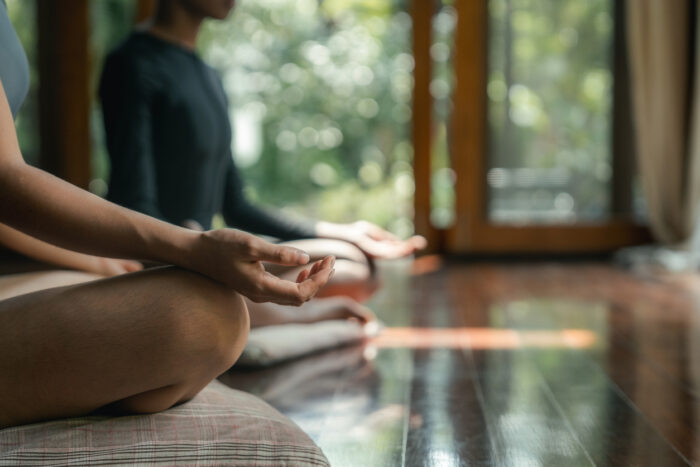
The first time I went on a silent meditation retreat, it was like a revelation. Not at the start. Initially, I was sitting silently with my eyes closed, probably looking peaceful on the outside, but on the inside my brain was frantically reaching for things to do: replaying movies I’d seen, reviewing social interactions gone wrong, investigating romantic entanglements, planning my future week or ten years into the future. But around day four of the seven-day retreat, my mind realized we weren’t going anywhere and started to quiet down. At some point that day, I realized my mind was actually empty and quiet. I’d never experienced that before.
Relief flooded my system. I think I even laughed out loud. For once, I was just in the moment, not worrying about the past or future or anything outside of the room containing me and the body I was in. I also realized God was in this moment, not in my mind, memories of times past, or imaginings of the future. Right now, God was here. And only right now. I wanted to be more present in the moment, and thereby more present to the Divine.
On silent meditation retreats I have been on, whether Jewish or Buddhist in the Vipassana tradition, there is time for learning in the late afternoon, in which the teacher gives a short lesson and the meditators ask questions. It’s always an odd moment of the day; after many hours of silence, we begin talking again. To ask a question during these lessons is like starting a car that hasn’t been working; it takes a while for the voice to kick over.
On that first retreat, after my personal revelation about being in the present moment, I worked up the strength to ask a question during the day’s lesson. I had finally experienced the present moment. But what was the larger picture here? What was the purpose?
My teacher explained: Right action. Awareness and attention to the present moment are only the first step. Building those muscles of self-awareness leads us to also be able to practice self-awareness and quietude in our daily lives, which leads to slowing down our emotional reactions, seeing our interactions more clearly, and choosing to act more compassionately and wisely.
This was news to me. I was all-in for the focusing on the present moment part and the peacefulness that it brought me, but I hadn’t yet seen the bigger picture of what this practice was working toward. You mean we’re not just trying to have a more peaceful experience for the week, like a spa? Yes, I was already traditionally Jewishly observant and concerned with questions of ethical living, but I didn’t totally understand the connection between meditation and ethical action. Once I began to learn this, my contemplative practice became much more important to me, both on retreat and in my daily life, as a way to become a better person and create a better world, one interaction at a time.
Now, twenty years after that first retreat, meditation, prayer, and spiritual chant form a significant part of my Judaism. As both a practitioner and a spiritual leader of these practices, I think a lot about how to explain them to people, how to teach them, and what their purpose is.
Along the way, I’ve become concerned with the way that meditation and other forms of contemplation have become commodified within the “wellness” industry. Divorced from any spiritual tradition from which they came, secularized meditation practices of the kind that are led in high-end spas and corporate retreats aim at acceptance, calm, and resilience—but without any demands on the self or others around us. (No one goes to a spa to be told they should become a better person.) In this context, it’s all about an individual person feeling good.
As Ronald Purser writes in his 2019 book McMindfulness: How Mindfulness Became the New Capitalist Spirituality,
Instead of paying attention to what our thoughts and feelings may be trying to tell us about our experience …and rather than listening to internal voices of dissent, or our reasons for frustration with bad bosses, social injustice or pointless tasks, we are taught to self-monitor internal states so we become more skilled at riding the waves of competitive enterprise. (p. 174)
In other words, when the message is simply, “Accept what is and you will be more peaceful and feel better,” the practice can serve to a) absolve someone who is actually harming others through their business or personal life or b) silence someone’s correct critique of the systems around her because she should rather locate her unhappiness in herself and her inability to “accept” it. Neither is an ideal outcome from where I stand.
How could we navigate this tension between accepting what is and articulating what might need to change?
Let’s look to the Jewish concept of sova, or “contentment.” Sova is from the Hebrew root sin-bet-ayin and it shows up in a variety of places in our sacred texts and liturgy. In this week’s Torah portion, Eikev, we read the line that inspired what is now Birkat HaMazon, the gratitude prayer after eating: “V’achalta v’savata u’verachta”—”You shall eat and you shall be satisfied and you shall bless” (Deuteronomy 8:10). In the Shabbat morning amidah, the main prayer of the service, we say, “kulam yisbi’u v’yitangu mituvecha”—”we shall be satisfied and rejoice in your goodness,” and later in the same prayer we ask God to “sabeinu mituvecha v’samcheinu bishuatecha”—”satisfy us with your goodness and make us happy in your redemption.”
It’s odd, really, to pray for “mere” contentment. Why, when we could be praying for wild abundance, do we just pray for contentment? Why is the vision in the Deuteronomy verse of being in the Land of Israel and everything going well that we will “eat, be satisfied, and bless,” instead of, for example, “eating until we are totally full to bursting”?
There is something important about being satisfied and content. In this Biblical meaning of sova, it’s about having what you need. Throughout the Tanach (Hebrew Bible), it is connected to either literally eating or drinking one’s fill or receiving the amount one needs (for example, in years of life).
In the contemporary wellness sense, being content has the connotation of accepting what is, no matter what is. In Jewish tradition, we also seek to be content, like in our Shabbat prayer mentioned above. Shabbat is the day when everything is as it should be, when we get to put down our work and efforts and just be. That part jives with a contemporary wellness approach. However, what’s implied by a Jewish sense of just being on Shabbat is that during the rest of the week we should be doing. We’re not meant to focus internally only on ourselves; the rest of the week we should be working to make the world a better place.
Contentment in the Jewish tradition does connect with being satisfied with what is, with having the faith that what God has given you could be exactly what you need. But it also requires ethical action—something contemporary wellness meditation could use more of.