
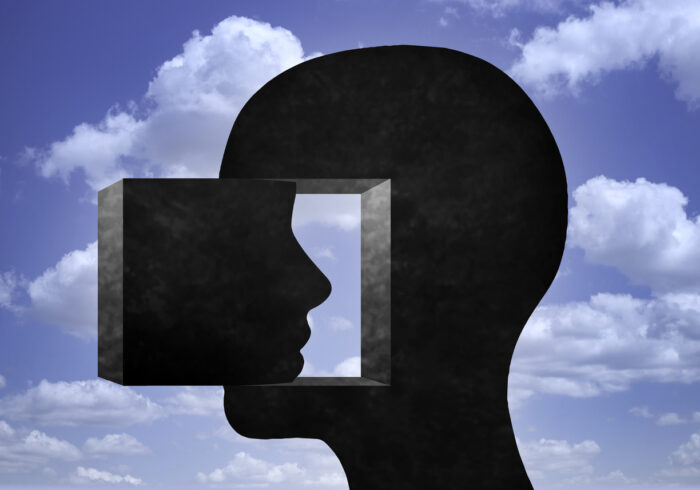
We say “Love your neighbor as yourself” (Lev. 19:18). It is our Jewish version of the Golden Rule, which exists across nations, cultures, and ideologies. Judaism has a unique take, though: We are required to love ourselves. And to do so, we must also know ourselves. For how can you love what is foreign and unknown? Not knowing is the basis of sinat chinam, baseless hatred, or prejudice, or any xenophobic dehumanization of the other. We often interpret what is unknown as something dangerous that must be feared.
In a world driven by social media and A.I., where our sense of self is ever more externally validated through likes, reposts, shares, followers, and other metrics, how do we live this greatest command? To love ourselves?
I was recently listening to an interview with Ezra Klein and author Gary Shteyngart. In it, Klein and Shteyngart had an exchange about our obsession with metrics—as in how many likes did I get on that recent post? They explored how this focus on social media for our validation makes it harder to talk to one another, because it is not within one another that we are finding our validation, but rather through a thumbs-up emoji. So, we are no longer practicing speaking to other people, which here, Shteyngard refers to as “verballing.” Without talking to other people, without practicing expressing to each other our own thoughts, feelings, and experiences, we are also losing our connection with ourselves.
Shteyngart: Letting sounds come out of your mouth as communication is very hard for people to do; much harder, obviously, than sending emojis or shortened text messages and stuff like that.
I think it’s interesting when you look at someone who is, for example, doing looksmaxxing, who is using a hammer—talk about the opposite of joy. This anti-enjoyment. You’re hammering your cheekbone in to make it a certain metric. And you feel like this is how you make yourself attractive to women.
But the real way to attract women—I learned this as a small, furry immigrant without a great deal of good looks—is by verbaling with them and saying interesting things, being an interesting human being, listening to them and then getting into conversations with them—having any kind of charisma that allows you to actually interact with somebody of the opposite or the same sex, whatever your preference is.
And this is like: No, we can’t do that. We can never achieve that level of being interested in another person or even being interested enough in our own interiority to access that kind of level of interaction.
So it’s hammer time. We’re going to get that hammer and just chisel ourselves.
If you are wondering, “looksmaxxing,” according to Wikipedia, is “an online self-improvement practice from the manosphere focused on maximizing one’s physical attractiveness… Looksmaxxing is very broad in the methods used to improve appearance; they can range from benign practices such as skincare routines and gym use, to more extreme interventions, such as invasive cosmetic surgery and the use of anabolic steroids. Commentators generally criticize the concept as being judgmental and harmful to its practitioners (“looksmaxxers”). Communities and influencers associated with the practice are described as rating individuals’ appearance without concern for their overall well-being…”
Looksmaxxing seems to be applying to men the same objectification that feminists have fought back against for decades as it applies to women. The obsession with women’s external appearance has damaged us for centuries, if not millennia. It says your interior self is irrelevant if your exterior self is not pleasing to others, often in a sexualized way. Love your neighbor as you love yourself requires not only loving yourself but having one. This reinforcement of the external over the internal self makes the Golden Rule ever more impossible.
In this same interview, Ezra Klein continues to tease out the extent of this trend away from knowing our own inner self, which he names here as interiority:
Klein: There’s been a fascinating recent trend among Silicon Valley types where they’re on a tear against interiority. You had Marc Andreessen [billionaire, venture capitalist, Silicon Valley businessman] talking about how he doesn’t want to have interiority. He doesn’t want to have introspection…
Archival clip:
Interviewer: You said something that I love, and I never hear other entrepreneurs think about, talk about, but I think it’s super-important — that you don’t have any levels of introspection.
Marc Andreessen: Yes. Zero. As little as possible.
Interviewer: Why?
Marc Andreessen: Move forward. Go. Yeah, I don’t know. I’ve just found people who dwell in the past get stuck in the past. It’s a real problem. It’s a problem at work, and it’s a problem at home.
Klein: I’ve been trying to think on this… a lot of modern intellectual culture is very neurotic and very anxious and is endlessly displaying how anxious it is. But then you go all the way to the other side, to where you’re not thinking in a deep way about yourself at all, and not trying to self-understand at all. That is the opposite problem and dysfunction.
It’s as if people are experiencing so much anxiety in the world right now that the way to manage the anxiety is to cut ourselves off from our own interior landscape, instead of trying to mitigate the anxiety, to learn to live with the discomfort it creates, to learn from it, or, maximally, to embrace it.
What seems to be clear is that as modernity advances, we are not happier people. We are more anxious, we are separating from ourselves, and we’re literally hammering our bones to be more beautiful, but we’re not more loving, more caring, or more satisfied. As Steyngart says,
“When I look at what the great industrialists of the world have given us lately—the last 25 years, 30 years—have they really been that great in terms of life?…[T]his is not a happy life that has been wrought by these wonderful industrialists who create screens and algorithms that have destroyed my life to a very large extent.”
Technologies, tools made by humankind to hack our lives in one way or another, have long been a hallmark of the human experience and of human ingenuity. And many of our technologies have made life better in some ways while also straining our ability to connect with one another. The tools of A.I. emerging in the world now are beyond what we have seen before. These new technologies can function in ways that it understands but we do not. Literally, A.I. can solve problems we present to it, but it cannot explain to us how it got the answer. What we are seeing now is that while our newest technologies make us more efficient, productive, or even smarter, they are not making us happier, and they are pulling us apart, one from the other, as well as away from our own sense of self.
I want to make the case here that faith traditions and wisdom traditions in general, but Judaism specifically, believe deeply in true interiority. And that leaning into these faith technologies concurrently with these other technologies may offer some solutions to the problems they create.
We Jews have always been an internal, if not downright cerebral, people. Historically, the whole enterprise of Jewish law is the externalization of the internal landscape. Legal codes throughout time and space ask, How do we make the mundane of this human being into something holy through Jewish law? When something does not sit right with us, we have looked to law to resolve the cognitive dissonance of conflict. While I am not a halachic Jew, as in Jewish law is not the Jewish organizing principle around which I structure my life, I love its history and its movements; how it reflects who we are and where we have been. To be so prolific in writing about and determining Jewish law, we have needed to have a deep interiority.
As more of a cultural or ethical Jew, I see the call to interiority in the way we have studied and learned texts for millennia. When the Second Temple was destroyed, we turned, as a people, towards study and prayer. Study to improve our minds and prayer to deepen our spirit or connection with The Divine. What is more interior than mind and soul?
We have historically been denied access to many trades and traditions, such as land ownership and therefore farming or building, that might have made us more physical and less internal people. Instead, because we were so often exiled from one nation or another, we built skills which traveled with us in disciplines such as banking, medicine, or education. We have passed down a focus on the interior landscape through our ways of life and through our traditions. Let us consider Yom Kippur. A whole day to think back on a year gone by and to feel the pain of the harm we have caused others.
The ultimate example of the Jewish emphasis on interiority is Shabbat. In Pirkei Avot, a third-century ethics text found within the Mishna, the first Jewish legal code, there is an exploration of Shabbat. Dr. Rabbi Shmuley Yanklowitz, in his commentary on this text, Pirkei Avot: A Social Justice Commentary, writes:
We are in an age of constant demands on our time and attention. As the insatiable demand for more consumer goods delivered at a quicker pace becomes normalized, workers experience more oppression, animals are more readily abused, the environment is harmed, and leisure time is diminished. All contribute to unhealthy people and a sick society. This is where the Sabbath comes in. The Sabbath acts as the great adjuster to both temporal and intangible time…Six days of labor represent human potential, what we create with our God-given faculties [such as all the technologies we have created]. Shabbat, paradoxically, is the zenith of actualization. [This Mishnah about what was created right before Shabbat] represents the complex intersection between potential and actualization, fate and destiny, the unpredictable and the inevitable. These phenomena …force us to expand our consciousness, which in turn allows people to reflect and think about the broad issues facing the world today. These attributes of Shabbat should give us focus and the drive to turn dreams into reality. (p. 300)
Shabbat is our opportunity to take it all in, process the complexities of the world we have created, pause, breathe, refresh, and then head back out to do it all again.
Lastly, I want to offer here a framing of the Shema prayer as focusing ourselves on our own interior spaces. The Shema reminds us to pay attention. It says “listen / attend Yisrael” which here I will translate “Israel” not as a people but literally in Hebrew as “those who wrestle” with the sacred. To wrestle with the sacred, we must pay attention to both what is within and what is without. And beautifully, this call is preceded and followed in our prayerbooks by prayers about love—our love for God and God’s love for us. Our tradition has long understood that this call of tuning in is both simple and profoundly difficult, and so it is held in the liturgy within a loving embrace, to offer comfort and encouragement in the work that it takes to do this and to do this well.
While I was writing this piece, my daughter just asked me a question and I told her I was deep in my brain right now and that I needed a minute before I could answer her. Being in our interior, reflecting on the lives we are living, is just part of who we are. Interiority is a thing for us Jews. In our current day, we are surrounded by so many new and exciting tools and technologies. I hope we can balance the ways that these technologies draw something new out of us and into popular culture without forcing us to let go of the robust landscape within us. And when, in this push-pull, we find ourselves tipping away from the self, the many access points to interior life that Judaism provides will ever offer a way back home to the space within.