Jewish tradition has a beautiful teaching about thirty-six righteous people—the lamed vavniks, named for the Hebrew letters lamed and vav, which together stand for the number thirty-six. The teaching holds that in every generation there are at least thirty-six truly righteous souls whose goodness is the reason that God lets the world go on existing; without them, the story goes, the weight of human cruelty would cause creation to collapse. The beauty of the teaching is that the lamed vavniks are hidden—they are not robed sages or famous holy figures, but the unassuming shoemaker, the farmer, the neighbor who slips you a kindness without expectation of reward. They don’t know that they are among the thirty-six, and crucially, neither do you; the woman behind you in line at the grocery store or the man sweeping the street could be one of the souls holding up the world. The call to action is not to find and identify the thirty-six, but something much more demanding and universal: to treat every single person as though they might be one of them, and to live in such a way that, for all you know, one of them might be you.
The lamed vavnik tradition is one way to reframe a question that many of us carry more heavily as we age: Does what I do still matter? The legend’s answer is radical in its ordinariness. Righteousness isn’t reserved for the famous, the powerful, or the young and able-bodied; there is nothing in the story that suggests that good acts diminish with grey hair or a slower step. If anything, the hidden righteous are defined by exactly the qualities a long life can deepen—steadiness, humility, attention to others. This raises the possibility that living with meaning and purpose is not something we age out of, but something we can grow more capable of.
And it turns out this isn’t only a matter of faith or sentiment, but it’s also a healthy way to live. A growing body of research suggests that how we think about aging—whether we see later life as a season of decline or one of continued meaning—measurably shapes how we actually age, from memory to mobility to how many years we live. In a recent study of more than 11,000 adults over the age of 65, Yale epidemiologist Becca Levy found that half of the sample showed measurable improvement in memory, cognition, or walking speed over 12 years of data, and that those holding more positive age beliefs at baseline were significantly more likely to improve, after controlling for age, sex, education, depression, and chronic disease.
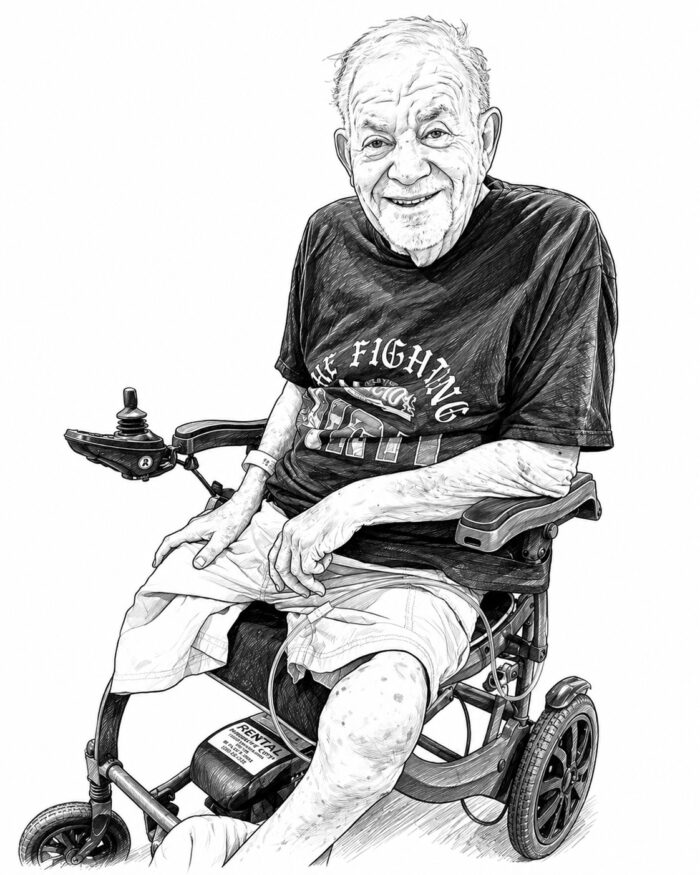
A few weeks ago, I met with Paul Rosofsky, a 92-year-old man who is committed to purposeful living even in the face of enormous adversity. Paralyzed for the last four years after a spinal cord injury, Rosofsky has also survived sepsis, endocarditis, a run of hospital stays for infections and bouts of pneumonia, the amputation of his right leg, and the week I spoke to him, he was three days from surgery to amputate the other. What struck me, over more than an hour, was not the catalogue of medical events but his unshakeable calm. People who know Rosofsky describe him as relentlessly positive, and I wanted to know where his sense of purpose comes from and how it survives contact with real pain. His answer was plain. “The sun comes up tomorrow for me. God has provided me with a new day. I choose to make the most of that day. Whether I have my legs or not, I can determine what kind of day it’s going to be.”
His purpose is three-fold: family, faith, and making a contribution to the world. He talks about his daughters, sons-in-law, and grandsons as his legacy, the only kind that counts. “It’s not the plaques on the wall,” he says, “it’s the people you’ve touched.” His faith is not a recent consolation but a lifelong fixture, a sense that he was given gifts and owes the world something in return. And he is determined, once he heals, to return to volunteering on the palliative care ward of his local hospital, partly because he has spotted a gap in services for disabled people who are not veterans, and partly for a blunter reason. “The more you give, the more you get back,” he says. “Volunteering is what’s going to keep me alive.”
What follows are highlights from our conversation.
Q: When you look back over the last several years, what stands out as the turning point when life changed dramatically?
The defining moment was my spinal cord injury. I went to sleep one Friday night after attending religious services, feeling completely fine. I woke up the next morning paralyzed. I couldn’t move my legs and had no idea why. It was terrifying. A surgeon told me, in the bluntest possible way, that I would never walk again and should essentially go home and die. That was the lowest point of my life. From there everything changed—my health, my independence, my daily routines. I went from being someone who drove friends to the airport just to save them a taxi fare to someone who suddenly needed help with the most basic tasks.
Q: How did you cope with the loss of independence and the need for caregivers?
It was deeply embarrassing at first. I had always been fiercely independent, and now I needed help getting dressed, washing, managing incontinence—everything. But I realized I didn’t have a choice if I wanted to live. I had to accept caregivers and a new way of being in the world. I like to say that night was the worst of my life, but it also showed me that if I could get through waking up paralyzed, I could get through anything that followed.
Q: That’s a remarkably positive outlook. Have you always approached life that way, or has it developed in response to these challenges?
It’s always been there. For me, “the sun comes up tomorrow.” I could have thrown in the towel a long time ago, but I refuse. I believe each new day is a gift. Whether I have my legs or not, I can decide what kind of day I’m going to have. That doesn’t mean the days are easy. I’ve had hospital stays, pain, bad nurses, bureaucracy, but I hold on to the idea that “this too shall pass” and ask myself, “What will you do with the day you’ve been given?”
Q: You speak often about God and spirituality. How have the last few years affected your faith?
They haven’t really changed it; they’ve confirmed it. I’ve always felt I have a relationship with God. I believe God has given me great gifts, and with them comes responsibility—to make God’s world a better place. I see life as a struggle between the forces of good and the forces of evil, and I know which side I want to stand on. I also believe we’re more than our bodies. The body dies, but the living soul—the part given to us by God—does not, even if I don’t know exactly what happens next. I’m very open about the fact that I think about death and welcome it when the time comes. It’s the “last great unknown.” I’m curious: Is there something more, or is it simply nothingness? Either way, I won’t be afraid. What I hope for is that what is truly alive in me continues.
Q: You’re about to have another major surgery—losing your left leg. How are you thinking about the future?
I’m going into surgery resigned but not defeated. First, I want to heal and see how I can function with no legs. After that, I plan to return to volunteering in palliative care. That’s not just “giving” to others; it’s what keeps me alive. The more you give, the more you get back. I see a gap in care for people with disabilities who aren’t veterans—there’s a lot for veterans, but very little for others. I’d like to have a hand in changing that, even if only in a small way.
Q: Family and relationships come up again and again when you talk about your life. What do they mean to you now?
They’re everything. My daughters, my sons, my sons-in-law, my grandsons—they are my legacy. It’s not plaques on the wall that matter; it’s the people you’ve touched. I look at my daughters and see strong, capable women who will be fine when I’m gone. That gives me tremendous peace. At the same time, I know my death will leave a hole, especially for [my daughter] Meryl, because we’ve had such an unusually close relationship and she has taken on so much of my care and advocacy. I also feel the presence of my late wife, Dena, very strongly in our home. People have told me I should move to a facility, but I always say I’m never leaving this house. Her spirit is here. This house has a spiritual warmth; people feel it when they walk in. That’s where I want to live out my days.
Q: You received a Lamed Vavnik award from your synagogue, Temple Shalom. How has that shaped your sense of purpose?
The award is based on the Jewish legend of the lamed-vavniks, thirty-six righteous people hidden in the world, doing God’s work without knowing who they are. Two of the other recipients were giants of community service. To have my name mentioned alongside theirs was profoundly humbling. I don’t believe I’m one of those hidden righteous people, but seeing that trophy reminds me of my responsibility. People think I can live up to that standard; I don’t want to let them, or myself, down.
Q: Looking back across your life—from a difficult childhood to this chapter of disability and illness—how do you see your journey?
My childhood was hard: poverty, mistreatment, a domineering stepfather, a mother who often saw the world through a lens of misfortune. You wouldn’t guess that, looking at me now. But those experiences forged who I became. Very early on, when I was just a schoolboy, I answered a question about what I wanted from life by saying, “A wife who loves me and children who respect me.” I probably didn’t understand then what I was saying—but I do now. I had a wife who loved me with every fiber of her being and three daughters who love and respect me. Add my sons?in?law and grandchildren, and I can honestly say I’ve had an embarrassment of riches. I feel I’ve accomplished everything I set out to do. I’m ready, when the time comes, to leave nothing on the table.
Q: And between now and that time?
Between now and then, I intend to use every bit of “gas in the tank” to do God’s work—to make the world a little better, to keep loving my family, to keep showing others that even when “shit happens,” they can still live meaningfully. If I can be an inspiration to even one person, that will be enough.
Rosofsky’s surgery was successful, but in the weeks that followed, he was again hospitalized after contracting pneumonia. He has now made a good recovery and today, July 2, he celebrates his 92nd birthday. Happy Birthday Paul!
Photo of Paul Rosofsky, illustrated using AI, pictured a few hours before surgery.