
I had the lovely opportunity to be in New York City the other day. And an even lovelier opportunity to have some free time. I was strolling down 5th Avenue with no particular aim or direction, and I wandered into Tiffany’s, the way you do when it’s cold outside, and beauty feels briefly like a place to stand.
The store was quiet. Almost empty. I found myself lingering near the watches, admiring them from a careful distance, aware that nothing there was meant for me. Or at least, nothing there was meant to leave with me.
A man approached and asked if I wanted to try anything on.
I shook my head. No, thank you. I didn’t want to waste his time. I knew I couldn’t buy anything in that store, and I said as much.
He paused and looked at me. Then asked again, gently, “Are you sure?”
I explained myself—how I didn’t want to take up space that belonged to someone else. Someone who could actually afford to be there.
He gestured around the floor. It was nearly empty. He had time, he said. Plenty of it.
So I tried on a watch.
It was beautiful in a restrained way. Balanced. Thoughtful. And suddenly he was telling me about it—how the design echoed watches from the 1950s, how mechanical watches are still assembled largely by hand, how the smallest gears require patience and precision. He spoke the way people do when they care about something and want you to care about it too. This guy had passion, and his passion was watches.
At one point, he said something that stayed with me.
He said that wearing a watch like this—one that isn’t digital, isn’t smart—seems to slow time down a little.
He smiled right after, quick to say that he knew it wasn’t literally true. Time moves as it moves. But still, he said, it feels different.
Then he showed me the watch he loved most.
Not one from the case. His own.
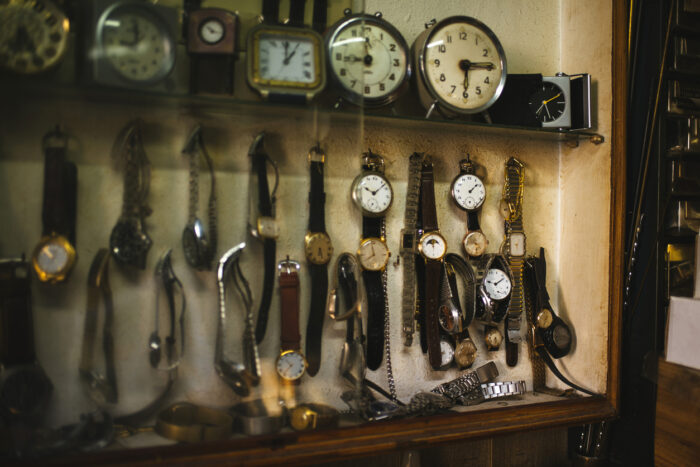
He had built it himself over years, piecing it together from mismatched parts. The band was worn and frayed. It didn’t gleam like the others around us. It wouldn’t draw attention unless you were paying attention.
His expression changed as he spoke about it. There was pride there. Care. Something quiet and personal.
What struck me most was the setting. We were standing in Tiffany’s—glass cases, precise lighting, objects polished to the point of near anonymity. Everything in that room seemed designed to suggest perfection. Like you’ve finally arrived.
And in the middle of it, he held out a watch that resisted all of that.
Its parts didn’t quite match. The band had softened with use. It didn’t pretend to be new. It hadn’t been protected from time so much as shaped by it. In that space, surrounded by objects meant to impress, it felt more human than anything else in the room.
I left without buying anything. But the contrast stayed with me.
Lately, I’ve been part of a project that asks people to give one another time in a similar way. Jewish and Christian teachers and leaders sitting together, not collapsing our differences and not resolving them quickly, but staying long enough for the work to become careful.
We’re writing a curriculum together.
That’s the efficient way to say it. The lived version is slower. It involves sitting with texts that don’t belong to all of us in the same way and noticing when a word that feels neutral to one tradition carries weight or history in another.
Sometimes a conversation stalls not because we disagree, but because we’re trying to be careful and we realize we don’t yet have the words we need. When that happens, the only honest response is to wait until it can be handled with more precision and more care.
The work requires us to give time not just to ideas, but to one another. We’ve stopped to recognize when something that sounds clear is actually too quick. Revision becomes less about correction and more about fidelity to the people in the room and to the traditions we’re trying to honor.
I’m still learning what Judaism teaches about time. I don’t speak from expertise. I’m learning by proximity—by being slowed down in rooms where time is treated seriously, where patience is a discipline.
Christian faith tells its own story about time. About a God who does not remain distant from it. About staying present in the long middle of things, even when clarity comes slowly and the work resists efficiency.
Somewhere in the space between those traditions, this curriculum is taking shape.
It isn’t moving quickly. And it would lose something essential if it did. What we are building depends on the time we are willing to give to one another.
That’s why I keep thinking about that watch in Tiffany’s.
In a room designed around polish and precision, the object that mattered most was the one that looked unfinished, that carried wear and existed because someone had taken the time to assemble it and keep it going.
And when this work is done, we’ll leave with something shaped slowly, by people who stayed long enough to build it together.