
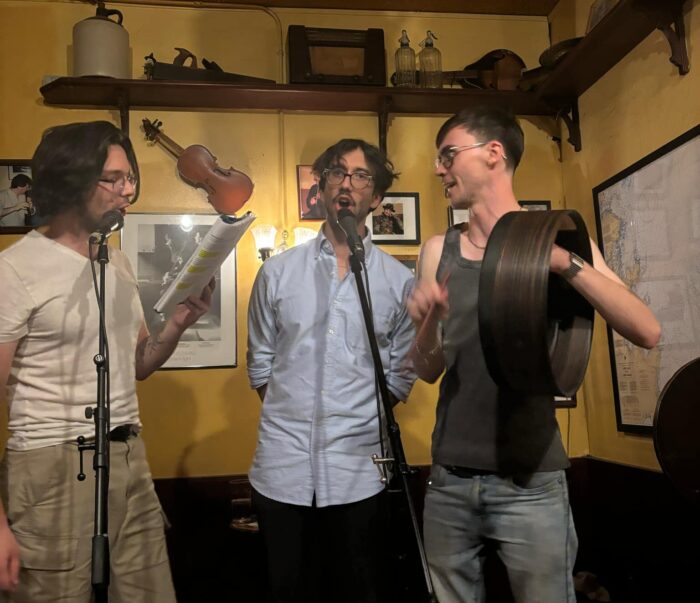
If the standard-issue existential despair of the twenty-first century is proving a challenge for you or members of your community, I’d like to make a suggestion: Get together and sing a bunch of sea shanties as loudly as possible.
I say this having had the privilege of co-hosting a sea shanty singalong night that takes place every three(ish) months at a pub in Toronto. Originally started as a small event for our friends, it has now run for eight years. We average about 150-200 attendees over the course of the night. Most of them are between the ages of twenty-five and thirty-five, but there is always a peppering of children and seniors.
It turns out that a diverse cross-section of the populace has a deeply emotional response to roaring out lyrics about maritime labour. Numerous attendees have spoken to us about feeling there is an expressly spiritual dimension to the experience. This has happened so frequently that whenever someone asks us “Why do you do this?” we now respond, half-glib and half earnest, “Because no-one goes to church anymore.”
How has our sea shanty night created a loose consensus that it gestures to the sacred?
It’s my belief that, in the interest of making our event fun and memorable, my fellow host and I unconsciously calibrated it to do this. Specifically, the way it’s been structured around three key elements.
First, an emphasis on participation. A description:
- We sing exclusively from printed lyric books that we give out. These contain about forty sea shanties and work songs, selected for their energy and accessible melodies.
- Everyone in the room is expected to sing the chorus together. Immediately before singing each song, we teach everyone the relevant melodies.
- Attendees are invited to get up and sing the verses to tunes that they know. Imperfect singing is welcome and the hosts are always onstage to support.
- There is no setlist. We’ll sing 3-4 songs from the book and then break for ten minutes, during which we take further song requests and people volunteer for the next set. We repeat this ad infinitum for around four hours.
- At some point during the evening, I read a single poem aloud. Crucially, it is never one that I have written.
All of this is structured so that people feel able to take part. Shanty night becomes something that allows the attendees to make the event their own.
But escape rooms and baby showers are also highly participatory, so there are clearly other features that lead to the “spiritual dimension” of these gatherings.
The second element is the haptic quality of collective song. Most people are familiar with how, in the right context, music will arrive like a wave on the shore of the body. It is easiest to experience among a crowd, but even when alone, we will occasionally feel a beat drop leave a wake of frisson along the surface of our skin, or notice our bones start to resonate with an orchestra that has just bloomed into polyphonic complexity.
Our physical response to music breaks down a lot of our mental and social barriers. This is similar to how horror effectively blends with other film genres by using a crowbar of fear to crack the audience open to other elements: The jokes become funnier, the action more exciting, the social commentary more incisive. Music can enable faith in the same manner, which helps to explain its place at the centre of so much religious worship. I recall a viral Twitter thread by a woman raised in the Southern-Baptist tradition that recounted how her absolute belief in God as a child had been built on a discernible presence she felt every Sunday at church, only to have a crisis of faith when, as a teenager, she experienced the exact same sensation while attending a Taylor Swift stadium concert. Music can physically arrange the individual to commune with something beyond themself.
History is my final suggestion of the trifecta of features that “elevates” our sea shanty night. It is an event where attendees are offered an explicit connection to historical others.
This defies our tendency to see people from the past as foreign to us, as fundamentally different. The tendency is an understandable side-effect of the speed of change since the Industrial Revolution in which, for example, people born in 1890 were able to read about the Wright Brothers first flight when they were thirteen and later watch the moon landing when they were seventy-nine.
But it’s a mistake to think that technological happenstance alters our fundamental humanity. Never trust anyone who claims the generations that came before us were innately better or worse than those of today. We are the same as them. This fact is occasionally made vivid in something like the images left by Onfim, a seven-year-old boy from thirteenth century Novograd, whose homework exercises scratched onto birch-bark skin are full of wonderful doodles.
Singing sea shanties has a similar effect as viewing Onfim’s artwork. It closes the distance with people of the past. Not because anyone in a Toronto bar personally relates to the specifics of sailing around Cape Horn or saying farewell to a lover on the shore, but because they are songs of labour—of common people pushing through quotidian struggles despite feeling themselves at the mercy of greater forces they are powerless to change. What a comfort for us here in the twenty-first century! We look to words written two hundred years ago and see ourselves reflected in them. In the face of uncertainty and despair, we uncover a sense of continuity that is laden with meaning. We bear witness, and are witnessed in turn.
These three elements—participation, collective song, and historicity—function together to create what I’ll hazard to call a moment of presence for the attendees. I draw the word “presence” from the critical work of literary theorist Hans Gumbrecht, who emphasizes the way certain cultural events and experiences have a tangible effect on our senses, emotions, and bodies. Our sea shanty night manages to tap into this idea in some small secular way.
I can say with some certainty that it isn’t “art.” Art requires craft, discipline, and a desire to communicate something in a cohesive way—qualities that become more and more absent as the evening wears on and the number of drinks increases. You do not attend sea shanty night to hear tremendous performances (though they happen!). Rather, the point is to feel part of something fundamental, embodied, and communal.
A final thought: This presence I’m describing is inherently amoral. Participation, collective song, and a sense of historical connection do not have inherently ethical qualities. When combined, they create a moment that is likely to engender a sense of spiritual significance, yet this can occur in a wide variety of contexts. At least at the level of the body, the way nerves and neurons flare within us, political rallies, sporting events, and riots invoke the same sense of presence I’ve described.
To experience a moment of transcendence is not, in and of itself, a reason to declare that whatever caused it is good and just and worthy of spiritual consideration. These moments can arise spontaneously or be purposefully created for us. Everyone must still be able to think critically and morally about whatever leads them to feel part of some greater collective, laden with meaning and significance. Religious worship, a Taylor Swift concert, a populist political rally, and singing sea shanties are fundamentally different in their capacity to fulfil the spiritual promise that is made to us in a moment of presence. Even when the sea shanties are really, really fun.