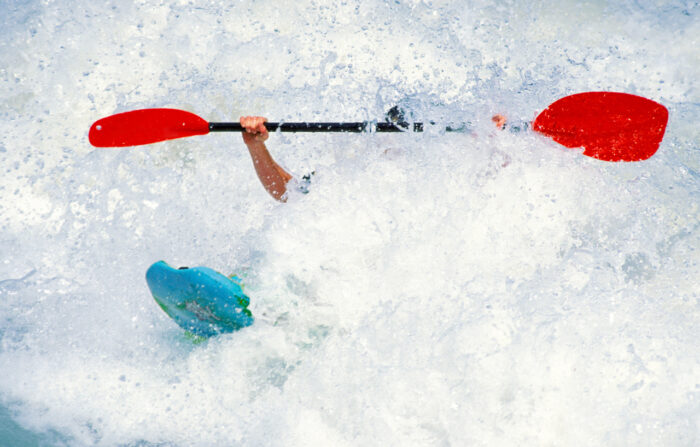
For my fiftieth birthday, I took a four-day, whitewater kayaking class over the Fourth of July weekend, which happened to be amongst the hottest on record. I have never whitewater kayaked before. I have spent a great deal of time in my life whitewater rafting and flat water kayaking. And while those experiences were relevant, what I did was something entirely new. I learned two incredible lessons from this experience, which are gifts as I celebrate half a century on this earth.
Lesson number one: There are always new things to learn.
I remember a conversation with a dear friend and colleague about ten years ago, when I was just a baby at forty. We were reflecting on how few and far between the “aha moments” were becoming and we recognized that it would only become more infrequent with time, as our lives became more predictable.
Personally, I am a long-time adventurer. If you know me or have read my articles in the past, you may know this already. I hiked the Appalachian Trail, I was a chaplain in the Navy and Marines, I have traveled extensively alone, I have lived overseas, I like to participate in mud obstacle course races, and lately I have been making an annual pilgrimage to Colorado to summit mountains that are 14,000 feet above sea level or higher. And of course, the biggest adventure of all in my life is that I am a solo parent. Because I started that experience later than many, I spent my younger years doing many of the less conventional (sometimes I refer to them as “crazy”) activities listed above. It means I didn’t feel I was having the “aha moments” now.
Until I set my tush in a kayak last week. While driving to the third day of the class, I spoke with my parents. My dad, who had learned how to sail in his forties when I was a preteen, was reflecting on his own experience of being a novice as an adult. “I was so scared!”
I also felt scared doing this thing. But I was curious about why he was scared. “Dad,” I said, “you owned the boat outright, you wore a life jacket, you never sailed in anything other than perfect weather with no wind… What were you afraid of?”
To which he replied, “I don’t know.”
When I was in Rabbinic school, I had a mentor who looked at me one day and said, “You keep making safe choices. You keep choosing learning experiences where you are already pretty competent. You’re not going to fail, and if you don’t fail, you won’t learn how to fail well. Now go out there and do something you are bad at.” So I went out into the world and tried doing things I had no idea how to do. I began learning the art of fall-down-get-up and am a better person for it.
I reflected this story back to my dad. “Do you think,” I wondered out loud, “that you were just afraid of doing it wrong?” To which he thoughtfully replied, “…Yes.”
It was with this knowledge that I started my third day of class, knowing that I was afraid of failing, of doing it wrong, that was holding me back. Letting go of that need to succeed and instead welcoming the urge to learn changed my experience of kayaking for the better. I was freer. And I flipped over. And I learned that I knew what to do when hanging upside down strapped into a boat in the middle of a rapid. Relax. Protect your head. Pull the release. Come up for air. Make sure you’re safe. Grab your boat. Go to the shore. Try again.
Lesson number two: my body knows things that my brain does not understand.
After my rabbinic school mentor urged me towards learning to fail, I went out and took African dance lessons. I have never been a dancer. I played soccer and swam but I was never good at dancing, although I wished I were. As a broke graduate student, I spent money to go to a class so I could fail. And fail I did. I remember the instructor asking me to stay all the way in the back. I went three times. I. Was. Bad. For the learning-to-fail experiment, perhaps this was not the bravest approach as I was not risking anything. But it served as an excellent mental tool to remind me to be brave, to take risks. And in this way, it worked. After this time, I became much more focused and adventurous. In fact, it was after this experience that I found the courage to become a military chaplain candidate and to travel much of the world alone.
The unexpected outcome of the African dance adventure was I learned that my body has wisdom that my brain does not have. I tried desperately to dance well or at least not insult the beauty of the culture and the tradition. But try as I might, I could not both remember the dance step I was doing while also anticipating what was coming next, let alone actually move my body in the way I was supposed to. I was exhausted with the effort and deeply discouraged. Then, in the fatigue of trying so hard, I found myself behind an excellent dancer and able to just follow her and do what she did. I found that if I thought less and stayed out of my analytical brain, some core, primal part of my brain could just mimic what I saw.
I have not used that wisdom about myself very much in the intervening years. The occasional line dancing experience or Zumba class, maybe. But then I was in a kayak. And the instructor said, “Go like this,” and I did. And he said, “If you look over there, your body will just know how to ferry across this current,” and I did. My body knew how to balance in the boat, how to pivot, how to hinge, how to not tip over when everyone else did. (No, I did not successfully complete an Eskimo roll where you lose your balance, flip upside down, and then turn such that you come right side up again. I could not see it so I struggled to copy it.) By the end of four days of kayaking, I was successfully and joyously navigating a series of Class II rapids. It took all my mental, physical, and emotional attention. Something happened that allowed me to be so present that I wasn’t thinking, I was just being. And did that ever feel amazing.
I spoke with my spiritual director about being present in my body in this way, and it turns out this type of physical flow state is also a spiritual good. Think about walking meditation or other moving meditations where the goal is to be fully present to your physical self in motion. I was experiencing a moving meditation in real time and in real life. This is the kind of thing I may now choose to engage in more for the sake of feeling closer to The Divine. And then she said the strangest thing. “Well, Rachael, I am not surprised. You are an athlete.”
“Am I an athlete?” I wondered.
I recently reconnected with a friend from high school. Over dinner, we caught one another up on the highlights and lowlights of the last thirty-plus years. As I told my tales of travel, of physical challenge, of rising above adversity, I heard what my spiritual director and perhaps others have long known about me which I am just now realizing. I am an explorer, an adventurer, an athlete, and much more.
While this story of discovery may not be yours, I share it with you here as an invitation to investigate the stories we tell about ourselves. How many experiences or adventures are we closed to because we say, “I cannot do that”? How many conversations do we avoid? How many times do we not say I love you or other brave and beautiful things because we have told ourselves that we just are not allowed?
In my life, I am approaching a new decade, and for those of us who are Jewish, we are rolling into the High Holy Day season. While I am looking back over a lifetime and considering where that brings me now, this time of the year is an opening to each of us to look backward and see where we have been, to look at where our own two feet are planted, and begin to pivot or turn in a future direction of our choosing.
May this season of rebirth, renewal, and transformation move, elevate, and inspire us all.