
In uniform, pastoral care rarely happens in quiet offices. Serving as an Army chaplain stationed at Fort Bragg means I spend long hours in motor pools and humid training ranges, meeting soldiers wherever they happen to stand. When a young soldier approaches me carrying grief or an impossible ethical question, I can’t pre-screen their theology or their politics. I step forward in the dust, look them in the eye, and offer presence. That ministry in the field demands an immediate willingness to meet people outside my own comfort zone.
The concept of hospitality often gets reduced to simple domestic comfort, like an open front door and someone pouring water into clean glasses at the dining room table. It sounds gentle and civilized, yet the foundational account of hospitality in Jewish tradition begins in blistering heat, physical pain, and deliberate self-disruption.
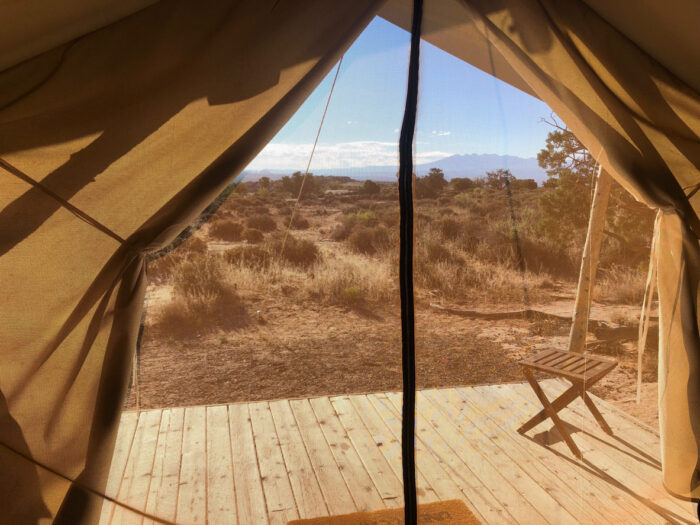
At the opening of Parshat Vayeira in Genesis 18:1, Abraham sits at the entrance of his tent during the peak of the desert sun, nursing the physical agony of a recent circumcision. God appears to him without commands, simply to visit him while he is healing, wrapping Abraham in radiant, unhurried divine attention. Then, when three figures emerge on the distant horizon, Abraham scrambles to his feet, runs into the open glare, and bows his face toward the dust. He could have just called out from the shade or waited for them to approach his doorstep, but instead he begs them to stay, washes the desert grit from their feet, and rushes to butcher a calf and bake fresh cakes. The Talmud in Shabbat 127a derives a radical assertion from this physical exertion: Showing hospitality to travelers must rank higher than receiving the Shechinah, the Divine Presence itself. Abraham was in the middle of a direct, intimate encounter with God, and he walked away from it to attend to mortal strangers walking down an unpaved road.
Rabbinic memory often treats the passage about Abraham jumping up to greet these guests as a heartwarming proof text about hospitality, but that reading casually scrubs out the danger. Abraham had absolute spiritual certainty right in front of him, where God was present and accessible. Staying within that communion would have been safe and completely justified by any standard of piety. Instead, he turned his back on absolute clarity to run toward three travelers whose identities and destination were completely unknown to him. Every chaplain recognizes that pivot: turning away from the quiet sanctuary of our own private faith to run toward the urgent, messy human encounter standing directly before us.
That sudden decision exposes the real burden of welcoming what is outside ourselves. Our physical homes, religious traditions, and even political communities function very much like Abraham’s tent. Inside the boundary, everything makes sense. The vocabulary belongs to us and the shared assumptions protect us from doubt. Walking out to the threshold exposes us to weather we cannot control. It demands that we leave the cool shade of our personal certainties and step into the glare of someone else’s reality.
This is the exact point where genuine hospitality transforms into the harder practice of pluralism. Encounter cannot happen exclusively on our home turf. True engagement does not mean waiting inside until the stranger crosses our sill and flatters our worldview. Welcoming the other means walking out of our perimeter into the dust to meet them, being willing to feel exposed, recognizing that the person approaching carries an entirely separate history and perhaps an agenda that directly complicates our own. Pluralism is a courageous choice.
The physical posture of Abraham’s camp reflects this tension. Traditional commentary notes that his tent was pitched open on all four sides. An open tent offers shelter, but it completely surrenders the illusion of privacy. Wind blows straight through it and every passerby has a clear view of what lies inside. If your primary goal in life is defense, an open tent is a strategic failure. Fastening the canvas tight and lashing the flaps shut keeps out the elements and enforces complete control over who enters. Abraham chose unfastened, wide-open flaps over sealed canvas walls because he understood that a life devoted entirely to self-protection suffocates the spirit.
Hospitality always extracts a genuine tax. The visitors Abraham ran toward were not simple nomads looking for lunch. They were messengers carrying news that would fundamentally rearrange Abraham’s life: Sarah would bear an impossible son in old age, and the cities of Sodom and Gomorrah were marked for complete destruction. Running out to meet those travelers shattered the peaceful silence of the camp and drew Abraham into fierce theological argument with God on behalf of strangers he might never meet. When you open your space to unfamiliar voices, you forfeit the right to remain unchanged.
When we create spaces that only amplify our existing convictions, we mistake quiet isolation for holiness. Our communities end up looking remarkably like echo chambers, and we congratulate ourselves on our internal harmony while the rest of the world walks past our door. Abraham walked away from God to serve human beings because he knew that divine truth does not exist only in solitary contemplation. God appears in the vulnerability of the doorway and in the courage to offer water to a traveler before you know whether they will agree with a single word you say.
If we can treat differing views not as threats to our survival but as paths toward a deeper wisdom, then our world will grow wider. Pluralism does not ask us to abandon our loyalties or bleach away our distinct commitments, but it does ask us to believe that God’s truth is simply too vast to fit entirely within any single tent. By unfastening the flaps and running out to greet those approaching from different horizons, we discover dimensions of reality that our own walls could never hold. The open tent turns the heat of difference into a shared table, and through that willingness to meet, we become partners in mending a fractured world.