
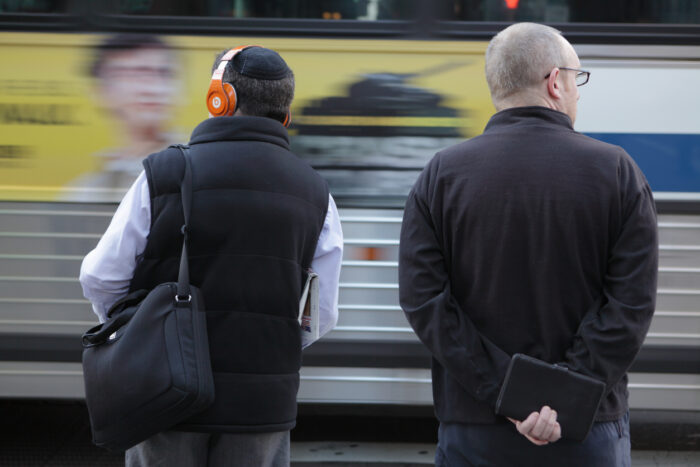
Should I take off my kippah?
I first asked myself that question years ago, before a trip to Hungary. Viktor Orbán was reaching for power by invoking an old script, the anti-Semitic tropes his country knows too well, and I did not want to become a small, portable target for whatever that script might awaken in a stranger. I was not traveling alone. My wife would be beside me, and the fear was not only for me. If my kippah made me a target, it made her one too.
I brought the question to my friend and teacher, Rabbi Brad, a man with a cooler, wiser head than mine. He didn’t answer it. He asked me to ask a different question. For many people I would meet, he said, I might be the first Jew they had ever stood beside in the flesh. Perhaps, he suggested, the kippah wasn’t a liability to manage. Perhaps I was being handed an assignment, an unlikely diplomat to a community that might be more curious than cruel.
I took his advice, and it opened doors I could not have imagined from the outside. Jews who had spent decades in hiding found me because I was visibly, unmistakably one of them, and that visibility told them it was safe to speak. I heard survival stories that had never been spoken aloud before that day. None of it would have reached me if I had made myself smaller, safer, and harder to see.
This is not just a piece of personal history. It’s an argument for a claim I still believe: the kippah was never a challenge thrown at the world. It was a door held open.
I did not expect to be asking the same question again, this time about New York City, in 2026. Yet here I am.
Here are the people I encounter on an ordinary day here. The cab driver who gets me to the airport. The man behind the bodega counter who knows my order before I say it. The woman at the pushcart serving food from a country I couldn’t find on a map, standing beside another cart from a country nowhere near it. The subway platform at rush hour, where I can stand for four stops and watch a whole world get on and off around me, no two people from the same place, all of them going somewhere.
New York was never the melting pot we were taught to sing about, where everyone’s edges dissolved into sameness. It is a stew, every ingredient still itself, still recognizable, simmering together anyway. It is a city built, whatever its failures, on the idea that a person gets to wear who they are without flinching, on that platform, behind that counter, and everywhere between.
I won’t pretend the danger people are naming is imaginary. There is an angry rabble here too, and a hateful mob, and, worse, the lone wolf who needs no crowd at all to do harm. And I won’t pretend that taking off the kippah wouldn’t make me a slightly harder target to find. It would. Hiding works, a little, the way hiding always works. But safety was never the only question worth asking, and it cannot be the only one we let ourselves ask. Playing it smart is real; each of us has to make our own honest reckoning about when a threat is truly a threat, and I won’t tell another Jew what their reckoning should be.
However, a life organized entirely around that reckoning isn’t a life. It’s a retreat dressed up as caution. We need a north star that isn’t fear. Something better. Something that still believes the man at the bodega counter, the driver, the woman at the pushcart, might be capable of curiosity instead of contempt—because most days, they are.
I learned this from my rabbi and friend, standing at a doorway to Hungary, years before I understood what he had truly given me: the kippah on my head was never a target on my back. It was always, and continues to be, an invitation. I won’t let anyone—not history, not a headline, not a lone wolf’s shadow—convince me to fold it up and put it away.