
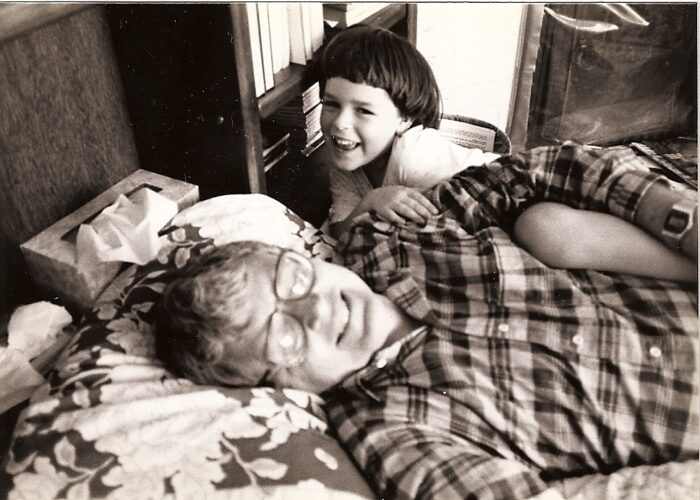
One morning when I was five or six years old, my father put on a pair of pale pink pants. His choice was exceptional enough that I was moved to ask my mother why he’d done it. Without missing a beat, she said, “Because he is a WASP.”
The reflexiveness of her reply revealed what was deeply embedded in the way my parents saw each other: as foreign to each other. My Jewish mother, born a refugee, a polyglot immigrant who was old enough when she arrived in America to remember her boat passage from Europe; my WASP (White Anglo-Saxon Protestant) father, who could trace his ancestry back to the Mayflower. They viewed each other with affection and humor, but also with a certain unease, each a stranger in the other’s land, a tension significant enough to point out, to joke about, to feel.
My father would probably identify as “ethnically Episcopalian:” the Christian faith he describes as a house of cards he could never get to stand up, but the Episcopal Church is the one whose rummage sale he’d donate to. It’s the bubble he’d fill out on the questionnaire. You’re sensing the ambivalence, I’m sure.
When it came to raising me, though, there was no ambivalence: I was Jewish, a hundred percent. While my parents were together my father learned Hebrew, chanted kiddush on Friday nights, and attended services and social events at our local chavurah, JCC, and shul. After they divorced, he moved to another city, and would go to sometimes outrageous lengths to make sure I observed holidays and lit Shabbat candles when I visited or vacationed with him. He still loves to claim I hold the record for the westernmost Shabbos ever made in the United States, which involved two hot dog buns, a tiny bottle of grape juice, and some tea candles at Ke?hole Point, Hawaii. “Just think,” he insisted, as we watched the sun go down. “You’re the last Jew in all of America to kindle the Sabbath lights today!”
But he never converted.
When I asked him why, he’d say, “I wasn’t ready; it wasn’t the right time. And in the end, I’m a ger toshav. Still wandering.” A toshav is a dweller, a resident, but not a citizen. Ger means the same thing, with the added connotation of a foreigner or someone seeking refuge.
So I was left with a strange paradox: This hundred percent Jewish thing was something I owed in no small part to a man who very adamantly was not Jewish. Certainly, he was fascinated by Judaism—but then again, he was fascinated by many things, from guinea pigs to Lakota language learning techniques. And the things in Judaism he was fascinated by were so obscure: how an eruv works, whether wine left in the care of a non-Jew can still be considered kosher, the even odder rules of schechting (ritual slaughter). He never mentioned its joys, its wisdom, its cuisine, its rituals. Why, then, did he feel so strongly about me? His answer was disarmingly simple. He had grown up an army brat, moving all the time, with a difficult and distant relationship with his parents, and he’d never really felt he had a home. “I wanted the opposite of that for you: I wanted you to be from somewhere.”
This, I have to admit, seemed kind of nuts to me. Of my two parents, he was the one with the encyclopedic knowledge of his family origins, which he liked to recite in detail. As for my mother’s side of the family… Well, as she once acidly remarked to the Chief Rabbi of Geneva when we were trying to arrange for a Jewish burial plot for my grandfather, “Pardon me, but when my parents were fleeing the Nazis, they didn’t deem it prudent to bring any documentation attesting to their Jewish ancestry!”
My mother’s family, as you will have deduced, were all Holocaust survivors—bewildered, alienated, grieving, exiled. They’d made it through the war in Europe, then emigrated, some to Israel, some to America. Before that, all the countries they had lived in had rejected them, stripped them of citizenship, and attempted to murder them. My grandmother was born in Romania, educated in France, and was alive because she’d escaped to Switzerland with my grandfather in the winter of 1942. She had an accent in every language she spoke. My grandfather had been stateless until well past the age of thirty, born to stateless parents. They both came from traditionally Jewishly observant families and had both abandoned their religious practice after the war. What kind of from was any of that?
Throughout my childhood, I felt the shame of the wanderer. On the one hand, a goyish (non-Jewish) father; on the other, a refugee mother. I felt like maybe I was asymptotically approaching Jewishness, but somehow never good enough, never quite there. I envied the other kids in my synagogue, who seemed to me to have uncomplicated relationships to Jewish practice, to their past, to who and what they were. They, with their two Jewish parents, their living memories of holidays and traditions not only held by their whole families but unmarred by trauma—they all seemed to be from somewhere, most likely vacationing in Florida on their way to a Judaism that was easy, natural, and fun. Their houses had menorahs and challah plates that were inherited, not bought. They could argue with their parents about Hebrew school without anyone invoking crematoria.
After I graduated from college, I moved back to Europe, and that certainly helped: I’ve felt much more from ever since. In France, where I live, grappling with bewilderment, alienation, grieving, and exile is a native language for most of the Jewish community, and indeed for the country as a whole. In the wake of October 7th, the bewilderment, alienation, grieving, and exile have surged to the surface again and become far more acute. In the past three years I have often been reminded of something else my father used to say when I asked him why he didn’t convert: “To be a Jew, you have to accept the fate of a Jew. And who can truly say they are ready for that?”
This year, my family moved to Paris from the rural village we have lived in for many years. We did it in large part because the fate of a Jew in the south of France has become, if not dangerous (although sometimes it is that), then unbearably painful. The manifestations of antisemitism in our daughter’s school had become so frequent that she was afraid to invite anyone home or let anyone, even friends, know that she was Jewish.
As I have matured into adulthood, the meaning of my father’s identification with the ger toshav has changed for me. Growing up, I never thought to explore the specificities of his particular fascinations with halacha (Jewish law)—I’m ashamed to say I had always assumed they were random. Recently, however, I got curious and looked up the passages in the Talmud that refer to the term ger toshav. It turns out they mention eruvim, questions of kashrut relating to wine left in the care of a non-Jew, and people who follow Jewish law but still eat meat that hasn’t been properly schechted. It seems Father the wanderer did quite a lot of studying along the way.
Historically, a ger toshav is a non-Jew who settles among Jews and agrees to observe the basic tenets of Judaism. Often, it has been taken to mean someone who is in the process of conversion, but hasn’t converted yet—who does not yet feel ready to stand before a bet din and say, “I’m ready, I’m here, this is me.”
Since a person is allowed to change their mind until the very last second of conversion, the image of my father studying those passages in the Talmud, wondering if it was the right time, has become more and more meaningful to me. Are we not all asymptotically approaching whatever our idea of Jewishness is? Do we not all feel (or fear), at least from time to time, that we are not quite getting it right? The Torah instructs us to be kind—including, and especially, to the ger toshav. After all, we are reminded each Passover that the first person to identify as a ger toshav was none other than our forefather Abraham. This means he was also the first person to step forward and say, “I’m ready, I’m here, this is me.” And it must, I believe, also mean that in the weeks and days and minutes leading up to that moment, he was the first person to feel like that almost-but-not-quite-there-yet Jew.
To be a Jew, you have to be willing to accept the fate of a Jew. And who can truly say they are prepared to do that? The insecurity of the past few years has now added another layer to that image of the ger toshav. Nowadays, I think that all Jews, however much or little we practice, are wondering if and how we and when are prepared to take that leap, to stand up, and say, not just in front of the beit din, but also in front of the entire, dangerous world, “Yes, I’m ready, I’m here, this is me.”
In the end, I think father and his WASPy pink pants were not a lesson in foreignness. Or not only that, at least. More important, they are a lesson in how to treat ourselves as Jews. I think my father’s real teaching in identifying as a ger toshav is that we are all imperfect strangers, all imperfect Jews, always slightly exiled, always reaching for a tradition, a prayer, or a ritual to clumsily embrace, hoping that this week, or tomorrow, or the next day, will finally be the time we get it right. The time we step forward and say, “I’m ready, I’m here, this is me.”