
The first time I lived outside of Israel, in Chicago, I attended a Friday night Kabbalat Shabbat service designed for Jews who do not belong to any specific stream. We sat in a circle, and the rabbi asked us: “Share what Shabbat is for you.” The service ended shortly after we finished the round and sang a few songs. I left the room frustrated. Everyone there had grown up almost entirely without Jewish tradition. They had come precisely because they were looking for a connection to something they did not have. The rabbi inquired sensitively about their thoughts, but he did not offer them Shabbat. They left just as they had entered—with permission to design Shabbat however they wished, but without an answer to what Shabbat actually is.
A few weeks later, I went to my first karate class. I stood with my left foot forward and my hands to the sides, and the instructor told us to take the first step and bring our right foot forward. The moment I did, she stopped me, placed her fist next to my left knee, and told me to push my left knee outward—otherwise, over time and thousands of steps, I would damage my knee. This experience was the exact opposite of the service in Chicago. The instructor was a source of knowledge who understood that if I made a movement without guidance and precision, I would get hurt, and by taking care of me, she introduced me to a Japanese tradition thousands of years old. When I finished the lesson, I knew there was a whole world ahead of me to discover—a world I continue to discover even after more than a decade of practice.
Jewish tradition is an overflowing wellspring of wisdom, stories, knowledge, poetry, and actions. Our role as educators is to take an interest in the student and ensure they connect to that same wellspring. Jewish success occurs when thousands of years of Jewish wisdom becomes part of the student’s body and spirit, so that after several years, it is experienced as their own Torah. The verse in Psalms writes: “For his desire is in the Torah of the divine, and in His Torah he meditates day and night.” The Sages, with their sensitivity, explain that the word “and in His Torah” no longer refers to the Torah belonging to the divine, but to the believer’s own Torah—it becomes his personal Torah.
It is fascinating that someone who understood this deeply was Nietzsche, who is perceived as the philosopher who “killed God.” He explained that the difference between an atheist and a religious person is that the atheist lacks a relationship with God and with religion. In contrast, the religious person, even if she decides to kill God, lives her life with the image of God—whom at a certain point she chooses to kill. She remains in a relationship. This, in my view, is the goal of Jewish education. There is no guarantee that my students will continue to be religious or spiritual Jews. That is not my job. My role as an educator is to create a deep connection for them with Judaism, so that any choice they make in the future regarding their Jewish identity will stem from a deep affinity for Judaism.
The way to connect our community to this body of wisdom, music, ancestors, and experience is by creating a sense of sweetness. One of my favorite practices in the Haredi (Ultra-Orthodox) world occurs when a father takes his three-year-old child to the cheder (daycare), wrapped in his father’s tallit. Letters written in honey are placed before him, and he licks the letters, while his older siblings kiss him and give him gifts. This act creates a direct connection between the wisdom embedded in the Hebrew alphabet and the toddler through the honey. Judaism needs to be sweet, sensory—the honey of the letters, the mother’s milk. A popular Haredi song quotes the commentator Or HaChaim (Morocco, 17th century): “If people were to feel the sweetness and pleasantness of the goodness of the Torah, they would go wild and burn with passion after it, for the Torah encompasses all the good things in the world.”
We often view Haredi Jews through the media and assume they are entirely consumed by trying to cope with the trauma of the Holocaust, making them fearful of all change (hence their name, Haredi—fearful / anxious). But the reality is different: Haredi Jews focus almost entirely on creating sweetness for the Torah, for the divine, and for the righteous, with only a small fraction of their time spent dealing with spaces they view negatively. As one Haredi leader told me in a conversation: “In Israeli society, there is a strong emphasis on learning what happened in the Holocaust. This stems from the view that for them, the Holocaust erased the Jewish past, and the State of Israel is a new Jewish creation whose role is to protect Jews so that the Holocaust will not happen again. Unlike them, for us Haredim, we are not engaged in educating about what happened in the Holocaust. We are primarily engaged in educating people to know the rich spiritual-sweet Jewish world that existed before the Holocaust, and trying to recreate it.”
To see the success of this mechanism, one only needs to follow Israeli ex-Haredi individuals on Instagram. Despite the difficulty of leaving and the trauma experienced by many, most still miss the sweetness of Judaism. They meet every Shabbat, sing Hasidic sacred songs, and study Jewish texts—only now as secular people. But they have no desire to abandon their love for Judaism. On the contrary, most of them share in conversations how now, as secular individuals, they have the freedom to choose how to experience the sweetness of the Torah (especially for formerly Haredi women).
How do we create the sweetness of Judaism? I see two key conditions for doing this.
First, a childlike and innocent space: An attitude of innocence toward the Torah as something whole and loving, and a perception of Torah as loving them in return. For example, when speaking with children about Divine Providence (Hashgacha Pratit), I think it is entirely appropriate to share stories of how the Divine, together with the Tzaddikim (the righteous ones), watches over them from heaven and protects them. This remains true even if, for us as adults, such stories conflict with the painful questions of where God was during the Holocaust or on October 7th. The choice to preserve parts of Judaism as innocent spaces does not come at the expense of creating complex Jewish lives. Complexity will come later, in the encounter between innocence and the complexity that life demands of us. But a Jew needs to know and feel in body and soul that even in the complex and difficult parts of life, there is an innocent and loving space that resides there.
Second, we need to create a continuity in time. The quantity of experiences is important. Jewish life cannot exist only once every few months, on holidays and selected Jewish events like a bar mitzvah or a wedding. Jewish life is a life of quantity, an accumulation of thousands upon thousands of Jewish moments. As Jewish leaders, we must provide parents who are building Jewish homes with tools to create daily and weekly Jewish moments for their children. It does not need to be intellectual. It should be through stories, through daily terms of endearment like Kappara (a Jewish Moroccan nickname that means my atonement or my beloved) and Mami (sweetheart) when kissing them. It is done by saying “Shema Yisrael” every night, and every time a child performs an act of kindness for a friend, calling it a Mizvah, naming each act as Jewish. It is putting on the tallit every Shabbat, even for a minute, bringing the child under the tallit, and kissing them. As the Israeli poet Yehuda Amichai wrote: “My father was a God and I did not know. He gave me the Ten Commandments not in thunder and not in fury, Not in fire and not in cloud, but in gentleness and love. And He added caresses and added good words.”
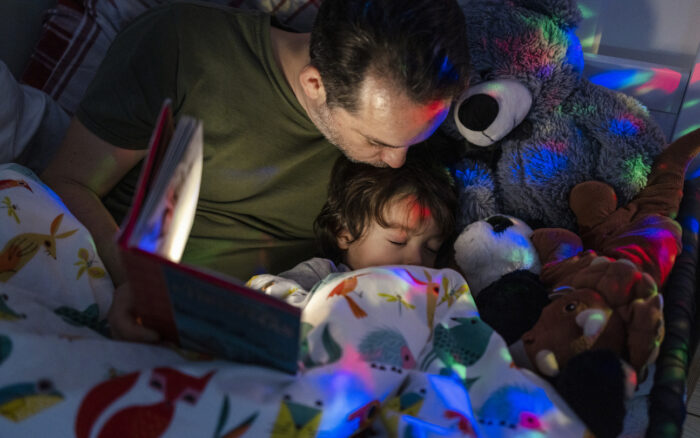
One of my favorite moments of the day is when my little Zusha gets into bed. Right before he goes to sleep, Annika and I read The Bedtime Shema: A Good Night Book with him, written by Sarah Gershman. (Although no one needs to read any prayer that doesn’t speak to them, I am grateful there are educators offering parents adaptations of prayer that suit their lifestyle today.) Sleep is a unique event because we must release control, allow ourselves to relax, and vanish for a few hours while our body continues to function. It is a process that requires trust, faith in life, especially at night when subconscious parts surface in dreams and the darkness itself brings existential change.
Every night, my role as a father and Annika’s as a mother is to give Zusha the courage to sink into sleep, and the bedtime Shema prayer is our tool for this. In the first few months, I did not know how he felt toward the prayer. Our Zusha is not only a toddler, but also a toddler with a brain injury who copes with difficulties expressing himself. But as time passes, we see the sweetness of the prayer through his physical movements. When we invite the angel on the right side, Zusha enthusiastically shakes his right hand. When I invite the angel behind him, saying, “Light is behind you,” Zusha pats his own back to attach light to his back so he feels safe in the dark. At the end of the prayer, Zusha kisses the prayer book with intensity and checks to make sure that Ima and Abba kiss the siddur too. For me, this is the sweetness of prayer. Will Zusha continue to say this prayer when he is an adult? I cannot promise that. But I can promise that I am creating a tool for him that will be available to him on future nights when I am no longer by his side.