
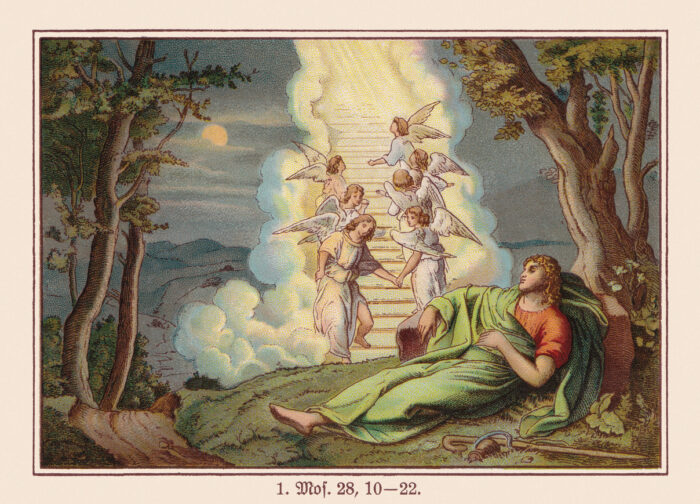
“He had a dream; a stairway was set on the ground and its top reached to the sky, and angels of God were going up and down on it. And the Lord was standing upon him / it” (Genesis 28:12-13).

Jacob’s dream of a stairway to heaven reveals a pathway from the human to the Divine and the possibility for us to gain some understanding of God. The difficulty, however, is that dreams are only as good as their interpretation. Two Jewish thinkers, Maimonides and Meir ibn Gabbai, have explained Jacob’s dream in two opposite ways. Their disagreement focuses on the final words, “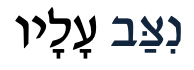 – God was standing upon him / it.”
Maimonides, in the introduction to the Guide for the Perplexed, points to Jacob’s dream as an example of a parable wherein every detail signifies something important. Part One of the Guide explains how God doesn’t have a bodily presence. It offers a lexicon of biblical words that could imply corporeality when applied to God, and Maimonides provides various definitions for each word, yet specifies that only the figurative meaning can apply to God. In chapter 15, he says that the word natzav  literally means to stand, but can also mean to be stable and permanent. Maimonides explains Jacob’s dream ladder as the path of prophecy, the rungs of the ladder as levels of prophecy, and the angels ascending and descending as prophets entering and exiting a prophetic trance. The last phrase of the verse, “God was natzav – standing upon it” means that God remains permanent and unchanging at the top level. In this reading, the dream teaches that God is static and eternally constant, while humans change as they grow in understanding of the Divine, to whatever degree they are able.
A very different reading is offered by Rabbi Meir ibn Gabbai, a 16th-century mystic living in the Ottoman Empire. In his major work Avodat Hakodesh, ibn Gabbai similarly includes a lexicon of words that the Bible uses anthropomorphically in relation to God. However, rather than interpret these words towards a philosophical understanding of a remote, unchanging conception of God, ibn Gabbai provides each word with a mystical meaning. The word natzav in his Kabbalistic reading means to become unified. In Jacob’s dream, God was , that is, became unified, because of Jacob. Ibn Gabbai explains, “God is maintained by the righteous for they are the cause of preserving the Name and unifying it.” The deeds and thoughts of righteous human beings have cosmic power to affect the Divine realm and thereby allow God’s Presence to connect with the earthly realm.
Both of these commentators reject a literal anthropomorphic reading of this verse and turn to figurative interpretation for a solution. Yet, the conclusions they reach could not be more different. In the formulation of James Diamond: “For Maimonides, God simply is and man is becoming, whereas for ibn Gabbai, man is becoming and God is becoming consequent to man’s becoming.” Maimonides’ philosophical God is a perpetual, perfect, static Existence; ibn Gabbai’s mystical God is a dynamic, immanent, ever-becoming Force.
Which is it? Perhaps one day, a new revelation or quantum breakthrough will help us better reach for the apex of Jacob’s ladder. Until then, we must submit that the question still, well, stands.